
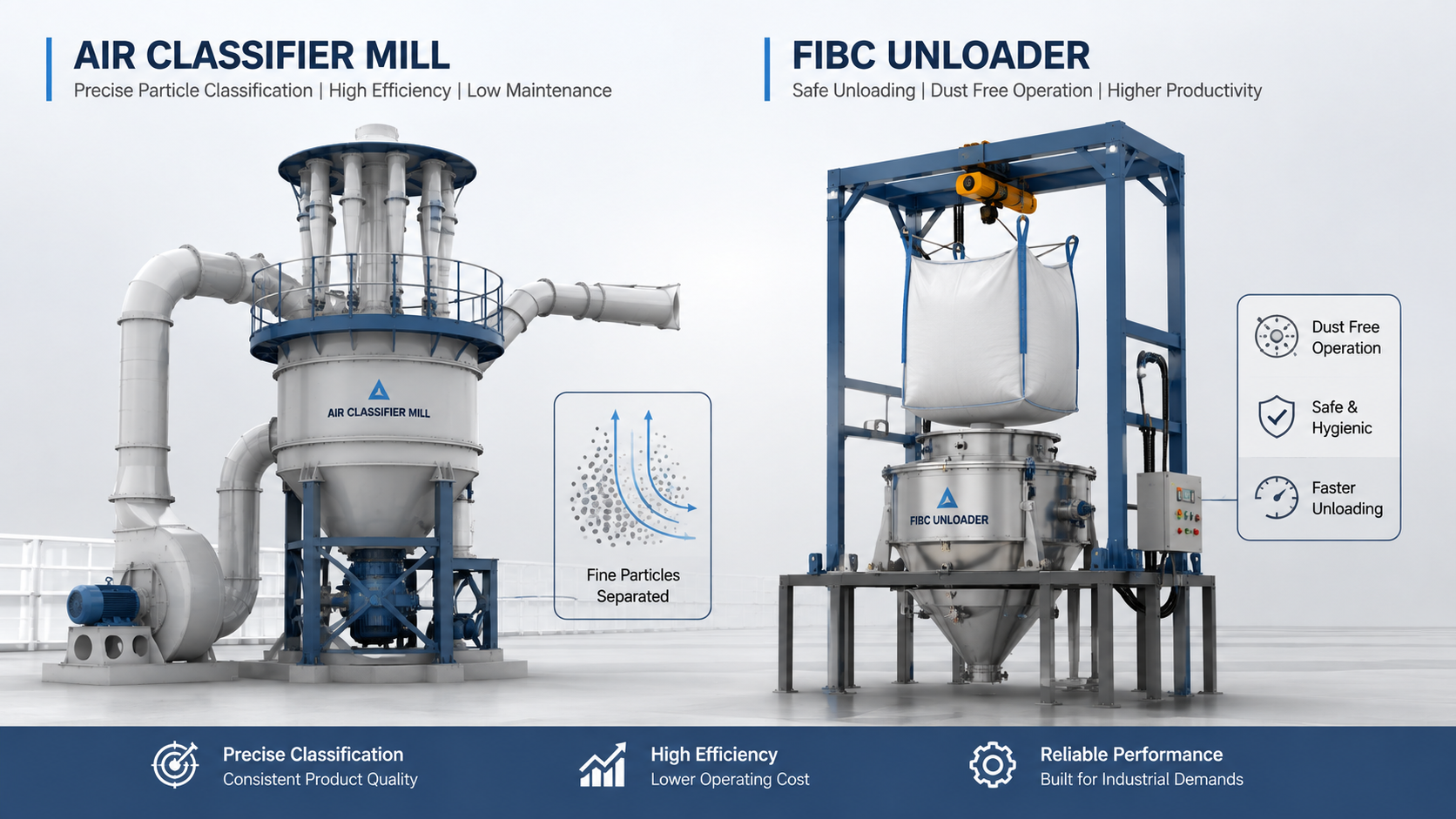
An air classifier mill is a versatile size-reduction machine designed to grind and classify powders in a single continuous process. By combining impact grinding with dynamic air classification, it can produce fine, controlled particle sizes while reducing the need for separate grinding and classification equipment.
For manufacturers handling powders, the choice of mill is not simply about achieving a smaller particle size. Factors such as feed material, target fineness, throughput, heat sensitivity, moisture content, product consistency and downstream conveying requirements all influence the right system design.
An air classifier mill can be particularly useful where a controlled fine powder is required and where particle-size distribution needs to be managed closely.
This article explains how an air classifier mill works, where it is used, what to consider before selecting one, and how equipment such as an FIBC unloader can be integrated into a complete powder-processing line.
What Is an Air Classifier Mill?
An air classifier mill is a grinding system that uses mechanical impact to reduce particle size while an integrated air classifier separates particles according to their aerodynamic behaviour.
In simple terms, the process works like this:
1. Material enters the grinding chamber.
2. High-speed rotating components subject the feed to impact and particle-to-particle forces.
3. An air stream carries the ground particles towards the classifier.
4. Coarser particles are rejected and returned to the grinding zone.
5. Finer particles pass through the classifier and leave the mill with the air stream.
6. The product is subsequently separated from the conveying air, commonly using suitable cyclone or filtration equipment.
The exact configuration depends on the material, required particle size and overall process requirements.
How Does an Air Classifier Mill Work?
The key feature is the combination of grinding and air classification.
A conventional mill may reduce material to a range of particle sizes, after which a separate classifier is used to achieve the required cut point. An air classifier mill incorporates these functions into a more integrated process.
The classifier controls which particles are fine enough to leave the system. Larger or heavier particles remain in circulation until they are reduced sufficiently to pass through the classification zone.
This recirculation can help produce a more controlled product compared with relying on grinding alone.
Key Components of an Air Classifier Mill System
A complete grinding and classification installation typically consists of more than the mill itself.
Depending on the application, the system may include:
· Feed hopper or feeding system
· Screw, rotary valve or pneumatic feeding equipment
· Air classifier mill
· Air supply and control system
· Cyclone separator
· Bag filter or dust collection system
· Product collection equipment
· Pneumatic conveying equipment
· Control panel and instrumentation
· Explosion protection or other safety provisions where required
The correct combination depends on the characteristics of the powder and the required production process.
For example, a free-flowing mineral powder may require a substantially different feeding and collection arrangement from a cohesive food ingredient or a heat-sensitive chemical product.
What Particle Size Can an Air Classifier Mill Produce?
There is no single particle-size specification that applies to every air classifier mill.
Achievable fineness depends on several variables, including:
· Material hardness
· Feed particle size
· Material density
· Moisture content
· Feed rate
· Rotor speed
· Classifier speed
· Airflow
· Mill configuration
· Required particle-size distribution
For this reason, selecting equipment purely on the basis of a quoted maximum or minimum particle size can be misleading.
A better approach is to define the feed specification, target particle size, acceptable particle-size distribution and required throughput before equipment selection.
Where the application is critical, representative material trials can provide valuable information about achievable performance.
Advantages of Using an Air Classifier Mill
1. Grinding and classification in one system
An air classifier mill combines two important powder-processing functions. This can simplify the process layout and reduce the need for separate classification equipment.
2. Controlled particle size
The classifier provides an additional level of control over the final product compared with grinding without classification.
3. Suitable for fine powders
These systems are commonly considered for applications requiring relatively fine and consistent powder products.
4. Flexible process control
Operating parameters such as grinding conditions, classifier settings, airflow and feed rate can often be adjusted to suit different products and target specifications.
5. Potentially more efficient process design
Returning oversized particles to the grinding zone means the system can continue processing material until it reaches the required classification range, rather than allowing a broad mixture of particle sizes to leave the mill.
The actual energy consumption and productivity, however, depend heavily on the material and operating conditions. Equipment should therefore be evaluated against the specific application rather than assuming a universal efficiency advantage.
Applications of Air Classifier Mills
Air classifier mills can be used across a range of industries where controlled powder fineness is important.
Typical applications may include:
· Minerals and industrial minerals
· Chemicals
· Pharmaceuticals, subject to suitable equipment and validation requirements
· Food ingredients
· Pigments
· Agricultural products
· Ceramic materials
· Fillers
· Specialty powders
· Various dry chemical and industrial products
The suitability of an air classifier mill depends on the physical and chemical characteristics of the material.
Materials that are particularly difficult to grind, sticky, highly abrasive, heat-sensitive or potentially combustible may require specialised equipment configurations.
Air Classifier Mill vs Conventional Grinding
The right comparison is not simply “which machine grinds finer?”
A conventional grinding system may be perfectly adequate when the required product specification is relatively broad. An air classifier mill becomes more attractive when controlled fine grinding and particle-size separation are important parts of the process.
| Requirement | Air Classifier Mill | Conventional Mill |
| Fine powder production | Well suited to many applications | Depends on mill type |
| Integrated classification | Yes | May require separate classifier |
| Particle-size control | Classification provides additional control | Depends on configuration |
| Process flexibility | Generally high | Varies by equipment |
| System complexity | Integrated but may require supporting equipment | Varies |
| Suitability | Depends on feed material and specification | Depends on mill design |
The best choice should be based on the complete process rather than the mill name alone.
What Should You Consider Before Buying an Air Classifier Mill?
Choosing an air classifier mill starts with understanding the product.
Feed material
Provide information about:
· Material name
· Hardness
· Bulk density
· Moisture
· Temperature
· Abrasiveness
· Stickiness
· Feed particle size
Required product specification
Define the target particle size and, importantly, the required particle-size distribution.
A specification such as “fine powder” is usually not enough for proper equipment selection. A defined target range gives the equipment supplier a much clearer basis for system design.
Required capacity
The desired production rate should be considered alongside the material characteristics and product specification.
A higher feed rate does not automatically translate into higher finished-product capacity if the material requires additional grinding or classification.
Heat sensitivity
Some materials can be affected by excessive temperature during grinding. Where temperature control is important, the grinding system should be designed accordingly.
Wear and contamination
Abrasive materials can increase wear on internal components. For sensitive products, material-of-construction and contamination considerations may also influence equipment selection.
Dust and explosion safety
Fine powders can create significant dust loads, and some powders may present combustible-dust hazards.
A professional system assessment should consider appropriate dust collection, grounding, isolation, explosion protection and other relevant safety requirements for the specific material and installation.
FIBC Unloader Integration: From Bulk Bag to Grinding System
An air classifier mill is only one part of a powder-processing line.
When raw material arrives in FIBC bags, also known as flexible intermediate bulk containers or bulk bags, an FIBC unloader can provide a controlled method of transferring the material into the grinding process.
An FIBC unloader is designed to support the safe and efficient discharge of bulk material from flexible containers.
A typical process may look like:
FIBC bag → FIBC unloader → feeder → air classifier mill → cyclone/filter → product collection
The exact arrangement depends on the powder characteristics and plant layout.
Why Use an FIBC Unloader?
Bulk bags can reduce manual handling compared with smaller bags, but they still need to be emptied in a controlled way.
An FIBC unloading station can help provide:
· Controlled bulk-bag discharge
· Reduced manual material handling
· Dust containment
· Connection to downstream conveying equipment
· More consistent feeding into the process
· Integration with weighing or dosing systems where required
For powders that are prone to bridging or poor flow, the unloader may also require additional discharge aids, such as vibration or controlled bag activation, depending on the application.
Designing the FIBC Unloader and Mill as One Process
One common mistake in powder-processing projects is selecting individual machines independently.
The FIBC unloader, feeder, air classifier mill, dust collector and product collection system should be considered as an integrated process.
For example, if the FIBC unloader discharges material faster than the mill can accept it, an intermediate hopper and controlled feeder may be required.
Similarly, if a powder has poor flow characteristics, simply placing a bulk-bag station above a mill may not provide reliable feeding.
The interface between each piece of equipment matters.
Example Process
Consider a manufacturer receiving a dry mineral powder in 500 kg or 1,000 kg FIBCs.
The material could be discharged through an FIBC unloader into a controlled feed hopper. A suitable feeder then regulates the material entering the air classifier mill.
Inside the mill, the material is reduced in size and classified. Fine particles are carried towards the product collection system, while oversized particles remain in the grinding circuit until they meet the required classification conditions.
The finished powder can then be transferred to a silo, hopper, filling machine or another downstream process.
This type of arrangement can reduce manual intervention and provide a more consistent material flow through the plant.
Common Air Classifier Mill Problems and What They Can Indicate
Unexpected performance does not always mean the mill itself is the problem.
Product is too coarse
Possible factors include:
· Incorrect classifier settings
· Excessive feed rate
· Unsuitable airflow
· Feed material being outside the specified range
· Changes in material moisture or hardness
· Wear of critical components
Product is too fine
Possible causes may include operating conditions that are producing excessive classification or grinding, depending on the equipment design.
Throughput is lower than expected
Investigate the entire process, including:
· Feed consistency
· Material properties
· Feeder performance
· Airflow
· Filter pressure drop
· Mill condition
· Classification settings
Irregular feeding
Poor flow from an FIBC can contribute to inconsistent mill feed.
Material properties such as moisture, particle shape, cohesion and bulk density can influence how reliably a powder leaves the bulk bag.
This is why the FIBC unloader and feeding system should be specified around the actual material, rather than treating the bulk-bag station as a generic accessory.
Air Classifier Mill Maintenance
Regular inspection and preventive maintenance can help maintain consistent operation.
Important areas may include:
· Grinding components
· Classifier components
· Bearings
· Seals
· Air ducts
· Filters
· Cyclone
· Feed equipment
· Wear surfaces
· Instrumentation
The appropriate maintenance interval depends on operating hours, material abrasiveness, process conditions and equipment design.
Keeping records of product performance can also help identify gradual changes. If particle size, throughput or pressure drop begins to move away from the normal operating range, investigation can begin before the issue becomes a major production problem.
Frequently Asked Questions
What is the main purpose of an air classifier mill?
An air classifier mill is used to grind material and classify the resulting particles in an integrated process. It is commonly selected where controlled fine powder production and particle-size management are important.
Is an air classifier mill suitable for every powder?
No. Suitability depends on material properties, required fineness, capacity, moisture, abrasiveness, heat sensitivity, flow characteristics and safety considerations. Product trials or engineering assessment may be appropriate before final equipment selection.
What is an FIBC unloader?
An FIBC unloader is a bulk-bag discharge system used to empty flexible intermediate bulk containers into a controlled downstream process. It can be connected to feeders, conveyors, hoppers, mills and other powder-handling equipment.
Can an FIBC unloader feed an air classifier mill?
Yes. An FIBC unloader can form the upstream part of an air classifier milling system, usually with a controlled feeding arrangement between the unloader and mill.
What information should I provide when requesting an air classifier mill quotation?
At minimum, provide the material name, feed particle size, moisture, bulk density, required product particle size, desired capacity and any relevant information about abrasiveness, temperature sensitivity and powder handling behaviour.
Providing a representative material sample may also help an equipment supplier assess the application more accurately.
How to Select the Right Air Classifier Mill Supplier
Equipment selection should go beyond comparing catalogue specifications.
A capable supplier should be able to discuss the complete application, including:
· Material characteristics
· Required particle size
· Production capacity
· Feed arrangement
· Air handling
· Dust collection
· Product recovery
· Wear considerations
· Plant layout
· Safety requirements
· Installation and commissioning
· Maintenance and after-sales support
If the project involves FIBCs, the supplier should also be able to consider the relationship between the FIBC unloader, feeder and grinding system.
The goal is not simply to purchase a mill. It is to develop a process that reliably delivers the required powder specification at the required production rate.