
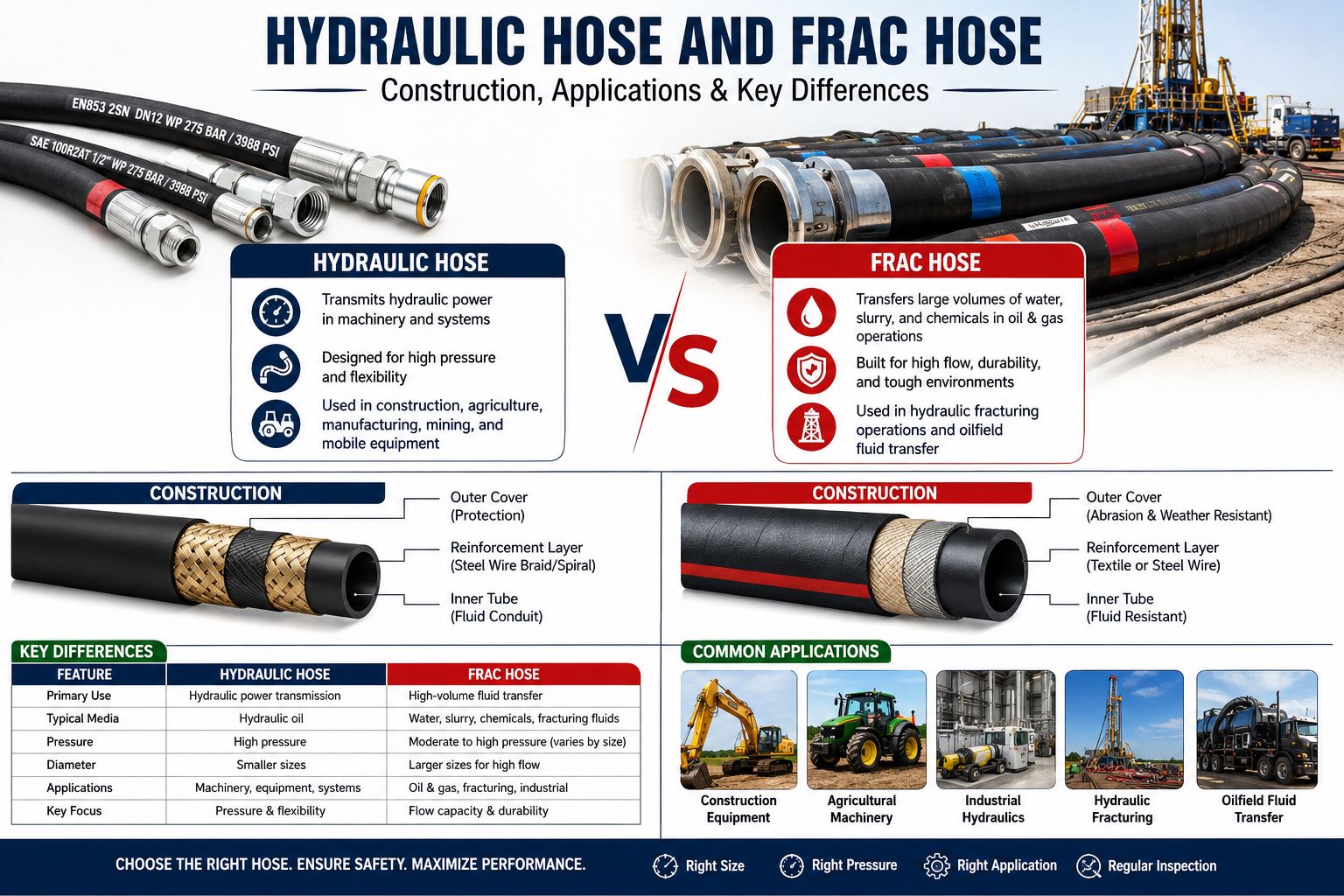
Industrial operators are placing stronger emphasis on the performance and correct specification of Hydraulic Hose and frac hose systems as construction, mining, manufacturing and oilfield applications continue to demand dependable fluid-transfer equipment.
Rather than treating hoses as standard replacement components, equipment operators and procurement teams are increasingly evaluating how pressure, flow rate, fluid compatibility, temperature and installation conditions affect performance.
The shift is particularly relevant in high-pressure hydraulic machinery and demanding oilfield environments, where an incorrectly selected hose can contribute to unplanned maintenance and operational interruptions.
Heavy Equipment Keeps Hydraulic Hose in Focus
Hydraulic technology remains central to modern heavy machinery because it allows significant force to be generated and controlled efficiently.
A Hydraulic Hose carries pressurised fluid between pumps, control valves, cylinders and motors. The fluid then enables machinery to perform movements such as lifting, pushing, steering, rotating and positioning.
The technology is widely used in:
- Construction machinery
- Agricultural equipment
- Mining operations
- Cranes and lifting systems
- Material-handling equipment
- Industrial production machinery
Flexibility is particularly important in mobile equipment. As an excavator boom or loader arm moves, hydraulic lines must accommodate changing positions without restricting the intended fluid movement.
Oilfield Operations Create a Different Challenge for Frac Hose
Oilfield fluid transfer presents a substantially different operating environment.
During hydraulic fracturing activities, large volumes of water and prepared fluids may need to move between storage systems, blending equipment, pumping units and other wellsite infrastructure.
A frac hose may provide flexible transfer capability within these operations.
Depending on its design and specified service, the hose may be suitable for water, fracturing fluids, chemical mixtures, slurry or other compatible oilfield media.
This means that buyers need to consider much more than pressure.
Flow capacity, internal diameter, abrasion resistance, media compatibility and field handling can all influence hose suitability.
Demand Moves Towards Application-Specific Hose Construction
A major consideration for industrial users is understanding how hose construction relates to performance.
A typical Hydraulic Hose consists of three important sections.
The inner tube provides the fluid pathway and needs to be compatible with the media. Reinforcement gives the hose structural strength against internal pressure. The outer cover protects against external conditions.
Depending on the application, reinforcement may include textile braid, steel-wire braid or spiral-wire construction.
A frac hose can similarly require specialised internal and external materials based on the transferred media and field conditions.
The result is a broad range of hoses that may look similar but perform very differently.
Pressure Rating Is No Longer the Only Buying Question
Pressure remains essential, but industry buyers are increasingly considering it as one part of a wider specification.
A hose can have sufficient pressure capability and still be inappropriate if its inner tube is incompatible with the fluid, its diameter is insufficient or its temperature limits do not match the application.
Key considerations now include:
- Working pressure
- Required flow
- Internal diameter
- Fluid composition
- Fluid temperature
- Ambient conditions
- Bend radius
- Hose movement
- Fittings and couplings
- External abrasion
For a Hydraulic Hose, these factors influence how effectively it operates within the hydraulic circuit.
For a frac hose, they help determine suitability for the specific fluid-transfer operation.
Hydraulic and Frac Applications Require Different Priorities
| Performance Area | Hydraulic Hose | Frac Hose |
| Main purpose | Transfer hydraulic power fluid | Transfer oilfield fluids |
| Typical location | Heavy machinery | Fracturing sites |
| Common media | Hydraulic oil | Water, slurry and compatible frac mixtures |
| Flow characteristics | Circuit dependent | Frequently high-volume |
| Major external challenge | Machine movement and heat | Field abrasion and weather |
| Major internal challenge | Pressure and fluid compatibility | Media, flow and abrasion |
| Selection approach | Hydraulic system requirements | Wellsite transfer requirements |
The comparison reinforces why one hose type should not be substituted for another without proper technical evaluation.
Flow Efficiency Becomes an Important Performance Metric
Hose diameter has a direct relationship with fluid velocity.
When the internal diameter is too small, fluid must move faster to deliver the required volume. This can increase pressure loss.
Within a hydraulic system, an undersized Hydraulic Hose may contribute to additional heat generation and reduced system efficiency.
For a frac hose, restricted internal diameter can become problematic when substantial fluid volumes need to be transferred.
Engineers typically evaluate flow rate, internal diameter, fluid properties, hose length and acceptable pressure drop together.
This makes hose sizing an engineering requirement rather than simply a matter of matching fittings.
Industry Attention Turns to Media Compatibility
Another area receiving increased attention is what happens inside the hose.
The inner tube remains continuously exposed to the transferred fluid. When the material is unsuitable for that media, deterioration can occur from within.
Possible changes include:
- Swelling
- Softening
- Hardening
- Cracking
- Loss of flexibility
For Hydraulic Hose applications, users need to identify the specific hydraulic fluid used by the system.
For frac hose applications, buyers may need to provide more detailed information about chemical additives and abrasive materials present in the fluid mixture.
Manufacturers’ chemical compatibility guidance remains important when selecting products for specialised media.
Harsh Operating Conditions Put Outer Covers to the Test
While internal compatibility receives attention, external damage remains an equally important concern.
A hydraulic line installed on moving machinery can repeatedly rub against frames or nearby components.
A frac hose operating on an outdoor site may be repositioned frequently or exposed to rough ground.
Over time, severe abrasion can damage the protective cover and potentially expose reinforcement.
Better routing, appropriate hose construction and suitable protection in high-contact areas can help reduce avoidable wear.
Temperature Remains a Hidden Source of Deterioration
Temperature-related problems are not always immediately visible.
The fluid inside a Hydraulic Hose may be hot, while the hose itself can simultaneously be exposed to heat from an engine or exhaust component.
Frac operations present different temperature challenges because hoses may remain outdoors under changing environmental conditions.
Users therefore need to consider both fluid and ambient temperatures when reviewing product specifications.
A hose suitable for the internal media may still be unsuitable if the surrounding temperature falls outside its recommended operating range.
Installation Practices Can Determine Long-Term Performance
Even correctly specified hoses can experience premature deterioration when poorly installed.
Common installation problems include:
- Twisting the hose during connection.
- Bending below the recommended radius.
- Stretching the hose between fittings.
- Allowing continuous contact with sharp surfaces.
- Routing lines too close to heat sources.
- Failing to accommodate machine movement.
The minimum bend radius specified by the manufacturer is particularly important.
Excessively tight bends can place additional mechanical stress on hose reinforcement.
Fittings Become Part of the Complete Engineering Decision
Industrial operators are also paying closer attention to hose connections.
A Hydraulic Hose and its fittings should operate as a compatible assembly. Hose size, fitting design, pressure capability and crimp specifications need to correspond.
The same principle applies to frac hose couplings.
A connection that physically fits does not automatically mean it is technically suitable.
Using compatible components and following manufacturer-approved assembly procedures helps maintain the intended performance of the complete hose assembly.
Preventive Inspection Gains Priority Over Reactive Replacement
A developing trend across heavy industry is greater emphasis on preventive maintenance rather than waiting for a hose to fail.
Routine inspection can identify warning signs including:
- Deep abrasion
- Surface cracking
- Fluid leakage
- Blistering
- Kinks
- Exposed reinforcement
- Corroded fittings
- Damaged couplings
- Flattening
- Unusual deformation
Maintenance personnel should also investigate recurring damage.
If several replacement hoses develop wear in the same location, the underlying issue may involve routing or equipment geometry rather than hose quality alone.
Buyers Are Being Encouraged to Provide Better Application Data
Correct hose selection depends heavily on accurate information.
Before requesting a Hydraulic Hose, buyers should identify:
- Internal diameter
- Overall length
- Working pressure
- Hydraulic fluid
- Flow requirement
- Fluid temperature
- Ambient temperature
- Required fittings
- Movement conditions
- Abrasion exposure
For frac hose, additional information about slurry content, chemical composition, transfer volume and field conditions can be particularly valuable.
Providing these details allows suppliers to make application-specific recommendations instead of relying on assumptions.
Frequently Asked Questions
1. What does a Hydraulic Hose do?
It transfers pressurised hydraulic fluid between components within a hydraulic system.
2. Where is Hydraulic Hose commonly used?
Construction, mining, agriculture, manufacturing and material-handling equipment are common applications.
3. What is a frac hose?
It is an industrial hose intended for specific fluid-transfer applications in hydraulic fracturing and related oilfield operations.
4. Can frac hose transfer slurry?
Certain hose constructions may handle slurry, but suitability should be confirmed for the specific media and application.
5. What is the biggest difference between the two hoses?
A hydraulic hose primarily supports hydraulic power transmission, while a frac hose is generally associated with oilfield process-fluid transfer.
6. Why does hose size matter?
Internal diameter affects fluid velocity, flow capacity and pressure loss.
7. What is working pressure?
It is the pressure at which the hose is specified to operate under defined conditions.
8. Can burst pressure be used as working pressure?
No. Burst pressure is a destructive-test value and is not the recommended operating limit.
9. Why do industrial hoses wear externally?
Movement, rubbing, sharp surfaces, rough handling and environmental exposure can contribute to external wear.
10. Why is fluid compatibility important?
Incompatible media can deteriorate the inner tube and reduce the hose’s suitability for continued service.
Read more – https://newsgrow.blogspot.com/2026/08/hydraulic-hose-manufacturer-and.html
https://newsgrow.blogspot.com/2026/08/hydraulic-hose-and-frac-hose-deep.html