
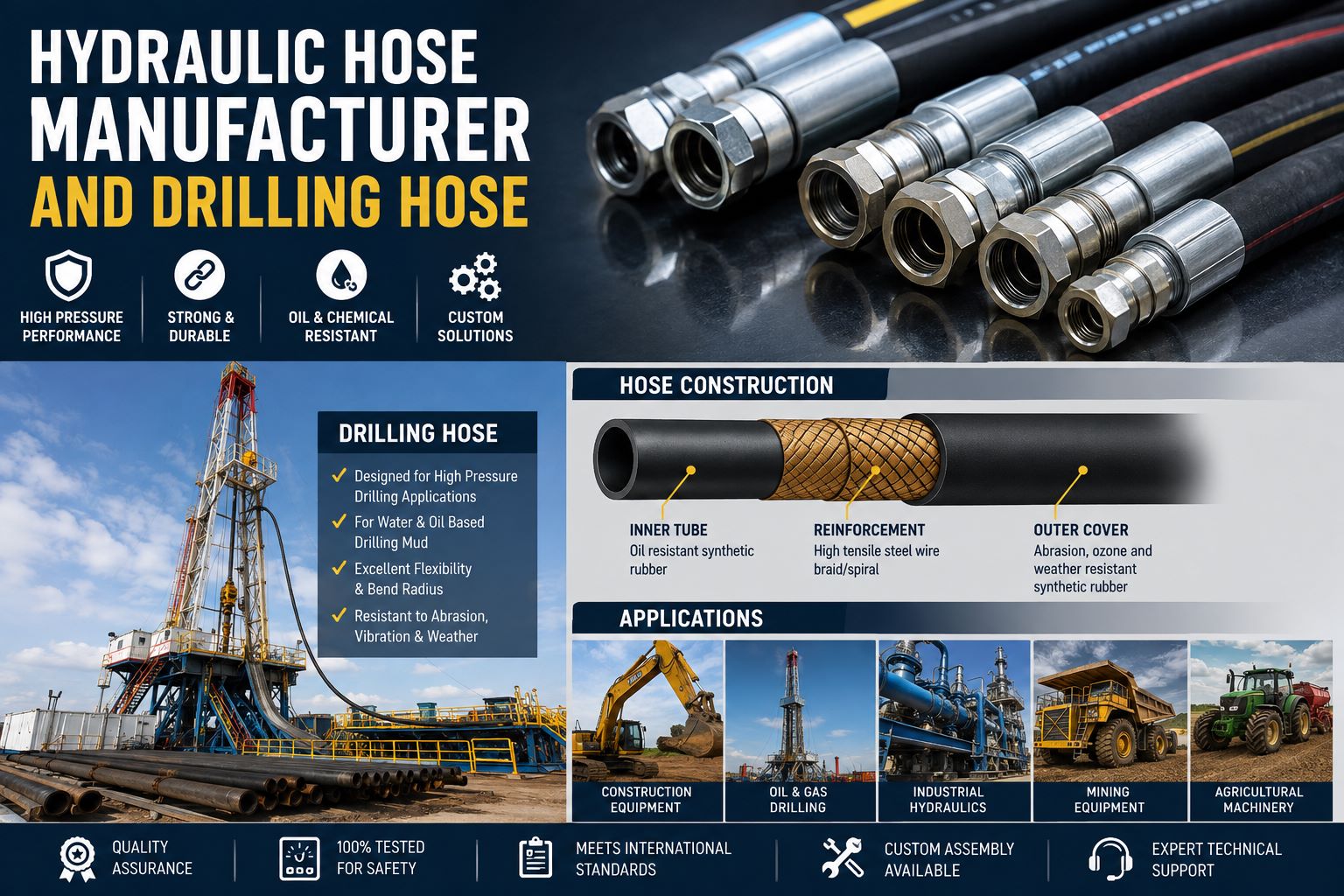
When a drilling rig is operating, attention naturally goes to the large equipment—the drill string, pumps, power systems and rotating machinery. Yet the flexible connections carrying fluids between moving components perform an equally important job. A Hydraulic Hose Manufacturer must design these products to cope with pressure, movement, temperature, vibration and demanding working environments.
A drilling hose is a particularly specialised example. It is not simply a thicker version of a standard hose. Its construction and specification must match the fluid being conveyed, expected working pressure, installation geometry and operating environment.
Understanding what happens inside these hoses helps procurement teams, engineers and equipment operators make more informed decisions.
Why Flexible Hoses Are Essential in Heavy-Duty Equipment
Rigid piping is excellent where components remain stationary. Heavy machinery, however, rarely stays completely still.
Excavator arms move continuously. Mining machines experience vibration. Drilling equipment changes position during operation. Hydraulic cylinders extend and retract.
Flexible hoses allow pressurised fluid to travel between these moving components.
A professional Hydraulic Hose Manufacturer therefore needs to balance two characteristics that appear contradictory: flexibility and strength.
The hose must bend sufficiently for the application while remaining capable of containing its specified internal pressure.
A Hydraulic Hose Is More Than Rubber Tubing
Looking at a hose from the outside reveals very little about its engineering.
Inside, multiple layers work together.
The Inner Tube Handles the Fluid
The innermost tube directly contacts the conveyed medium. Its compound must be compatible with that fluid and appropriate for the expected temperature range.
Incorrect compatibility may contribute to deterioration such as swelling, hardening or softening.
Reinforcement Provides Pressure Strength
The reinforcement surrounding the inner tube helps the hose withstand internal pressure.
Depending on its intended duty, construction can include:
- Textile reinforcement
- Steel-wire braid
- Multiple wire-braid layers
- Spiral-wire reinforcement
Heavy-duty applications generally demand more substantial reinforcement than low-pressure services.
The Cover Faces the Working Environment
The outer cover protects reinforcement against external influences such as abrasion, weather, oil and physical contact.
This is particularly relevant for equipment operating outdoors or around abrasive surfaces.
Where Does a Drilling Hose Fit Into the System?
A drilling hose provides a flexible fluid connection in drilling operations where rigid piping would not adequately accommodate movement or vibration.
Depending on the hose design and applicable specification, it may handle drilling mud and other approved media.
Drilling environments present an unusual combination of challenges. The hose may experience internal pressure while simultaneously being subjected to movement, vibration and harsh external conditions.
That means purchasing decisions cannot be based on pressure alone.
What Makes Drilling Hose Selection More Complex?
Imagine two hoses with identical internal diameters and similar appearances. One might be suitable for a particular drilling operation while the other could be completely inappropriate.
Why?
Because hose performance depends on several variables working together.
| Technical Factor | Why It Matters |
| Working pressure | Determines required pressure capability |
| Inside diameter | Influences flow characteristics |
| Fluid type | Determines tube compatibility |
| Temperature | Affects material performance |
| Bend radius | Controls acceptable hose curvature |
| Movement | Influences routing and hose length |
| Reinforcement | Provides pressure-bearing strength |
| End fittings | Connect hose safely to equipment |
| Environment | Determines external protection needs |
An experienced Hydraulic Hose Manufacturer should request this information before recommending a hose for a demanding application.
Pressure Ratings Need to Be Understood Correctly
One of the most important purchasing mistakes to avoid is confusing working pressure with burst pressure.
Working pressure represents the pressure limit established for normal service under specified conditions.
Burst pressure, on the other hand, is associated with destructive qualification testing. It should never be interpreted as the normal operating pressure of the hose.
A drilling hose should always be selected according to its applicable working-pressure specification and actual system requirements.
Why Bigger Is Not Always Better When Choosing Hose Diameter
Some buyers assume that selecting a larger hose automatically provides better performance. Hydraulic engineering is more complicated than that.
Inside diameter influences fluid velocity, pressure loss, physical size, weight and installation requirements.
A hose that is too small may create excessive fluid velocity or unwanted pressure losses. A hose that is unnecessarily large can increase weight, space requirements and cost.
For high-volume drilling applications, proper sizing becomes particularly important.
This is another area where technical support from a Hydraulic Hose Manufacturer adds value.
Drilling Fluids Make Material Compatibility Critical
Drilling fluids can have very different formulations. Therefore, buyers should tell the hose supplier exactly what medium will pass through the hose.
A manufacturer may need information about:
- Water-based drilling mud
- Oil-based drilling mud
- Hydraulic fluids
- Additives
- Expected operating temperature
- Fluid concentration
Selecting an inner tube without understanding the medium can create unnecessary compatibility risks.
Why Bend Radius Can Determine Hose Performance
A hose is flexible, but that does not mean it can be bent into any shape.
Every design has a specified minimum bend radius. Installing the hose more tightly than recommended can create stress within its reinforcement and may affect flow.
This becomes particularly important with a drilling hose, where equipment movement can continuously change the hose position.
Good Routing Practices Include
- Avoiding sharp bends
- Preventing twisting
- Allowing sufficient movement
- Keeping hoses away from abrasive surfaces
- Avoiding unnecessary tension at fittings
- Protecting hoses from excessive heat
A high-quality hose installed incorrectly can still experience premature deterioration.
What Separates a Reliable Hydraulic Hose Manufacturer From a Basic Supplier?
Price and delivery time matter, but technical capability should carry significant weight when selecting a Hydraulic Hose Manufacturer.
A reliable manufacturer should be able to discuss the application rather than simply ask for diameter and length.
Buyers should evaluate:
- Manufacturing capabilities
- Material selection
- Reinforcement technology
- Testing procedures
- Product traceability
- Fitting compatibility
- Custom assembly options
- Technical documentation
- Quality-control systems
- Application support
For specialised drilling projects, relevant standards and project specifications should also be discussed before ordering.
How Testing Helps Verify Hose Performance
Quality testing provides information about whether a hose or assembly meets defined requirements.
Proof Pressure Testing
This can verify the integrity of a hose assembly under a specified test pressure.
Burst Testing
The hose is subjected to increasing pressure under controlled conditions until failure. This helps evaluate pressure-related design characteristics but does not establish the normal operating pressure by itself.
Impulse Testing
Hydraulic systems frequently experience thousands or millions of pressure cycles. Impulse testing evaluates hose behaviour under repeated pressure cycling according to defined test conditions.
Dimensional and Visual Inspection
Manufacturers may also inspect dimensions, cover condition, markings, fittings and overall assembly quality.
Why Hose Assemblies Need Regular Inspection
Industrial hoses are wear components. Their condition can change because of operating cycles, external damage and environmental exposure.
Operators should routinely check for:
- Cracking
- Leakage
- Abrasion
- Exposed reinforcement
- Bulging
- Kinking
- Damaged fittings
- Unusual deformation
A damaged drilling hose should not simply be wrapped, patched or returned to critical service without appropriate technical assessment.
Applications Beyond Drilling
Although drilling represents one demanding use case, hydraulic hoses are found across almost every heavy industrial sector.
A Hydraulic Hose Manufacturer may supply solutions for:
- Construction machinery
- Mining equipment
- Agriculture
- Material handling
- Steel plants
- Manufacturing equipment
- Marine machinery
- Oilfield equipment
- Infrastructure projects
- Mobile hydraulic systems
Each industry creates a different combination of pressure, movement, temperature and environmental conditions.
Frequently Asked Questions
1. What does a Hydraulic Hose Manufacturer do?
A Hydraulic Hose Manufacturer develops reinforced flexible hoses for transferring pressurised fluids in industrial and mobile equipment.
2. What is a drilling hose?
A drilling hose is a reinforced flexible hose designed for specified fluid-transfer duties in drilling operations.
3. Is drilling hose the same as normal hydraulic hose?
No. Drilling applications can involve different flow, media, dimensions, movement and operating requirements.
4. How is hydraulic hose pressure capability created?
Pressure strength primarily comes from the hose reinforcement combined with the overall engineered construction.
5. What information is required when ordering drilling hose?
Specify pressure, fluid, temperature, inside diameter, length, fittings, movement and relevant standards.
6. Why is hose diameter important?
Inside diameter affects fluid velocity, flow characteristics, pressure losses and overall system performance.
7. Can a hose be bent sharply during installation?
No. Installation should respect the manufacturer’s specified minimum bend radius.
8. What is the difference between working and burst pressure?
Working pressure applies to normal specified operation, while burst pressure relates to destructive testing conditions.
9. What causes premature hose damage?
Incorrect routing, abrasion, excessive pressure, heat, twisting and incompatible fluids are common contributors.
10. Can drilling hoses be customised?
Manufacturers may offer customised lengths, connections and constructions depending on application requirements.
Read more – https://newsgrow.blogspot.com/2026/08/hydraulic-hose-manufacturer-and.html