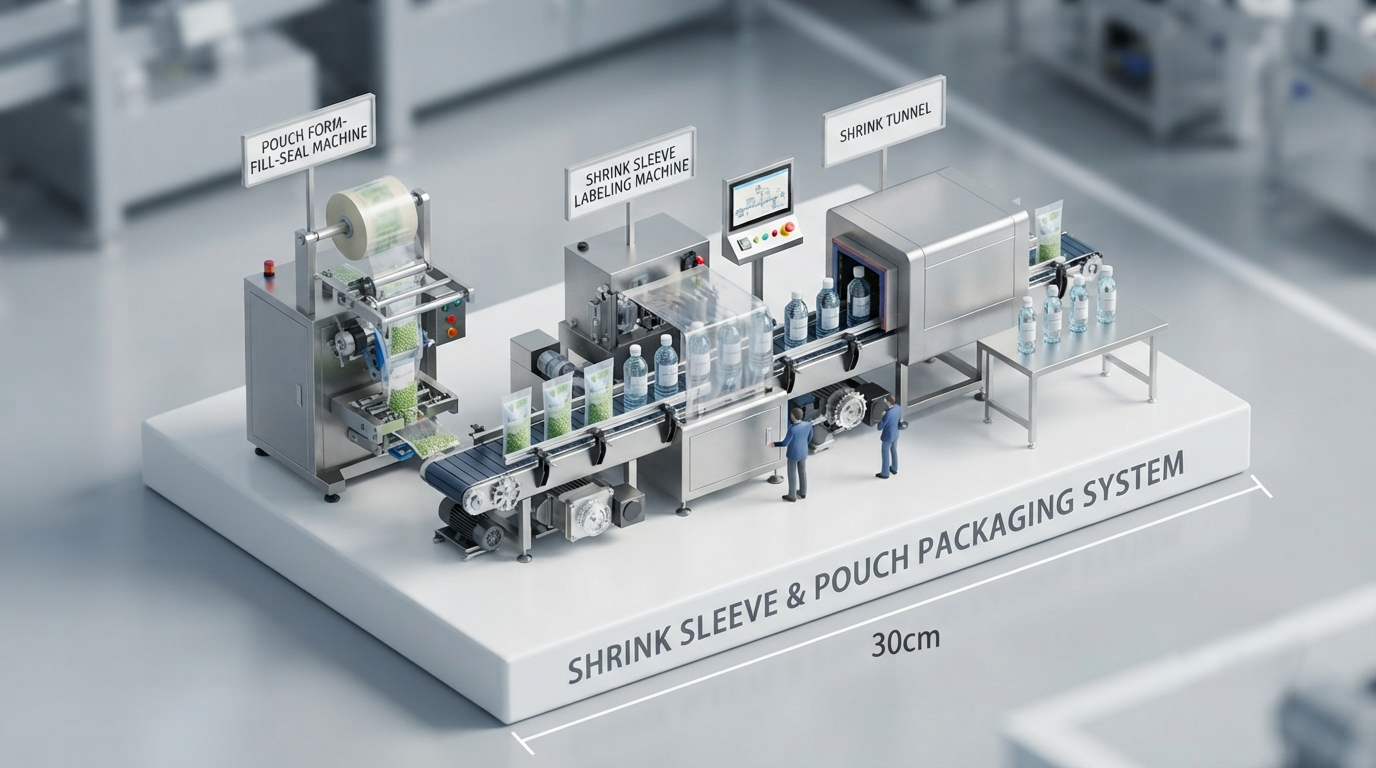
Walk through any supermarket, pharmacy or convenience store and one thing becomes immediately clear: products are competing for attention before customers even read their names. Packaging has become part of the product experience itself. A bottle with seamless graphics can communicate premium quality, while a well-designed pouch can make a product easier to carry, store and use.
This is where Shrink Sleeve packaging and an experienced stand up pouch supplier play different but equally important roles. One transforms rigid containers into powerful branding surfaces; the other creates flexible packaging that can combine product protection, shelf presentation and consumer convenience.
For manufacturers planning new packaging, understanding these formats from a practical rather than purely visual perspective is essential.
Why Packaging Decisions Should Start With the Product
Packaging should never be selected simply because a particular format looks attractive. The product inside determines what the package actually needs to do.
Consider roasted coffee and a fruit drink. Coffee may need protection against oxygen, moisture and aroma loss. A fruit drink may already be packed inside a rigid bottle and primarily need branding, product information and possibly tamper evidence.
The coffee producer might therefore approach a stand up pouch supplier, while the beverage manufacturer could consider a Shrink Sleeve.
Before choosing either format, manufacturers should examine product sensitivity, filling method, storage conditions, distribution environment, expected shelf life and customer usage.
This product-first approach reduces the possibility of choosing attractive packaging that performs poorly in real-world conditions.
How Shrink Sleeve Packaging Creates a Different Branding Experience
Traditional labels usually provide a defined front or back area for branding. A Shrink Sleeve works differently because printed film can surround much of the container.
After being positioned around a bottle or container, controlled heat causes the film to contract and conform to the container’s contours.
This provides substantial design freedom.
A brand can use different sections of the sleeve for its logo, product story, ingredients, directions, nutritional information, barcodes, QR codes and regulatory information.
For products competing in visually intensive categories, the ability to create almost continuous graphics around a container can be particularly valuable.
Why Container Shape Matters With Shrink Sleeve Design
One of the most interesting characteristics of a Shrink Sleeve is its ability to follow curved and unusually shaped containers. However, this advantage also creates a technical challenge.
Imagine printing a perfect circular logo onto flat film. If the film shrinks significantly around a narrow section of a bottle, that circle may no longer appear perfectly circular.
Professional sleeve development therefore requires consideration of shrink distortion before printing.
Container measurements, shrink percentage, film characteristics and artwork positioning all need to work together. Barcodes, QR codes and small regulatory text require particular attention because excessive distortion could affect readability.
The best results come when packaging engineers, designers and printers consider the final container from the beginning of the project.
Where Shrink Sleeve Packaging Can Be Used
Shrink sleeves have applications across numerous consumer-product industries, including:
- Water and beverage bottles
- Juices and dairy drinks
- Food containers
- Cosmetics
- Shampoo and personal care bottles
- Pharmaceutical containers
- Household cleaning products
- Nutritional products
- Promotional packs
They can also be developed for partial-body applications or tamper-evident bands, depending on the packaging requirement.
This flexibility means businesses can use shrink technology for decoration, information presentation and selected security-related applications.
Why Stand-Up Pouches Have Become an Important Flexible Packaging Format
Stand-up pouches solve a different packaging challenge.
Instead of decorating an existing bottle, the pouch normally becomes the package that directly contains the product. A bottom gusset expands when filled, creating a stable base that allows the pouch to stand vertically.
This seemingly simple design provides several practical advantages.
The package presents a broad front panel for branding, while the back provides space for product information. Empty pouches can also be relatively compact before filling, which can help with storage and handling.
A capable stand up pouch supplier can develop the pouch around both product and consumer requirements rather than providing only a generic packaging format.
What Makes a Good Stand-Up Pouch More Than Just a Bag?
A professionally engineered stand-up pouch is a combination of material structure, sealing performance, printing and functional design.
Suppose a company wants to package roasted nuts. The product may require protection from moisture and oxygen. If the pouch looks attractive but does not provide appropriate barrier performance, product quality could deteriorate during storage.
This is why a stand up pouch supplier should ask questions before recommending a structure.
Important information includes:
- What product will be packed?
- Is it solid, powder, liquid or semi-liquid?
- What quantity will each pouch contain?
- How will it be filled?
- What shelf life is expected?
- What storage conditions are anticipated?
- Does the product require moisture or oxygen protection?
- Will customers need to reseal the package?
Answers to these questions help determine an appropriate packaging specification.
Functional Features That Can Improve Stand-Up Pouches
Modern flexible packaging can incorporate useful features according to how customers interact with the product.
A stand up pouch supplier may offer resealable zippers for products used multiple times. Tear notches can make initial opening easier, while spouts may provide controlled dispensing for appropriate liquids.
Other options can include transparent windows, hang holes, degassing valves and different surface finishes.
For example, coffee packaging may incorporate a valve where technically required, while snack packaging may benefit more from a zipper.
Adding every available feature does not necessarily improve packaging. Features should solve a genuine product or consumer need.
Shrink Sleeve and Stand-Up Pouch: Two Different Packaging Strategies
| Consideration | Shrink Sleeve | Stand-Up Pouch |
| Packaging function | Decorates or covers a rigid container | Holds the product directly |
| Branding opportunity | Wraparound presentation | Large front and rear panels |
| Typical format | Bottle, jar or container | Flexible pouch |
| Resealing | Not normally required | Zippers/spouts available |
| Shaped design | Follows container contours | Shape determined by pouch construction |
| Product protection | Primarily depends on container | Depends heavily on pouch structure |
| Printing | Highly customisable | Highly customisable |
| Storage before packing | Supplied as sleeves/film | Usually stored relatively flat |
The comparison demonstrates why the two formats should not be viewed simply as alternatives. They solve different packaging problems.
Material Selection Can Determine Packaging Performance
Good packaging begins beneath the printed graphics.
Different Shrink Sleeve materials have different shrink characteristics. Depending on the application, films such as PETG, PVC or OPS may be considered. Container shape, equipment, shrink requirement and other technical factors influence material selection.
Stand-up pouches can involve an even broader range of structures because the pouch may be responsible for protecting the product itself.
A stand up pouch supplier may need to consider resistance to moisture, oxygen, light, grease or aroma transmission.
Material selection should therefore be based on measurable packaging requirements rather than assumptions.
Why Print Quality Deserves Serious Attention
Customers may never know what printing technology produced a package, but they will notice poor results.
Inconsistent colours, misaligned artwork, blurred text or poorly positioned graphics can immediately affect product presentation.
Printing methods used for flexible packaging may include gravure, flexographic or digital processes depending on production quantities and specifications.
For Shrink Sleeve printing, the artwork must account for what happens after heat application. For stand-up pouches, designers should consider seals, gussets, zipper positions and folds.
The final package—not the flat artwork file—should always be the reference point for design approval.
How to Judge a Stand Up Pouch Supplier
Supplier selection should be treated as a technical purchasing decision.
A strong stand up pouch supplier should be able to discuss why a particular structure is recommended, rather than simply quoting a price.
Evaluate suppliers on:
- Knowledge of flexible packaging materials
- Barrier expertise
- Printing capabilities
- Sealing quality
- Custom sizing
- Sampling support
- Quality-control procedures
- Production consistency
- Lead-time reliability
- Technical communication
A low quotation has limited value if packaging failures create damaged stock, production delays or customer complaints.
Why Packaging Testing Should Never Be Skipped
Sample testing is one of the most valuable stages of packaging development.
For a Shrink Sleeve, businesses should ideally test the sleeve on the actual container and observe fit, distortion, seams, wrinkles and overall appearance.
For stand-up pouches, testing may involve filling the package with the intended product and evaluating seals, stability, closures and storage performance.
Where relevant, manufacturers should also assess packaging under realistic transportation and environmental conditions.
Bulk production should begin only after critical functional requirements have been confirmed.
Sustainability Requires More Than Changing the Material
Flexible packaging sustainability is complex. A package using less material is not automatically recyclable, and a recyclable material is not necessarily compatible with recycling systems in every market.
Businesses should discuss options such as material reduction, film optimisation, mono-material structures where technically appropriate, recyclability and local waste-management infrastructure.
Both a Shrink Sleeve manufacturer and stand up pouch supplier should provide accurate information about materials and avoid unsupported environmental claims.
Packaging must still perform its primary responsibility: protecting the product adequately throughout its intended life.
Frequently Asked Questions
What exactly is a Shrink Sleeve?
A Shrink Sleeve is printed heat-sensitive film that contracts around a container when exposed to controlled heat.
Why do brands use shrink sleeves?
They provide extensive decoration space and can conform to curved or unusually shaped containers.
What is a stand-up pouch?
It is flexible packaging featuring a gusseted base that enables the filled pouch to stand upright.
What should a stand up pouch supplier know about my product?
The supplier should understand the product type, filling process, weight, storage conditions, barrier requirements and desired shelf life.
Can stand-up pouches have zippers?
Yes. Resealable zippers are commonly available for products intended to be opened multiple times.
Can Shrink Sleeve packaging include tamper evidence?
Yes. Certain sleeve designs can incorporate tamper-evident features around closures.
Can stand-up pouches be printed on both sides?
Yes. Front and back panels can normally be customised according to printing and manufacturing specifications.
Can QR codes be printed on shrink sleeves?
Yes, although distortion and positioning should be considered to maintain scan performance.
Which products commonly use stand-up pouches?
Coffee, snacks, spices, dry fruits, powders, pet treats, confectionery and numerous other products can use them.
How important is barrier protection?
It can be critical for products sensitive to oxygen, moisture, light or aroma loss.
Should I test samples before bulk production?
Yes. Samples help verify dimensions, appearance, sealing and compatibility with the actual packaging process.
Is a Shrink Sleeve better than a stand-up pouch?
Neither is universally better. Their suitability depends on the product, container and required packaging function.
Read more – https://newsgrow.blogspot.com/2026/08/foil-lid-and-stand-up-pouch.html
https://newsgrow.blogspot.com/2026/08/spout-pouch-and-stand-up-pouch-with.html
https://newsgrow.blogspot.com/2026/08/stand-up-pouch-filling-machines.html
https://newsgrow.blogspot.com/2026/08/why-zipper-stand-up-pouch-packaging-is.html
https://blogstream.net/standing-pouch-and-lidding-film-a-deep-guide-to-modern-flexible-packaging/
https://gosarkarijobs.com/how-standing-pouch-and-lidding-film-are-changing-modern-product-packaging/
https://newsgrow.blogspot.com/2026/08/shrink-sleeve-and-stand-up-pouch.html