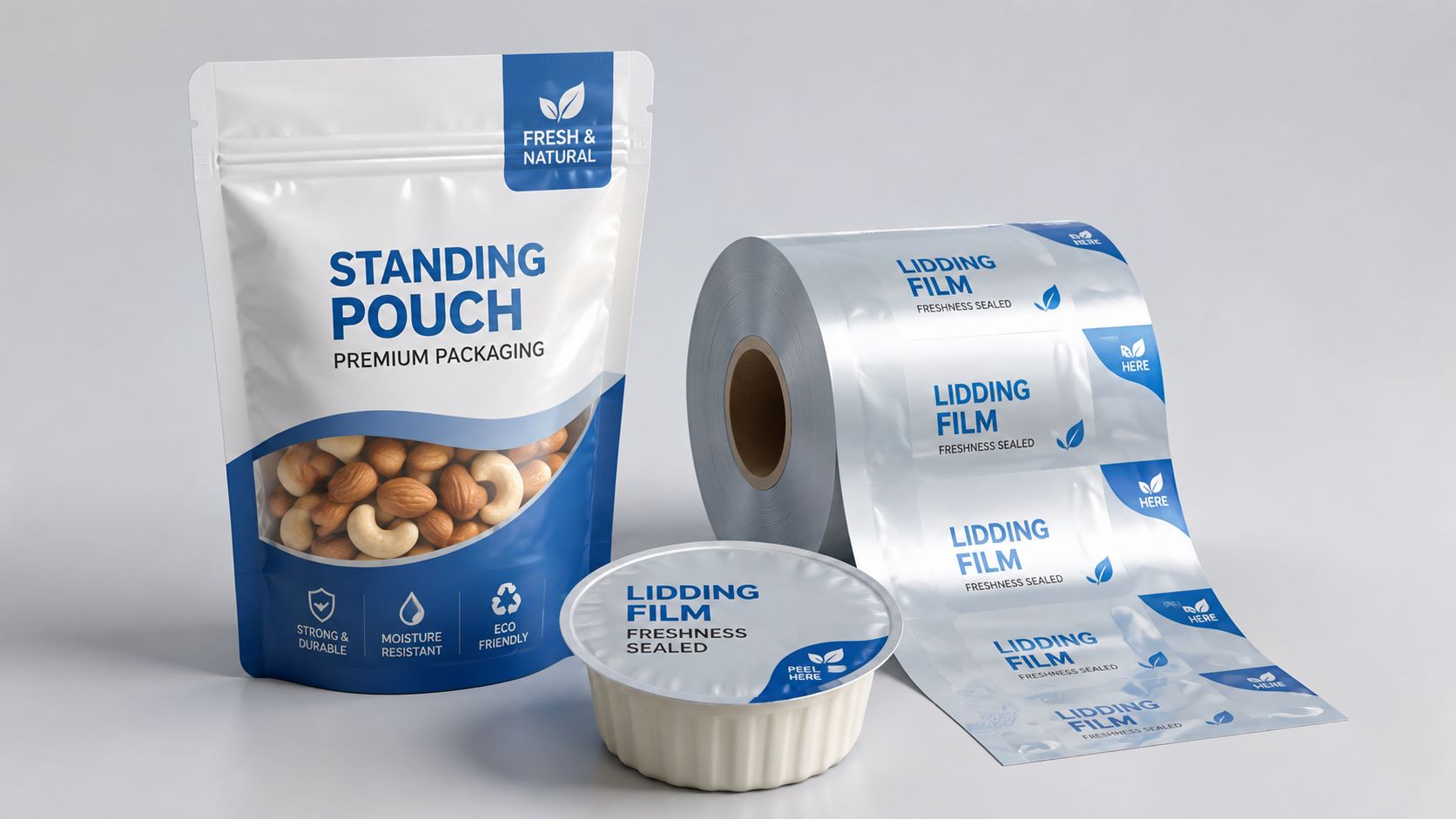
Walk through a supermarket and you will notice how dramatically packaging has changed. Coffee that once came primarily in tins is now displayed in resealable pouches. Snacks, dry fruits, spices and pet foods increasingly appear in flexible packs that stand neatly on shelves. At the same time, ready meals, dairy products, fresh meat and desserts are commonly protected by transparent films sealed directly onto trays and cups.
Two packaging solutions playing an important role in this transition are the standing pouch and Lidding Film.
They may both belong to the flexible packaging industry, but they solve very different packaging challenges. A standing pouch becomes the package itself, whereas lidding film generally creates the closure for a separate tray, tub or cup. For brands and manufacturers, understanding this distinction is the first step towards choosing packaging that performs well throughout production, transportation, retail display and consumer use.
Why Standing Pouches Have Become So Popular
A standing pouch, often referred to as a stand-up pouch, gets its distinctive shape from a gusset at the bottom. When the pouch is filled, the gusset expands to create a base that allows the package to stand independently.
That simple design provides a significant merchandising benefit.
Instead of lying flat on a shelf, products can be displayed vertically with branding facing customers. The front and rear panels provide plenty of space for logos, product information, nutritional details, instructions and attractive graphics.
Standing pouches are commonly seen across categories such as:
- Coffee and tea
- Nuts and dried fruits
- Snacks and confectionery
- Spices and seasoning
- Cereals
- Protein powders
- Nutritional products
- Pet food and treats
- Sauces and condiments
- Household products
- Personal care products
Their versatility is one reason the format has expanded far beyond traditional dry-food packaging.
A Standing Pouch Is More Technical Than It Looks
Consumers normally see an attractive printed pouch. Packaging professionals, however, see a carefully engineered film structure.
A standing pouch may consist of multiple layers, with each layer performing a particular function.
The external layer may provide printability and mechanical protection. Intermediate materials may contribute oxygen, moisture, aroma or light barriers. The internal layer usually needs suitable sealing characteristics and, for food applications, appropriate food-contact properties.
The right structure depends on the contents.
Coffee, for example, can be sensitive to oxygen, moisture and aroma loss. A dry powder may have different moisture-barrier requirements. A liquid product creates completely different demands for seal strength and leakage resistance.
This is why manufacturers should avoid choosing pouch material simply because another product uses something similar.
Small Features Can Make a Big Difference
Modern flexible packaging is increasingly designed around how consumers actually use products.
A resealable zipper is particularly useful for products consumed gradually. Tear notches can make the initial opening easier, while transparent windows allow shoppers to inspect the contents.
Spouts can transform the standing pouch into a practical option for certain liquids and semi-liquid products.
Coffee packaging can incorporate one-way degassing valves, while larger pouches may include handles for easier carrying.
These additions should not be treated purely as design features. Every component can influence manufacturing costs, filling speed, package integrity and consumer convenience.
Where Lidding Film Fits into Flexible Packaging
While a pouch surrounds the product, Lidding Film normally works with another packaging component.
Consider a yoghurt cup, ready-meal tray or fresh-food container. Once the product has been placed inside, a flexible film is sealed across the open rim. That upper layer is the lidding material.
This packaging approach is particularly common for:
- Yoghurt and dairy products
- Ready-to-eat meals
- Fresh meat
- Poultry
- Seafood
- Cheese
- Desserts
- Fresh fruit
- Prepared vegetables
- Dips and sauces
The container provides structural support while the film creates the closure and contributes to product protection.
What Makes Good Lidding Film Perform Reliably?
A reliable seal involves much more than placing film over a container.
Lidding Film must be compatible with the material used for the tray, tub or cup. Packaging machinery then applies controlled heat, pressure and dwell time to produce the required seal.
Several factors can affect the result:
- Container material
- Film composition
- Sealant technology
- Sealing temperature
- Applied pressure
- Dwell time
- Cleanliness of the container rim
- Product contamination in the sealing area
- Packaging-machine settings
A mismatch can result in weak seals, leakage or packaging that becomes unnecessarily difficult for consumers to open.
Testing the complete package is therefore more valuable than evaluating the film independently.
Why Barrier Performance Matters
Packaging must protect the product throughout its intended shelf life, not merely look attractive when it leaves the production line.
Both standing pouch and Lidding Film structures can be engineered to provide specific barrier properties.
Depending on the application, packaging may need to reduce exposure to:
- Oxygen
- Moisture
- Light
- External odours
- Aroma loss
- Grease
- Environmental contamination
The required level depends heavily on the product.
For example, oxidation can affect certain foods considerably more than others. Dry foods may primarily require protection against humidity, while products with sensitive aromas may need materials that help retain their characteristic flavour and smell.
Easy-Peel and Anti-Fog Lidding Films Improve the Consumer Experience
Two features are particularly important in many food applications: peelability and visibility.
Easy-peel Lidding Film is engineered to provide sufficient seal integrity while still allowing consumers to remove the lid without excessive force.
Anti-fog technology addresses another familiar problem.
Refrigerated products can develop condensation inside their packages. If water droplets accumulate on a transparent lid, shoppers cannot clearly see the product. Anti-fog film helps maintain better visibility by reducing the formation of visually obstructive droplets.
For products where freshness and appearance influence purchasing decisions, clear presentation can be commercially important.
Standing Pouch vs Lidding Film: Which One Makes More Sense?
| Consideration | Standing Pouch | Lidding Film |
| Packaging role | Complete flexible package | Seals a separate container |
| Rigid tray required | Usually no | Usually yes |
| Upright shelf display | Built into design | Depends on container |
| Resealable options | Widely available | Less common |
| Branding area | Large front and back panels | Primarily top-facing area |
| Barrier options | Available | Available |
| Easy-peel functionality | Possible | Common |
| Common applications | Coffee, snacks, powders, pet food | Dairy, meat, meals, produce |
There is no universal winner.
The correct choice depends on the physical properties of the product and the experience the manufacturer wants to provide.
Questions Manufacturers Should Ask Before Ordering Packaging
Price per pouch or kilogram of film should never be the only purchasing criterion.
Before approving packaging, manufacturers should ask:
- What shelf life does the product require?
- Is it sensitive to oxygen or humidity?
- Does it require refrigeration?
- At what temperature will it be filled?
- Does the packaging need puncture resistance?
- Will consumers reopen the package repeatedly?
- What sealing equipment is available?
- What conditions will the package face during transportation?
- Is high-quality printing required?
- What regulatory requirements apply?
Packaging Trials Should Come Before Large Orders
Samples and production trials can reveal problems that specifications alone may not identify.
Testing can assess seal strength, leakage, drop resistance, opening behaviour, puncture performance, filling-machine compatibility and appearance after transportation.
Correcting a packaging problem during testing is generally preferable to discovering it after products have entered distribution.
Sustainability Requires More Than Using Less Plastic
Flexible packaging is frequently discussed in sustainability conversations because lightweight formats can reduce material consumption and transportation weight compared with some rigid alternatives.
However, sustainability is more complicated than simply comparing package weights.
Businesses should evaluate:
- Material composition
- Product-to-package ratio
- Recyclability
- Local collection infrastructure
- Manufacturing efficiency
- Transportation requirements
- Shelf-life performance
- Product waste
- Possibilities for mono-material structures
Packaging that fails to protect food effectively can contribute to product waste, so environmental evaluation should consider both the package and the product it protects.
Frequently Asked Questions
What is a standing pouch?
A standing pouch is flexible packaging with a bottom gusset that enables the filled package to stand upright.
What products are suitable for standing pouches?
They are commonly used for coffee, snacks, nuts, spices, powders, pet foods, sauces and selected liquid products.
Can standing pouches be resealed?
Yes. Zippers, sliders and spout closures can provide resealable functionality.
What is Lidding Film?
Lidding Film is flexible film used to seal the opening of trays, tubs, cups and other containers.
Where is lidding film commonly used?
It is widely used for dairy products, ready meals, meat, seafood, produce, desserts, dips and similar packaged products.
What is easy-peel lidding film?
It is designed to maintain the required seal while allowing consumers to remove the film relatively easily.
What does anti-fog lidding film do?
Anti-fog technology helps reduce visible condensation on transparent packaging surfaces.
Can both packaging types provide barrier protection?
Yes. Both can incorporate structures designed for specific oxygen, moisture, aroma or light-barrier requirements.
Is thicker packaging always better?
No. Thickness should correspond to product weight, barrier requirements, puncture risks, sealing conditions and distribution demands.
Which is better for retail branding?
A standing pouch offers substantial front and back printing areas, while lidding materials provide valuable top-facing branding on trays and containers.
Read more – https://newsgrow.blogspot.com/2026/08/foil-lid-and-stand-up-pouch.html
https://newsgrow.blogspot.com/2026/08/spout-pouch-and-stand-up-pouch-with.html
https://newsgrow.blogspot.com/2026/08/stand-up-pouch-filling-machines.html
https://newsgrow.blogspot.com/2026/08/why-zipper-stand-up-pouch-packaging-is.html
https://blogstream.net/standing-pouch-and-lidding-film-a-deep-guide-to-modern-flexible-packaging/