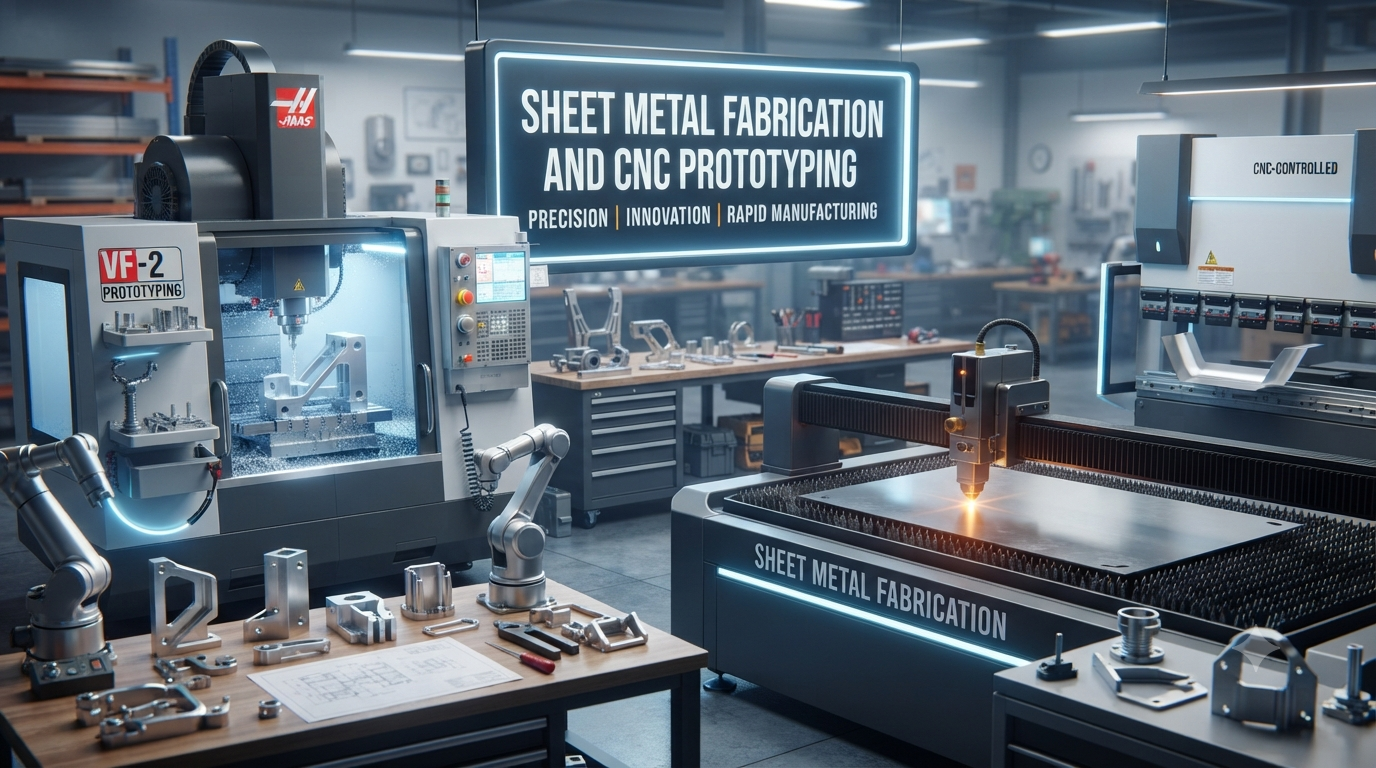
As manufacturers face growing pressure to develop products faster, control production costs and maintain consistent component quality, advanced production technologies are becoming central to modern engineering strategies. Sheet metal fabrication and CNC prototyping are two processes helping businesses bridge the gap between initial product concepts and manufacturable components.
Instead of focusing solely on high-volume manufacturing, engineering teams are increasingly considering manufacturability at the earliest stages of product development. This approach allows prototypes to be tested, designs to be refined and production challenges to be addressed before substantial resources are committed.
Growing Importance of Sheet Metal Fabrication in Modern Industry
From compact electronic housings to large industrial equipment, fabricated metal components can be found throughout modern infrastructure.
Sheet metal fabrication transforms flat metal stock into functional parts using processes such as laser cutting, punching, bending, forming, welding and finishing. The technology provides considerable design flexibility because manufacturers can create different component geometries without machining every feature from a solid block.
Typical applications include:
- Equipment enclosures
- Electrical cabinets
- Automotive components
- Machinery panels
- Mounting brackets
- Server and network racks
- Control-system housings
- HVAC assemblies
- Battery cabinets
- Industrial frames
Stainless steel, aluminium, mild steel, galvanised steel, brass and copper are among the materials used according to application requirements.
Digital Technology Is Reshaping Metal Component Production
One of the most significant developments in sheet metal fabrication is the integration of digital engineering with automated manufacturing equipment.
CAD drawings can move into CAM systems, where cutting paths and manufacturing instructions are prepared. CNC laser cutters can then produce profiles, holes and detailed shapes directly from programmed data.
After cutting, CNC press brakes form the component into its required geometry.
Greater Control from Design to Production
Digital manufacturing can provide greater control over:
- Component dimensions
- Hole positioning
- Cutting geometry
- Bend sequences
- Production repeatability
- Material utilisation
- Engineering revisions
However, technology alone does not guarantee a successful fabricated component. Engineering knowledge remains essential.
Engineering Factors That Cannot Be Ignored
Material thickness, minimum bend radius, springback, bend allowance, welding distortion and tolerances must be considered before production.
Why This Matters
A component that appears perfect in a CAD model may behave differently during physical manufacturing. Metal stretches and compresses during bending, while welding can introduce heat-related distortion.
Successful fabrication therefore combines digital precision with practical manufacturing knowledge.
CNC Prototyping Creates a Practical Link Between CAD and Reality
Digital design tools allow engineers to develop highly detailed components before anything is manufactured. However, a virtual model cannot always demonstrate exactly how a physical component will behave.
This is where CNC prototyping becomes valuable.
Using computer-controlled milling, turning and multi-axis machining equipment, manufacturers can produce physical components directly from CAD-based designs.
Unlike processes intended primarily for visual models, CNC prototyping can produce parts from engineering materials such as:
- Aluminium
- Stainless steel
- Carbon steel
- Brass
- Copper
- Titanium
- Nylon
- ABS
- POM
- Acrylic
- Other engineering plastics
This allows prototypes to be evaluated under conditions closer to their intended application.
Prototyping Before Production Can Reduce Development Risk
Moving directly from CAD design to volume manufacturing can create unnecessary risk.
Imagine an equipment manufacturer developing a precision mounting system. Hundreds of components are ordered, but during final assembly the engineering team discovers that two mounting holes are slightly misaligned.
The individual error may appear small, but across an entire production batch it can create reworking, delays and additional expense.
CNC prototyping provides an opportunity to identify these issues earlier.
Engineers can examine:
- Dimensional accuracy
- Component fit
- Mounting alignment
- Mechanical movement
- Thread engagement
- Assembly clearance
- Functional behaviour
- Design accessibility
Changes can then be made to the CAD model before production specifications are finalised.
Different Technologies with a Shared Manufacturing Objective
Sheet metal fabrication and CNC prototyping should not be viewed as competing manufacturing methods. Each addresses different engineering requirements.
| Consideration | Sheet Metal Fabrication | CNC Prototyping |
| Material form | Flat metal sheet | Solid material |
| Manufacturing approach | Cut, bend and assemble | Remove material |
| Ideal components | Panels, brackets, enclosures | Precision mechanical parts |
| Prototype capability | Strong | Strong |
| Thin-walled structures | Highly suitable | Often inefficient |
| Complex 3D geometry | Moderate | Highly suitable |
| Typical machines | Laser cutter, press brake | CNC mill, CNC lathe |
| Material options | Primarily metals | Metals and engineering plastics |
| Scalability | Prototype to volume production | Prototype to production quantities |
Choosing between them requires an understanding of the component rather than simply comparing machine capabilities.
Hybrid Manufacturing Is Supporting More Complex Products
Many finished products contain components manufactured using several technologies.
Consider an electric vehicle charging station. Its external housing could be manufactured through sheet metal fabrication, while internal mounting blocks, precision connectors, mechanical interfaces and specialised components could be produced through CNC prototyping.
Similar combinations can be found in:
- Robotics
- Industrial automation
- Medical equipment
- Telecommunications
- Aerospace systems
- Electronics
- Laboratory instruments
- Renewable energy systems
- Packaging machinery
- Special-purpose machines
Combining manufacturing processes allows designers to select the most practical technology for each individual component.
Design for Manufacturability Moves to the Centre of Product Development
Design for Manufacturability, or DFM, is becoming increasingly important as companies attempt to reduce unnecessary manufacturing complexity.
For sheet metal fabrication, DFM can include reviewing bend locations, material thickness, standard hole dimensions, welding accessibility and fastening methods.
For CNC prototyping, the review may focus on tool accessibility, internal radii, cavity depth, wall thickness, undercuts and dimensional tolerances.
Small Design Decisions Can Have Large Manufacturing Consequences
A deep pocket may require specialised CNC tooling. An unnecessarily tight internal corner may increase machining time. A poorly positioned hole may deform during sheet bending.
Designing Around the Manufacturing Process
The most efficient component is not necessarily the simplest-looking design. It is a design developed with a clear understanding of how the selected manufacturing process actually works.
Material Strategy Is Becoming Part of Cost Engineering
Selecting the lowest-cost material does not automatically produce the lowest-cost component.
Aluminium may cost more than some steel grades but can offer advantages where reduced weight, corrosion resistance or machining efficiency is required.
Stainless steel can provide corrosion resistance and durability for demanding environments, while mild steel remains suitable for many structural and cost-sensitive applications.
Engineering teams should consider:
- Strength requirements
- Weight
- Corrosion exposure
- Temperature
- Machinability
- Weldability
- Surface treatment
- Appearance
- Expected service environment
- Total production cost
Material selection should therefore be connected to both engineering performance and manufacturing economics.
Quality Control Remains Essential as Precision Requirements Increase
Advanced manufacturing depends on verification as much as production.
Components may be inspected using callipers, micrometers, gauges, height-measurement systems, optical equipment and coordinate measuring machines.
For sheet metal fabrication, inspection may focus on bend angles, hole locations, overall dimensions, flatness and assembly alignment.
For CNC prototyping, critical dimensions, threads, bores, surface characteristics and geometric tolerances may require verification.
A controlled inspection process becomes particularly important when an approved prototype moves into repeat manufacturing.
Manufacturers Are Looking Beyond Individual Components
A wider shift is also taking place in supplier selection.
Rather than sourcing cutting, machining, finishing and assembly from completely separate suppliers, some businesses prefer manufacturing partners capable of supporting several stages of development.
This can include:
- Engineering drawing review
- DFM recommendations
- Prototype manufacturing
- Sheet metal fabrication
- CNC prototyping
- Surface finishing
- Assembly
- Inspection
- Low-volume manufacturing
- Scalable production
A connected manufacturing workflow can improve communication when designs change during development.
Frequently Asked Questions
1. What does sheet metal fabrication involve?
It involves converting flat metal sheets into finished components through cutting, bending, forming, joining and finishing operations.
2. What industries use fabricated metal components?
Automotive, electronics, industrial machinery, construction, telecommunications, medical equipment and energy industries are common users.
3. What does CNC prototyping mean?
It means producing prototype components using computer-controlled machining equipment and digital design data.
4. Why use CNC machining for prototypes?
It allows engineers to evaluate physical components for dimensions, assembly, mechanical behaviour and functionality.
5. Can aluminium be used for sheet metal fabrication?
Yes. Aluminium is widely fabricated for lightweight enclosures, panels, brackets and other components.
6. Can aluminium also be CNC machined?
Yes. Many aluminium alloys offer good machinability and are commonly selected for CNC prototype components.
7. Is sheet metal fabrication suitable for low quantities?
Yes. Modern laser cutting and CNC bending can support prototypes and low-volume orders as well as larger production runs.
8. What files are required for CNC manufacturing?
STEP and other recognised 3D CAD formats are commonly used, together with technical drawings where detailed tolerances must be communicated.
9. Why are manufacturing tolerances important?
They define acceptable dimensional variation and help ensure that components fit and function correctly.
10. What is DFM in manufacturing?
DFM means Design for Manufacturability. It involves optimising a design so it can be manufactured efficiently while maintaining required performance.
https://newsgrow.blogspot.com/2026/08/rapid-injection-molding-and-china-rapid.html
https://newsgrow.blogspot.com/2026/08/aluminum-prototype-and-sheet-metal.html
https://newsgrow.blogspot.com/2026/08/deep-information-about-sheet-metal.html