A successful product does not move directly from a computer screen to mass production. Between the first CAD model and the final manufactured component, engineers must answer dozens of practical questions. Will the parts fit together? Is the material suitable? Are the walls too thick? Can the component be moulded efficiently? Will it perform as expected after repeated use?
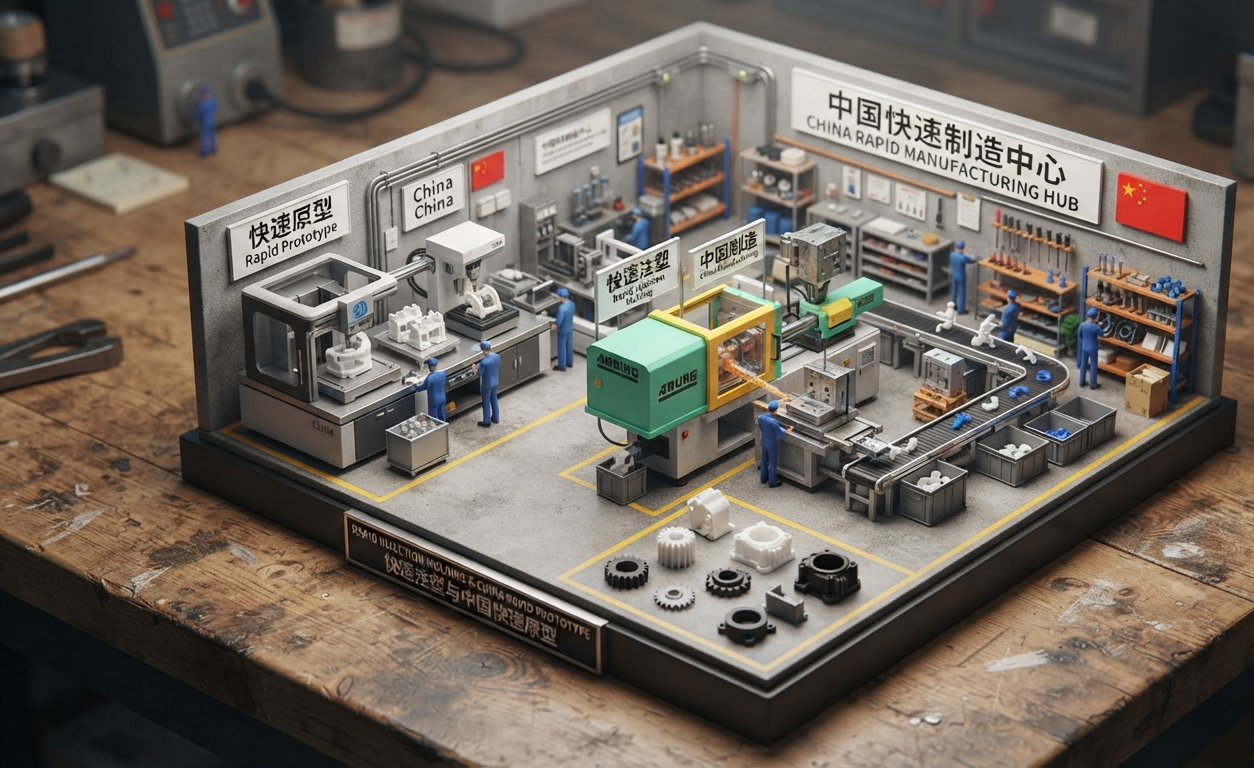
This is where rapid injection molding and china rapid prototype services become valuable. Instead of making a large tooling investment while a design is still evolving, businesses can manufacture physical prototypes, test critical features and gradually move towards production.
For startups developing their first physical product and established manufacturers launching a new component, rapid manufacturing can make development more flexible, measurable and commercially practical.
A Prototype Is More Than a Sample
People sometimes think of a prototype as a model created mainly to show what a finished product will look like. In engineering, its role is much broader.
A prototype can answer specific questions at different stages of development.
An early prototype might simply confirm whether the dimensions and proportions feel right. A later prototype might test snap-fits, screw bosses or mating components. Another version may be produced specifically for mechanical or assembly testing.
This is why china rapid prototype manufacturing can involve several processes rather than a single technology.
Common options include:
- CNC machining
- SLA 3D printing
- SLS 3D printing
- Vacuum casting
- Sheet-metal fabrication
- Rapid tooling
- Plastic injection moulding
Choosing between these methods depends on what the development team needs to learn from the prototype.
Where Rapid Injection Molding Enters the Development Process
Imagine that a company is developing a plastic housing for a portable electronic device.
The first prototype is 3D printed. The designers immediately discover that one button opening is difficult to reach and the enclosure feels unnecessarily bulky.
They modify the CAD design.
A second prototype confirms the external dimensions, but engineers now need to understand how the housing will behave when manufactured from the intended thermoplastic.
This is the point where rapid injection molding may become useful.
A rapid mould can be manufactured, allowing the team to produce actual injection-moulded components. These samples can provide a more realistic understanding of material behaviour, surface quality, assembly and manufacturing consistency.
Instead of viewing prototyping and injection moulding as competing technologies, they can be treated as different stages of the same development journey.
China Rapid Prototype Services and the Manufacturing Ecosystem
China has a broad manufacturing network covering machining, prototyping, mould making, injection moulding, finishing and assembly.
For international product developers, a china rapid prototype supplier may provide access to several manufacturing technologies through one project workflow.
Consider a product containing:
- A plastic outer housing
- CNC-machined aluminium components
- Rubber buttons
- Sheet-metal brackets
- Injection-moulded internal supports
Producing these parts can require several manufacturing disciplines. A supplier with access to multiple processes may simplify coordination during prototype development.
However, location alone does not guarantee manufacturing quality. Supplier selection should always consider engineering capability, quality management, communication and experience with similar components.
Rapid Injection Molding Is Not Simply Faster Traditional Molding
The term “rapid” can create the impression that conventional injection moulding has simply been accelerated.
The distinction is more meaningful.
Production tooling is commonly designed around long-term manufacturing requirements. Tool construction, cavity configuration, automation and materials may be selected to support substantial production volumes.
Rapid injection molding, by comparison, is typically designed around immediate development or lower-volume requirements.
| Requirement | Rapid Molding | Traditional Production Molding |
| Main objective | Development and faster production | Long-term manufacturing |
| Typical tooling | Simplified aluminium or steel options | Production-grade tooling |
| Initial investment | Project dependent, often lower | Generally higher |
| Design stage | Validation or early production | Mature design |
| Design flexibility | Greater before final tooling | Changes can become expensive |
| Typical application | Prototype, pilot and bridge runs | Large-scale production |
Neither approach is inherently superior. The correct choice depends on product maturity and manufacturing objectives.
The Hidden Value of Finding Problems Early
The biggest advantage of a china rapid prototype programme is not necessarily the speed at which a sample arrives.
Its real value is information.
Suppose an injection-moulded enclosure requires four screws for assembly. A prototype reveals that one screw boss interferes with an internal circuit board.
If discovered during prototype testing, engineers can adjust the CAD model.
If discovered after expensive multi-cavity production tooling has been completed, correcting the problem may require tooling modification, additional engineering work and another validation cycle.
Prototype manufacturing therefore helps businesses ask an important question before scaling:
“Are we confident enough in this design to manufacture thousands of identical units?”
Materials Can Change How a Product Performs
Geometry is only part of product engineering.
A component manufactured from ABS may behave differently from one produced using polypropylene, nylon or polycarbonate. Flexibility, impact behaviour, chemical resistance, heat performance and dimensional stability vary between materials.
Common materials considered for rapid injection molding include:
- ABS for general-purpose housings
- Polypropylene for flexible and chemical-resistant applications
- Polycarbonate where impact performance and clarity may be relevant
- Nylon for certain mechanical components
- POM for low-friction precision applications
- TPE for flexible parts
- Filled engineering polymers for specialised requirements
The actual grade should be selected according to the component’s operating conditions and applicable standards.
Designing a Part That Can Actually Be Moulded
A beautiful CAD model is not automatically a good injection-moulded design.
Design for Manufacturing, or DFM, helps bridge the gap between product design and manufacturing reality.
Engineers commonly review several areas before starting rapid injection molding.
Keep Wall Thickness Under Control
Unnecessarily thick sections consume additional material and can influence cooling, shrinkage and surface appearance.
Think About Draft
Components normally require suitable draft so they can release effectively from the mould.
Evaluate Undercuts Carefully
An undercut can require sliders, lifters or additional tooling mechanisms. If the feature is unnecessary, redesigning it may simplify manufacturing.
Examine Ribs and Bosses
Structural features should provide the required strength without introducing avoidable moulding problems.
Do Not Ignore Gate and Parting-Line Locations
These features can influence appearance and manufacturing behaviour. Cosmetic surfaces should therefore be identified before tooling begins.
When Should You Consider Rapid Injection Molding?
There is no fixed quantity at which every project should move from prototyping to injection moulding.
Instead, consider the questions the next manufacturing stage needs to answer.
Rapid injection molding may be appropriate when:
- The design has passed initial prototype testing.
- Multiple identical components are required.
- Production-grade thermoplastic needs to be evaluated.
- Assembly testing requires realistic moulded components.
- Pilot production is beginning.
- Market-testing quantities are needed.
- Production tooling is not yet justified.
If the design is still changing significantly, another prototype iteration may be more sensible than immediately manufacturing a mould.
How to Request an Accurate Prototype Quotation
Sending only a screenshot or product photograph rarely gives a manufacturer enough information for an accurate engineering quotation.
For a china rapid prototype project, prepare a complete technical package where possible.
Include:
- 3D CAD files
- 2D engineering drawings
- Required material and grade
- Quantity
- Critical tolerances
- Surface finish
- Colour requirements
- Intended application
- Cosmetic requirements
Clearly identify dimensions that directly affect assembly or performance.
The more precisely requirements are communicated, the easier it becomes for manufacturers to evaluate the appropriate production method.
Cheap Tooling and Cost-Effective Tooling Are Not Always the Same
Price matters, but the lowest quotation does not automatically represent the lowest manufacturing cost.
Suppose Supplier A offers cheaper tooling but the first samples repeatedly fail dimensional inspection. Supplier B charges more initially but provides proper DFM feedback and produces acceptable components with fewer modifications.
Supplier B may ultimately offer better value.
When comparing rapid injection molding quotations, examine tooling specification, expected tool life, included modifications, material, inspection, finishing and production pricing.
Cost should be evaluated across the project rather than at the quotation stage alone.
How to Evaluate a China Rapid Prototype Manufacturer
A suitable supplier should be able to discuss engineering details confidently.
Before selecting a manufacturing partner, ask questions such as:
- Can you provide DFM feedback?
- Which prototype process is most appropriate and why?
- Which mould material do you recommend?
- How will critical dimensions be inspected?
- Can you supply material documentation when required?
- Which operations are completed internally?
- How are design revisions controlled?
- How is confidential product information handled?
Strong technical communication before manufacturing often indicates how effectively problems will be managed later.
Frequently Asked Questions
What is rapid injection molding?
It is an injection-moulding approach focused on shorter tooling lead times for prototypes, validation, pilot production and lower-volume parts.
What does china rapid prototype mean?
It commonly describes prototype manufacturing in China using CNC machining, 3D printing, vacuum casting, rapid tooling and other processes.
Why not move directly into mass production?
Prototype testing can identify design, assembly and manufacturing problems before major tooling and production commitments are made.
Is rapid molding only suitable for prototypes?
No. It can also support pilot runs, bridge production and certain low-volume commercial requirements.
Which prototype method should I choose?
The right process depends on geometry, material, quantity, tolerance, finish and what you need to test.
Can actual production materials be tested?
Rapid injection molding can often produce parts from the intended thermoplastic, depending on material and tooling requirements.
What is DFM?
Design for Manufacturing evaluates whether a product is designed appropriately and efficiently for its intended manufacturing process.
Why are undercuts important?
Undercuts may require additional tooling mechanisms, increasing mould complexity and potentially affecting cost.
Are China prototype services suitable for startups?
They can be suitable for startups and established manufacturers when the selected supplier meets the project’s technical and quality requirements.
What files are needed for a quotation?
A 3D CAD file, engineering drawing, material specification, quantity, tolerance and finishing requirements are commonly requested.
How should prototype quality be checked?
Critical dimensions, material, appearance, assembly and functional performance should be verified against agreed specifications.
Can the same company make prototypes and production parts?
Some china rapid prototype companies provide prototyping, tooling, moulding, finishing and production services, allowing projects to remain within one manufacturing workflow.
https://newsgrow.blogspot.com/2026/08/rapid-injection-molding-and-china-rapid.html