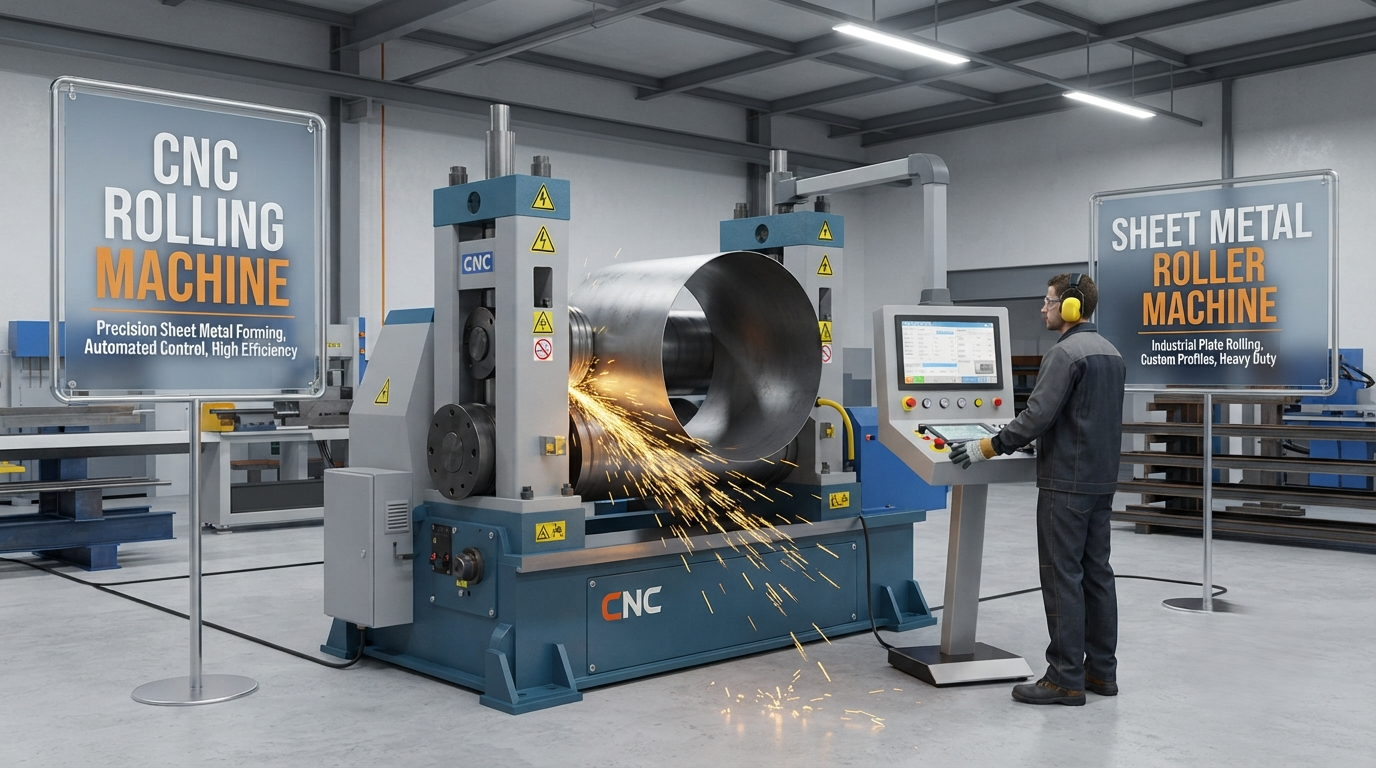
The demand for accurate, efficient, and high-quality metal fabrication solutions is increasing across industries. From heavy engineering plants to automotive manufacturing units, companies require advanced equipment that can shape metal materials with precision and consistency. This is where the CNC rolling machine and sheet metal roller machine have become essential tools for modern manufacturing.
Metal rolling is a critical process used to transform flat sheets and plates into curved structures. With advanced automation, CNC technology has improved this process by offering better control, faster production, and reduced errors. These machines allow manufacturers to produce complex metal shapes while maintaining excellent quality standards.
Today, industries are moving away from traditional manual bending techniques and adopting automated rolling solutions to achieve higher productivity and long-term cost efficiency.
The Role of CNC Rolling Machine in Modern Manufacturing
A CNC rolling machine is an advanced metal-forming system that uses computer-controlled technology to perform precise bending operations. Unlike conventional machines, CNC models allow operators to program specific instructions, ensuring accurate roller movement and consistent results.
These machines are designed to handle challenging fabrication tasks where accuracy and repeatability are important. They are especially beneficial for industries producing large quantities of metal components with identical specifications.
The advanced control system of CNC rolling equipment helps manufacturers achieve:
- Precise bending angles
- Consistent production quality
- Faster manufacturing cycles
- Reduced material damage
- Improved operational efficiency
Because of these advantages, CNC rolling technology has become a preferred choice for professional fabrication companies.
What Makes a Sheet Metal Roller Machine Essential?
A sheet metal roller machine is a mechanical device used to bend metal sheets into curved shapes. It works by passing metal material through rollers that apply controlled pressure to achieve the required form.
These machines are commonly used for producing:
- Cylindrical components
- Circular tanks
- Curved panels
- Metal pipes
- Industrial structures
The flexibility of sheet metal roller machines allows manufacturers to work with different metals and thicknesses according to project requirements.
Working Process of Metal Rolling Equipment
The operation of a modern rolling machine involves several controlled steps:
Material Placement
The metal sheet is positioned between the rollers before the bending process begins.
Roller Adjustment
The rollers are adjusted according to the thickness, width, and material properties of the sheet.
Controlled Bending
The rollers rotate while applying pressure, gradually forming the metal into the required curve.
Quality Inspection
After rolling, the finished component is checked for accuracy, shape, and surface quality.
This controlled process ensures better results compared with traditional manual bending methods.
Different Types of Rolling Machines Used in Industries
Manufacturers can select different rolling machines based on their production requirements.
Three Roller Bending Machine
A three-roll system is widely used for general fabrication applications. It provides reliable performance for medium-level bending operations.
Four Roller Bending Machine
Four-roll machines provide greater control and accuracy because the sheet remains properly positioned during operation.
Hydraulic Plate Rolling Machine
Hydraulic rolling machines deliver powerful bending force, making them suitable for heavy-duty applications involving thick metal plates.
CNC Plate Rolling Machine
CNC plate rolling machines provide automated operation with advanced programming features for complex manufacturing requirements.
Industrial Applications of CNC Rolling and Sheet Metal Roller Machines
The versatility of these machines makes them valuable across various industries.
Oil and Energy Sector
Rolling machines are used to manufacture:
- Storage tanks
- Pressure vessels
- Pipelines
- Energy equipment
Automotive Manufacturing
Automotive companies use precision rolling technology to create durable metal components and structural parts.
Shipbuilding Industry
Large metal plates used in marine structures require accurate bending, which is achieved through advanced rolling systems.
Construction and Infrastructure
Construction industries use rolled metal components for buildings, bridges, industrial frameworks, and architectural projects.
Aerospace Manufacturing
The aerospace sector depends on high-precision fabrication equipment for producing lightweight and strong components.
Advantages of Using CNC Rolling Machine Technology
The adoption of CNC-based rolling solutions offers several benefits for manufacturers.
High Accuracy
Computer-controlled systems provide precise roller movement, reducing production variations.
Improved Productivity
Automation allows companies to complete fabrication projects faster compared with manual processes.
Lower Production Waste
Accurate programming minimizes mistakes, helping manufacturers reduce material consumption.
Better Repeatability
Once programmed, CNC machines can produce multiple identical components with consistent quality.
Enhanced Safety
Reduced manual handling improves workplace safety and minimizes operational risks.
Comparison Between CNC Rolling Machine and Sheet Metal Roller Machine
| Category | CNC Rolling Machine | Sheet Metal Roller Machine |
| Operation | Automated computer control | Manual or semi-automatic control |
| Precision | Extremely accurate | Good accuracy with proper operation |
| Production Capacity | High-volume manufacturing | Small to medium production |
| Programming | Digital programming available | Limited control options |
| Cost | Higher investment | Budget-friendly option |
| Ideal Application | Complex industrial fabrication | Standard bending requirements |
How to Select the Right Rolling Machine for Your Business
Choosing suitable equipment requires understanding specific production needs.
Analyze Material Requirements
Consider the type of materials you will process, including:
- Stainless steel
- Aluminum
- Mild steel
- Alloy metals
- Carbon steel
Check Machine Capacity
Important factors include:
- Maximum sheet thickness
- Rolling width
- Bending diameter
- Production speed
Consider Automation Level
Businesses with complex projects and high production demands should select CNC-controlled systems for better efficiency.
Evaluate Machine Reliability
A durable machine structure, quality components, and proper technical support ensure long-term performance.
Maintenance Tips for Better Machine Performance
Regular maintenance helps extend the lifespan of rolling equipment.
Important maintenance practices include:
- Checking hydraulic systems regularly
- Lubricating moving components
- Inspecting rollers for wear
- Cleaning machine surfaces
- Updating control software when required
Proper care reduces downtime and keeps production operations running smoothly.
Future of CNC Rolling Machine Technology
The future of metal fabrication is becoming more intelligent with the adoption of automation and smart manufacturing technologies. Modern CNC rolling machines are expected to include advanced features such as artificial intelligence monitoring, automated adjustments, and real-time performance analysis.
Future trends include:
- Smart factory integration
- Automated production tracking
- Digital quality management
- Remote machine operation
- Energy-saving systems
These advancements will help manufacturers improve efficiency while meeting growing market demands.
Frequently Asked Questions About CNC Rolling Machine and Sheet Metal Roller Machine
1. What is a CNC rolling machine?
A CNC rolling machine is an automated metal bending machine controlled through computer programming for precise fabrication.
2. What is a sheet metal roller machine used for?
It is used to bend flat metal sheets into curved shapes for industrial and commercial applications.
3. Which industries use CNC rolling machines?
Industries such as automotive, construction, aerospace, shipbuilding, and energy use CNC rolling technology.
4. Can these machines process different metals?
Yes, they can process materials including stainless steel, aluminum, carbon steel, and various alloys.
5. Why are CNC rolling machines more accurate?
They use computer-controlled operations that reduce manual errors and maintain consistent results.
6. What shapes can a sheet metal roller machine create?
It can create cylindrical, circular, conical, and customized curved metal shapes.
7. Are CNC rolling machines suitable for large production?
Yes, they are ideal for industries requiring continuous and high-volume production.
8. How can rolling machine performance be improved?
Regular maintenance, proper operation, and correct machine selection improve efficiency.
9. What factors affect the cost of a rolling machine?
Machine size, automation features, material capacity, and technology level influence pricing.
10. Is CNC rolling technology the future of metal fabrication?
Yes, increasing automation and smart manufacturing trends are making CNC rolling technology more important.
Read more – https://newsgrow.blogspot.com/2026/08/seam-welding-machine-and-metal-spinning.html
https://newsgrow.blogspot.com/2026/08/cnc-rolling-machine-and-sheet-metal.html