
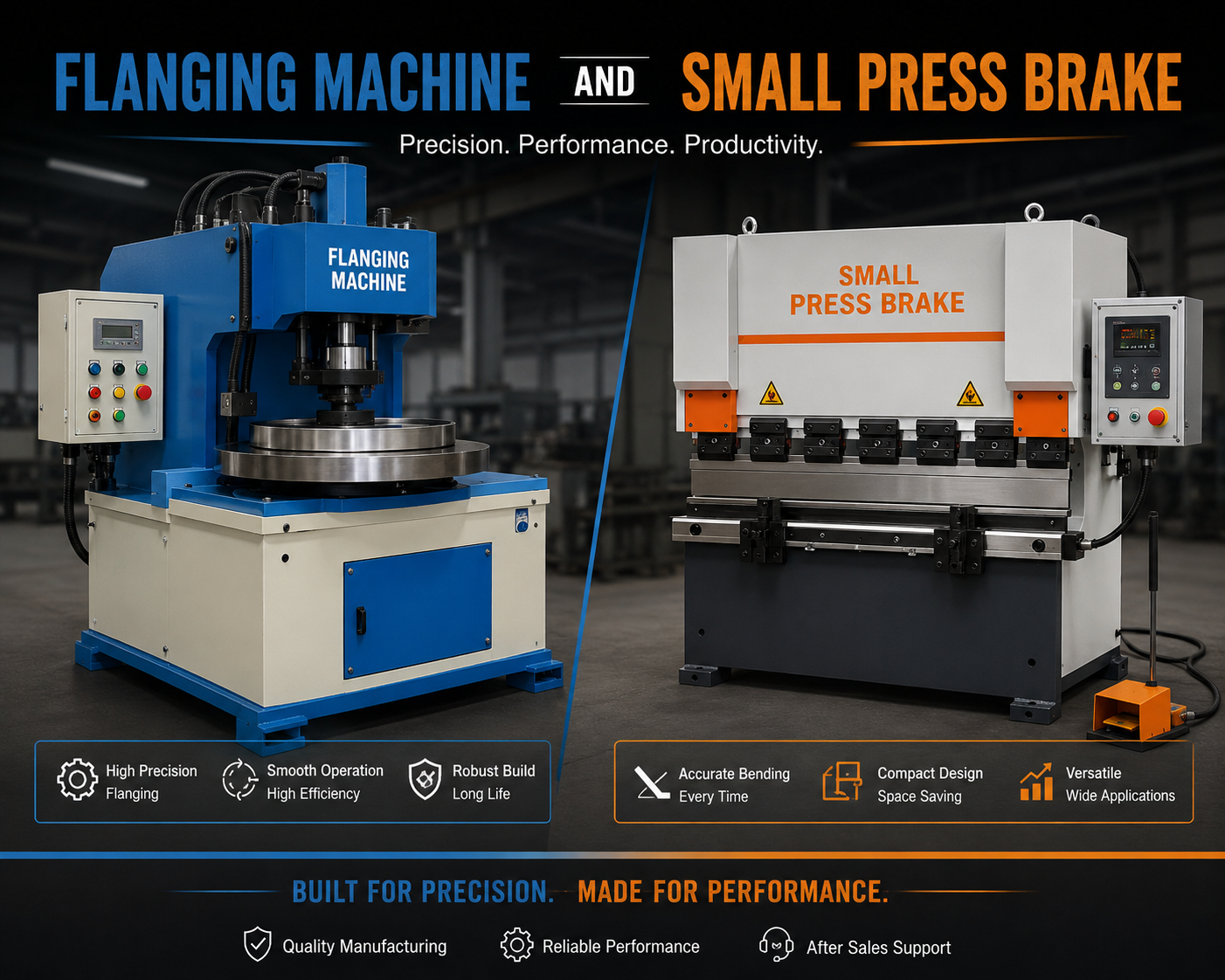
Sheet metal manufacturers increasingly need equipment that can handle accurate forming without making production unnecessarily complicated. Two machines that support this requirement are the flanging machine and small press brake. Both are used to reshape metal, but they solve different fabrication challenges.
A flanging machine focuses on forming controlled edges around flat, curved, or circular components. A small press brake, on the other hand, is designed for bending sheet metal along straight lines. For manufacturers producing tanks, ventilation components, brackets, control boxes, metal covers, machine parts, and custom assemblies, understanding these machines can lead to better purchasing and production decisions.
The Growing Need for Compact Metal Forming Equipment
Modern workshops often produce smaller batches of highly varied components. Instead of depending only on large production machines, many businesses are investing in compact equipment that can be configured quickly.
The main goals are:
- Reducing setup time
- Improving repeatability
- Saving workshop space
- Handling multiple material types
- Lowering scrap rates
- Simplifying prototype production
- Producing custom parts efficiently
The small press brake fits particularly well into flexible production environments, while a flanging machine becomes valuable where consistent edge forming is required.
Flanging Machine as an Edge-Forming Solution
A flanging machine creates a shaped border around a sheet metal component. The edge may be bent upward, downward, inward, or outward depending on the final product.
A properly formed flange can provide structural reinforcement without significantly increasing component weight.
How Flanges Improve Product Design
Flanging is not used only for appearance. It performs several engineering functions.
A flange can:
- Increase edge rigidity
- Provide a welding surface
- Create mounting locations
- Assist bolted assembly
- Improve sealing
- Connect neighboring components
- Prevent sharp exposed edges
This makes flanging particularly important for fabricated products that later undergo welding or assembly.
Rotary Flanging Operations
Circular workpieces often require rotary forming. The component rotates while tools progressively shape its edge.
This method is commonly associated with round covers, vessel parts, duct sections, and industrial containers.
Controlling Metal During Flanging
Material must flow correctly during edge formation. Too much deformation in one stage may produce wrinkles or cracks. Controlled forming passes can help distribute stress more evenly.
Small Press Brake for Flexible Sheet Bending
A small press brake uses controlled force to bend sheet metal between two forming tools. The punch pushes the material toward the die, causing plastic deformation along a defined bending line.
Unlike dedicated machines that produce only one profile, a press brake can perform many jobs by changing tooling and machine settings.
What Can Be Manufactured on a Small Press Brake?
A single small press brake may support numerous fabrication projects.
Typical products include:
- Equipment brackets
- Electrical enclosure parts
- Metal trays
- Cabinet sections
- Machine covers
- Automotive support parts
- Small channels
- Stainless steel kitchen parts
- Custom mounting plates
- Prototype components
This versatility is one reason compact press brakes are common in job shops and general fabrication businesses.
Understanding Press Brake Bending Methods
Different bending methods may be used according to accuracy and production requirements.
Air Bending
During air bending, the sheet contacts the punch and two sides of the die rather than being fully pressed into the die bottom.
It offers flexibility because multiple angles can often be produced using the same tooling.
Bottom Bending
Bottom bending pushes the workpiece farther into the die. It can provide good angle consistency when tooling and settings are properly matched.
Why Bending Method Matters
The selected process affects force requirements, bend radius, springback, tooling selection, and finished accuracy.
Flanging Machine and Small Press Brake: Functional Differences
| Manufacturing Factor | Flanging Machine | Small Press Brake |
| Main objective | Create edge profiles | Create controlled bends |
| Typical motion | Progressive or rotary forming | Vertical pressing |
| Common components | Rings, ducts, tanks, covers | Brackets, boxes, panels |
| Circular work | Excellent | Not primary purpose |
| Multi-angle bending | Limited | Excellent |
| Tool variation | Application focused | Wide variety |
| Prototype suitability | Application dependent | Very good |
| Repetitive edge work | Highly efficient | Possible but less specialized |
Understanding these differences prevents manufacturers from selecting equipment based only on machine price or size.
Material Behavior During Forming
Different metals do not react identically when pressure is applied.
Mild Steel
Mild steel is commonly fabricated because it generally offers predictable bending characteristics.
Stainless Steel
Stainless steel usually requires higher forming force and may exhibit more springback than mild steel.
Aluminum
Aluminum is lightweight and formable, but certain grades can crack when bent around excessively tight radii.
Material Testing Before Production
A trial component should be formed when working with unfamiliar material grades. This allows operators to fine-tune pressure, radius, and forming sequence before starting a larger batch.
Choosing Flanging Equipment Based on Production Needs
A manufacturer considering a flanging machine should evaluate actual component requirements.
Important points include:
- Maximum metal thickness
- Minimum and maximum diameter
- Flange width
- Edge angle
- Material grade
- Component geometry
- Required production speed
- Number of repeated parts
It is also worth checking how quickly tooling can be adjusted between different component sizes.
Selecting the Correct Small Press Brake
A small press brake should provide enough capability without being unnecessarily oversized.
Important specifications include:
Bending Length
Working length determines the maximum width of components that can be bent in a single operation.
Machine Tonnage
Available tonnage should match material thickness, material strength, die opening, and bending length.
Backgauge
The backgauge positions the workpiece before bending. Accurate positioning is essential when several identical parts are required.
CNC and Digital Controls
Programmable controls can store job parameters, reduce repeated manual adjustments, and improve consistency for multi-bend components.
Production Quality Checks
Quality inspection should begin with the first manufactured piece rather than after the entire batch has been completed.
Operators should verify:
- Bend angle
- Flange height
- Overall component dimensions
- Edge condition
- Surface scratches
- Hole positions after bending
- Part-to-part consistency
Correcting settings early can prevent large quantities of rejected material.
Reducing Waste in Sheet Metal Fabrication
Material waste can significantly influence production costs.
Useful practices include:
- Planning blank sizes carefully
- Performing trial bends
- Recording proven settings
- Maintaining accurate gauges
- Inspecting tools for wear
- Avoiding excessive forming pressure
- Keeping similar production jobs together
A well-organized production process allows both the flanging machine and small press brake to operate more effectively.
Maintenance for Consistent Performance
Forming equipment works under significant mechanical loads, so routine maintenance is essential.
Machine operators should regularly inspect:
- Hydraulic systems
- Forming rollers
- Punches and dies
- Lubrication points
- Electrical connections
- Backgauge mechanisms
- Safety devices
Preventive maintenance is usually less expensive than unplanned machine downtime.
Frequently Asked Questions
1. What is the basic purpose of a flanging machine?
A flanging machine forms reinforced or functional edges on sheet metal components.
2. Where is flanging commonly required?
It is frequently used in tanks, vessels, ducts, containers, round covers, and fabricated assemblies.
3. What makes a small press brake different from a large press brake?
A small press brake generally has a shorter working length and lower tonnage while requiring less workshop space.
4. Can a press brake handle multiple product designs?
Yes. Different tooling and settings allow it to manufacture many sheet metal profiles.
5. What causes wrinkles during flanging?
Excessive material compression, incorrect tooling, or unsuitable forming sequences may cause wrinkling.
6. Why does bend angle change after pressure is released?
The material experiences springback and partially returns toward its original position.
7. Can copper be processed on these machines?
Yes, when machine capacity, tooling, and forming settings are suitable for the selected copper grade.
8. What is press brake tonnage?
Tonnage represents the force available to perform a bending operation.
9. Why is a backgauge important?
It controls workpiece positioning and helps maintain consistent bend dimensions.
10. Can a flanging machine improve component strength?
Yes. A properly designed flange can increase edge rigidity and structural stability.