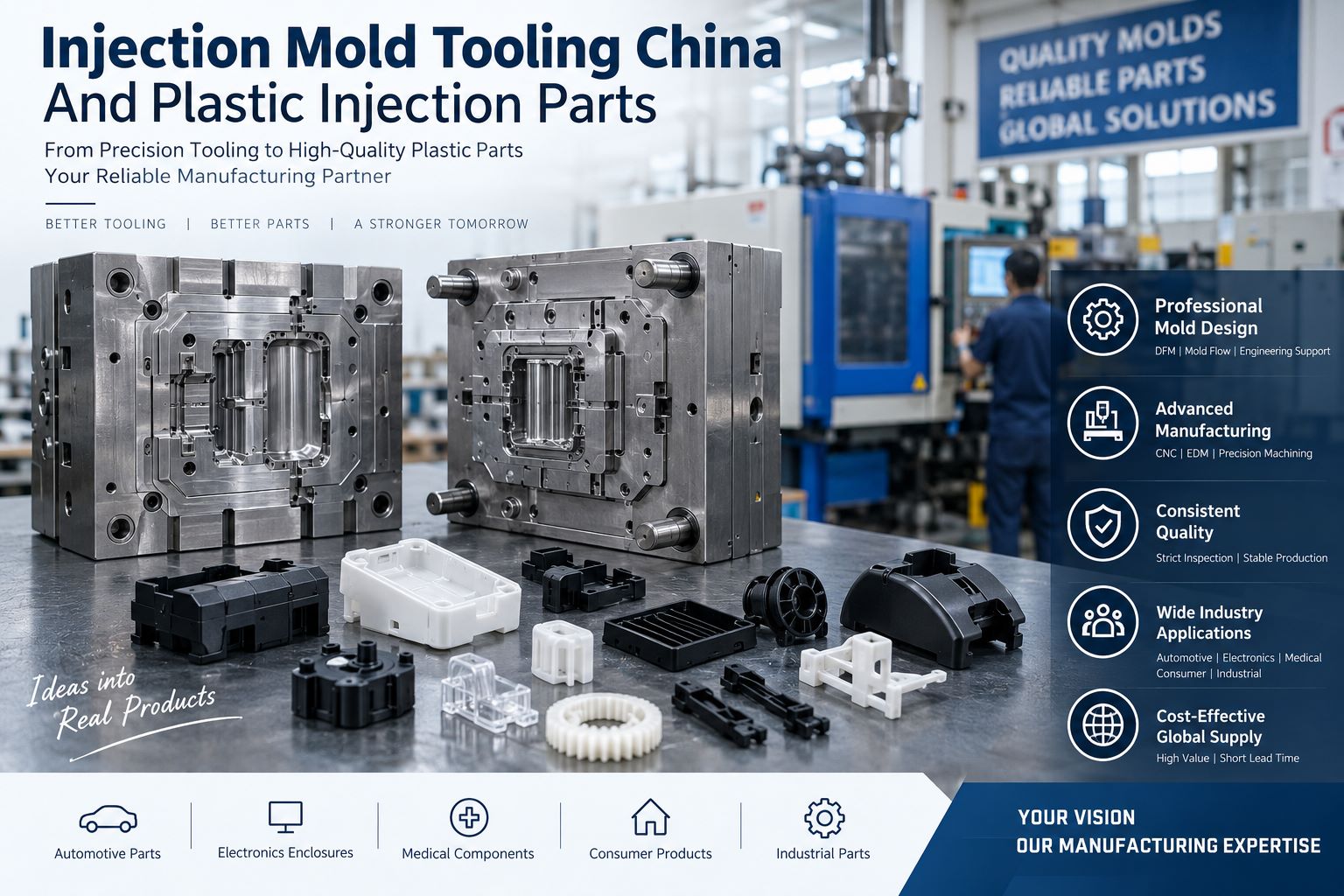
Creating a successful plastic product is not simply about choosing a material and starting production. The real foundation is built much earlier—during product engineering, mold development, material evaluation, testing, and process optimization. This is why many global manufacturers consider experienced Injection Mold Tooling China suppliers when developing custom products for automotive, electronics, appliances, industrial equipment, and consumer markets.
At the same time, producing dependable Plastic Injection Parts requires much more than an accurate mold. Material behavior, machine settings, cooling efficiency, shrinkage, tolerances, and inspection standards all influence the final result.
This blog explains the complete journey from an initial product idea to repeatable injection-molded components and highlights the decisions that can make a manufacturing project more efficient.
A Product Idea Must Become a Production-Ready Design
Every injection molding project starts with a design, but not every design is immediately suitable for manufacturing.
An industrial designer may focus primarily on appearance and functionality, while a tooling engineer must consider how molten plastic will enter the mold, cool, shrink, and eventually leave the cavity.
Before starting Injection Mold Tooling China development, manufacturers usually review the product for issues related to wall thickness, sharp corners, ribs, bosses, undercuts, draft, gate locations, and ejection.
This early engineering review is valuable because modifying a digital model is normally easier and less expensive than modifying completed tooling.
DFM Helps Prevent Expensive Tooling Problems
Design for Manufacturability, or DFM, connects product design with real-world manufacturing requirements.
During a DFM review, tooling engineers examine whether the component can be molded reliably and repeatedly.
Important areas include wall uniformity, parting lines, ejector marks, dimensional tolerances, surface requirements, mold movement, and areas where plastic flow may become difficult.
For Plastic Injection Parts, a strong DFM process can help reduce defects while simplifying tooling construction.
It may also identify features that unnecessarily increase mold complexity.
For example, an undercut may require an additional slide or lifter. If that feature can be redesigned without affecting product function, tooling may become simpler and easier to maintain.
Tooling Material Should Match Production Goals
Not every mold requires the same steel or construction method.
Tooling material should be selected according to expected production volume, plastic resin, part geometry, surface requirements, and durability expectations.
For prototype quantities, lower-volume tooling may be sufficient. High-volume manufacturing normally requires mold materials capable of handling repeated production cycles and wear.
A reliable Injection Mold Tooling China supplier should evaluate expected mold life instead of selecting steel based only on initial cost.
The plastic material also influences this decision. Filled engineering resins, for example, can create more tooling wear than some standard thermoplastics.
Choosing suitable tooling materials from the beginning can reduce maintenance requirements and unexpected production interruptions.
Accurate Mold Construction Requires Multiple Technologies
Injection molds are complex assemblies containing numerous accurately manufactured components.
Modern mold production may involve CNC milling, EDM, wire EDM, grinding, drilling, polishing, fitting, and dimensional inspection.
The core and cavity must reproduce the product geometry accurately, while moving components such as slides and lifters must operate smoothly.
Cooling channels, ejector pins, gates, runners, inserts, guide components, and mold bases must also work together correctly.
This means Injection Mold Tooling China manufacturing is not simply machining a block of steel. It is a coordinated engineering process where multiple systems must perform as one production tool.
Material Behavior Shapes the Final Component
Choosing plastic material requires understanding how the finished component will be used.
Common materials include ABS, polypropylene, polycarbonate, nylon, POM, polyethylene, and thermoplastic elastomers.
Different polymers behave differently when heated, injected, cooled, and used in real environments.
| Material | Important Characteristic | Common Use |
| ABS | Tough with good appearance | Appliance and electronic housings |
| PP | Lightweight and chemical resistant | Containers and automotive parts |
| PC | High impact resistance | Protective components |
| Nylon | Strong and wear resistant | Mechanical components |
| POM | Dimensional stability and low friction | Precision parts and gears |
| TPE | Soft and flexible | Seals and grips |
For high-quality Plastic Injection Parts, material selection should consider operating temperature, mechanical strength, chemical exposure, flexibility, appearance, dimensional stability, and regulatory requirements.
Flow and Gate Design Influence Product Quality
Molten plastic must travel through the mold and completely fill the cavity before it begins to solidify.
Gate location therefore has a significant influence on molded component quality.
Poor gate placement can contribute to visible marks, weld lines, incomplete filling, air traps, or uneven packing.
Engineers may use simulation and previous tooling experience to determine suitable gate locations.
Runner design is also important, particularly in multi-cavity molds where every cavity should receive balanced material flow.
Well-planned flow systems help Plastic Injection Parts achieve more consistent dimensions and appearance.
Cooling Is a Major Factor in Production Efficiency
After molten resin fills the mold cavity, it must cool enough for the component to maintain its shape when removed.
Cooling often represents a significant part of total cycle time.
If cooling is too slow, production capacity decreases. If cooling is uneven, components may warp or shrink inconsistently.
Well-designed cooling channels can help remove heat efficiently from important mold areas.
For manufacturers producing large quantities of Plastic Injection Parts, even a small cycle-time improvement can create meaningful production savings over thousands of manufacturing cycles.
Testing the Mold Before Mass Production
A newly completed mold should not move directly into large-scale production.
Mold trials are conducted to identify tooling and processing issues.
During testing, engineers evaluate how the mold fills, packs, cools, opens, and ejects components.
Sample products are then inspected for dimensional accuracy and visual defects.
Typical checks can include:
- Dimensions and tolerances
- Surface appearance
- Flash or sink marks
- Warpage
- Part weight
- Ejection marks
- Color consistency
- Assembly fit
- Functional performance
Trial findings may lead to mold adjustments or changes in processing parameters before customer approval.
Production Consistency Matters More Than One Good Sample
Producing one acceptable component is relatively easy compared with producing thousands of consistent components.
Stable mass production requires repeatable control over material preparation, melt temperature, mold temperature, injection pressure, holding pressure, cooling time, and machine operation.
Manufacturers should therefore monitor production processes rather than relying only on final inspection.
For Plastic Injection Parts, statistical measurements and regular inspections can help detect dimensional drift or process changes before they create larger quality problems.
Consistent documentation also helps manufacturing teams reproduce proven processing conditions during future production runs.
Mold Maintenance Protects Long-Term Performance
Injection molds require maintenance just like other production equipment.
Repeated opening, closing, heating, cooling, and plastic flow can eventually create wear.
Slides may require lubrication, vents may need cleaning, cooling channels can require inspection, and mold surfaces should be protected against corrosion.
Regular maintenance can extend tooling life and help preserve product quality.
When working with an Injection Mold Tooling China manufacturer, customers should discuss mold maintenance expectations, spare components, and repair support before high-volume manufacturing begins.
Selecting a Suitable Manufacturing Partner
Finding the lowest tooling quotation does not necessarily produce the lowest overall manufacturing cost.
A poorly designed mold can create slower cycles, higher rejection rates, frequent repairs, and inconsistent components.
Businesses should instead evaluate the complete manufacturing capability of a potential supplier.
Engineering experience, mold-making equipment, inspection facilities, material knowledge, project communication, sampling procedures, documentation, and production capacity are all important.
A technically capable supplier should also be able to explain manufacturing risks rather than simply accepting every drawing without review.
Frequently Asked Questions
1. What is Injection Mold Tooling China?
Injection Mold Tooling China describes mold design and manufacturing services provided by Chinese companies specializing in plastic injection tooling.
2. Why is mold design important?
Mold design affects filling, cooling, ejection, dimensions, appearance, and overall manufacturing stability.
3. What are Plastic Injection Parts?
Plastic Injection Parts are components manufactured by injecting molten thermoplastic material into a precision mold cavity.
4. What is DFM in injection molding?
DFM is a design review used to identify manufacturing issues before mold construction begins.
5. Why are draft angles necessary?
Draft angles help components release from mold surfaces during ejection.
6. Can injection molding produce small precision components?
Yes. Proper tooling, machines, materials, and process control can produce highly detailed precision components.
7. What causes plastic parts to warp?
Uneven cooling, material shrinkage, component geometry, and processing conditions can contribute to warpage.
8. What is the purpose of a mold trial?
A mold trial verifies tooling performance and allows manufacturers to evaluate sample components before mass production.
9. Can different colors be used in injection molding?
Yes. Manufacturers can use suitable color concentrates or pre-colored materials according to product specifications.
10. How should an injection mold be maintained?
Regular cleaning, lubrication, inspection, corrosion protection, and replacement of worn components can help preserve mold performance.