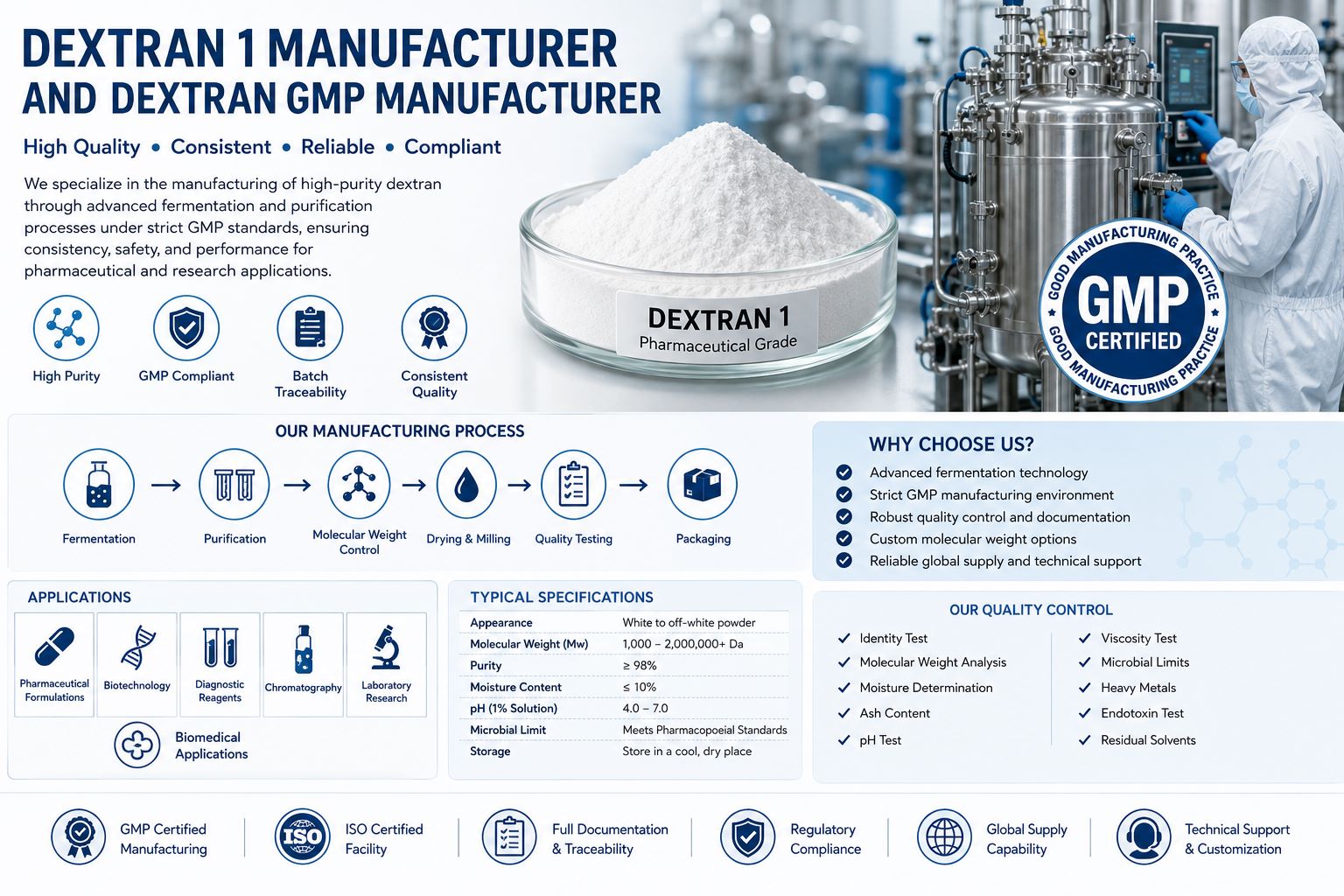
Finding the right raw-material supplier is one of the most important decisions in pharmaceutical and biotechnology development. A material may look suitable on a specification sheet, but its actual value depends on consistent manufacturing, reliable testing, traceability, documentation, and long-term supply capability.
Dextran is a good example. This glucose-based polysaccharide is available in different molecular weights and quality grades for various scientific and technical applications. As a result, selecting a dextran 1 manufacturer should involve considerably more evaluation than comparing quotations.
For regulated applications, organizations may also need a qualified dextran GMP manufacturer capable of providing controlled manufacturing and appropriate quality documentation.
This guest post explores the major factors buyers should consider before establishing a dextran supply partnership.
Why Choosing the Right Dextran Supplier Matters
Dextran is primarily composed of glucose units and is commonly produced through microbial fermentation. Its properties can vary according to molecular characteristics, manufacturing conditions, purification methods, and finished-product specifications.
Important quality characteristics may include:
- Molecular weight
- Molecular weight distribution
- Purity
- Solubility
- Viscosity
- Moisture
- Microbial quality
- Physical characteristics
- Relevant impurities
For research applications, certain specifications may be sufficient. Pharmaceutical or regulated applications, however, can require tighter controls and more extensive documentation.
A dependable dextran 1 manufacturer should therefore understand the intended application and provide clear technical information about the supplied material.
Look Beyond the Product Specification Sheet
A specification sheet is an important starting point, but it does not explain everything about manufacturing quality.
Two suppliers could theoretically offer dextran with similar specifications while operating very different manufacturing and quality systems.
Ask How the Dextran Is Manufactured
Commercial dextran production typically begins with controlled microbial fermentation using an appropriate carbohydrate-containing substrate.
Manufacturers may control parameters such as:
- Temperature
- pH
- Nutrient conditions
- Substrate concentration
- Fermentation time
- Microbial culture conditions
Process control matters because variation during fermentation can potentially influence the resulting material.
Examine Downstream Processing Capabilities
After fermentation, dextran must be separated from other components in the process mixture.
Potential downstream stages can include filtration, precipitation, separation, washing, concentration, membrane processing, additional purification, and drying.
Purification Should Never Be an Afterthought
The quality of purification can influence the characteristics of the finished product.
When evaluating a dextran GMP manufacturer, buyers should therefore consider how manufacturing and purification processes are controlled rather than focusing exclusively on final test results.
Pay Close Attention to Molecular Weight
Molecular weight is one of the most important factors when selecting dextran.
Different molecular characteristics can influence viscosity, solubility, diffusion, processing behavior, and functional performance.
This means one dextran grade cannot automatically replace another.
A qualified dextran 1 manufacturer should clearly define the molecular characteristics associated with the supplied grade and use appropriate analytical techniques to monitor consistency.
Molecular weight distribution can also be relevant because it provides additional information about the range of polymer sizes within a sample.
Understand What GMP Manufacturing Really Means
Good Manufacturing Practice is frequently mentioned in pharmaceutical procurement, but GMP should not be viewed simply as a marketing label.
A dextran GMP manufacturer operates within a structured quality framework covering relevant aspects of production.
| GMP Area | What Buyers Should Look For |
| Raw Materials | Defined qualification procedures |
| Personnel | Appropriate training |
| Equipment | Controlled maintenance and use |
| Production | Documented manufacturing procedures |
| Cleaning | Established cleaning controls |
| Testing | Defined analytical procedures |
| Documentation | Traceable records |
| Deviations | Investigation procedures |
| Changes | Formal change control |
| Release | Quality review before distribution |
These controls provide greater visibility into how consistently the material is manufactured.
Evaluate the Manufacturer’s Analytical Capabilities
Testing provides evidence that a production batch meets predetermined requirements.
Depending on grade and intended use, dextran may be evaluated for parameters such as:
- Identity
- Appearance
- Molecular characteristics
- Moisture content
- Solubility
- pH
- Viscosity
- Microbial characteristics
- Relevant impurities
Buyers should understand which tests are routinely performed and whether the analytical approach is suitable for their intended application.
A professional dextran GMP manufacturer should be able to discuss its testing strategy and relevant product specifications.
Never Underestimate Batch-to-Batch Consistency
A successful development project may eventually move from laboratory scale to routine commercial production.
At that stage, inconsistent raw materials can become particularly problematic.
Reliable manufacturers focus on producing material that repeatedly conforms to established specifications.
Why Consistency Matters
Consistent raw-material characteristics can help organizations maintain predictable downstream processes and reduce unnecessary variability.
When qualifying a dextran 1 manufacturer, buyers should consider historical manufacturing capability rather than evaluating only a single sample.
Check the Documentation Before You Buy
Documentation requirements should ideally be discussed during supplier qualification.
Depending on the grade and intended application, buyers may request:
- Certificate of Analysis
- Product specification
- Safety Data Sheet
- Batch identification
- Storage information
- Quality statements
- Manufacturing information
- Retest or expiry information
- Applicable regulatory documentation
A Certificate of Analysis is particularly important because it generally provides batch-specific analytical results.
However, documentation should be considered together with the manufacturer’s overall quality system.
Make Traceability Part of Supplier Qualification
Imagine receiving a batch and later identifying an unexpected quality issue.
Can the manufacturer trace relevant production records? Are analytical results available? Can important manufacturing information associated with that batch be reviewed?
These questions illustrate the importance of traceability.
A reliable dextran GMP manufacturer should maintain appropriate batch records and quality documentation according to applicable requirements.
Traceability becomes especially valuable for organizations operating within regulated supply chains.
Consider the Intended Application
Dextran can potentially support many scientific and technical applications depending on grade and suitability.
Examples include:
- Pharmaceutical research
- Biotechnology processes
- Diagnostic applications
- Biomedical research
- Laboratory reagents
- Analytical applications
- Chromatography-related processes
- Specialized formulation development
Buyers should avoid assuming that material suitable for general research is automatically suitable for pharmaceutical manufacturing.
Product suitability should be assessed according to specifications, quality requirements, manufacturing standards, and intended use.
Compare GMP and Non-GMP Options Carefully
Not every project requires GMP material.
| Factor | Standard Dextran | GMP Dextran |
| General Research | Often suitable | May exceed requirements |
| Documentation | Supplier dependent | More structured |
| Traceability | Variable | Strongly emphasized |
| Change Control | May vary | Formal process |
| Deviation Management | Variable | Documented |
| Quality Oversight | Manufacturer dependent | Systematic |
| Regulated Use | Requires assessment | Often preferred or required |
The correct choice should be based on technical and regulatory requirements rather than terminology alone.
Think About Long-Term Supply Before Choosing a Supplier
Supplier selection should not focus only on today’s order.
A company may initially need a small development quantity but eventually require significantly larger commercial volumes.
Before approving a dextran 1 manufacturer, consider:
- Current manufacturing capacity
- Scale-up capability
- Lead times
- Batch consistency
- Quality systems
- Packaging options
- Documentation support
- Technical communication
- Supply continuity
- Commercial-volume capability
Changing raw-material suppliers later can introduce additional qualification work. Evaluating scalability early can therefore be beneficial.
Frequently Asked Questions
What is a dextran 1 manufacturer?
A dextran 1 manufacturer produces dextran according to defined molecular, physical, purity, and quality specifications.
What is a dextran GMP manufacturer?
A dextran GMP manufacturer manufactures dextran within applicable Good Manufacturing Practice controls and documented quality systems.
How is dextran normally produced?
Dextran is commonly produced using microbial fermentation followed by purification, downstream processing, drying, testing, and packaging.
Why is molecular weight important?
Molecular weight can influence dextran’s viscosity, solubility, diffusion, processing behavior, and functional characteristics.
Is every dextran product pharmaceutical grade?
No. Dextran grades can differ significantly in specifications, manufacturing controls, purity, testing, documentation, and intended use.
What documents should buyers request?
Common documents include a Certificate of Analysis, specifications, Safety Data Sheet, storage information, and relevant quality documentation.
Why is GMP important?
GMP provides systematic controls for manufacturing, documentation, personnel, equipment, deviations, changes, testing, and product release.
What does batch consistency mean?
It means individual production batches repeatedly conform to predetermined specifications and expected quality characteristics.
Why is traceability important?
Traceability helps connect finished material with relevant manufacturing, testing, raw-material, and quality records.
Is GMP dextran necessary for research?
Not always. The required grade depends on the research purpose, quality expectations, and applicable organizational or regulatory requirements.
What should I ask a dextran supplier?
Ask about molecular specifications, purification, analytical testing, GMP status, documentation, capacity, packaging, traceability, and supply reliability.
How do I compare dextran manufacturers?
Evaluate technical expertise, manufacturing controls, analytical capability, quality systems, documentation, scalability, and long-term supply performance.
https://newsgrow.blogspot.com/2026/08/the-science-behind-reliable-dextran-gmp.html
https://newsgrow.blogspot.com/2026/08/new-procurement-priorities-drive.html