Businesses today depend on fast, reliable information. Whether the goal is to track assets, secure entry points, manage inventory, or monitor movement across a large site, RFID technology has become a powerful solution. Two of the most useful options in this space are the Long Range RFID Reader and the Active RFID Reader.
Both systems are built to improve visibility and reduce manual work, but they serve slightly different needs. If you are trying to understand which one is right for your operation, this guide breaks it down in a simple and useful way.
Why RFID Has Become So Important
RFID, or Radio Frequency Identification, allows data to be transferred wirelessly between a tag and a reader. Unlike barcode systems, RFID does not require direct line-of-sight, which makes it faster and more convenient in busy environments.
That is one reason RFID is now used in warehouses, factories, hospitals, parking systems, retail stores, and transport hubs. It helps organizations save time, improve accuracy, and gain better control over physical assets.
RFID systems usually include:
- RFID tags
- RFID readers
- Antennas
- Tracking software
- Reporting or control platforms
What Is a Long Range RFID Reader?
A Long Range RFID Reader is designed to identify tags from a significant distance. Depending on the configuration, it may read tags from several meters away and, in some installations, from more than 20 meters.
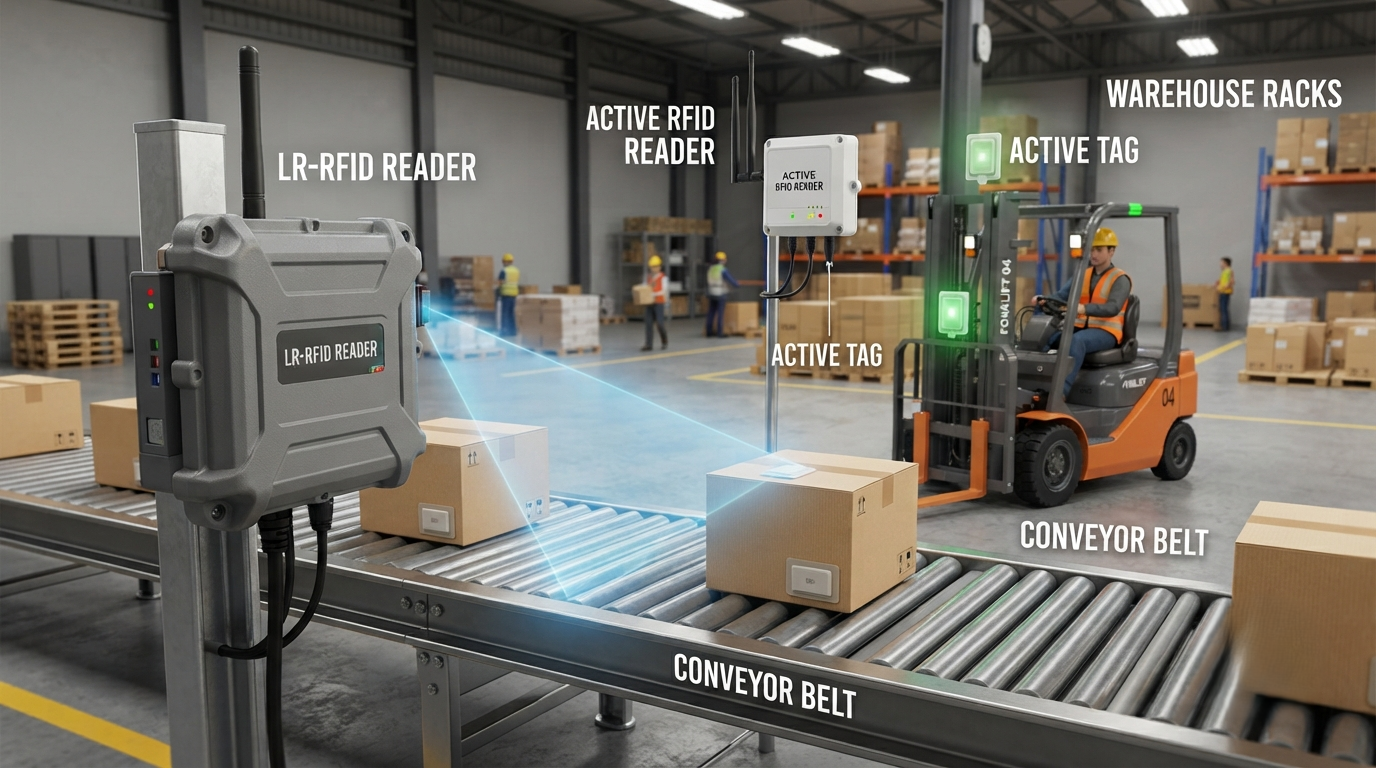
This makes it especially useful in places where people, vehicles, or goods move through a controlled point. Instead of stopping to scan each item, the system can detect and record identification data automatically.
Common advantages of Long Range RFID Readers
- Contactless identification
- Faster processing
- Multi-tag reading
- Lower manual effort
- Better control at checkpoints
- Strong performance in industrial applications
Because of these benefits, long range readers are often used in access control, toll gates, warehouse entry points, and logistics operations.
What Is an Active RFID Reader?
An Active RFID Reader works with active RFID tags, which contain a battery and transmit signals on their own. This gives the system a much greater reading range and better performance in large or complex environments.
Active RFID is especially valuable when real-time tracking matters. For example, companies can monitor expensive equipment, track containers, or follow vehicles across large yards and facilities.
Common advantages of Active RFID Readers
- Long-distance communication
- Real-time visibility
- Better tracking in large areas
- Strong signal performance
- Suitable for high-value assets
- Continuous monitoring capability
For organizations that need more than basic identification, active RFID offers a highly effective solution.
Long Range RFID Reader vs Active RFID Reader
Although these two technologies are related, they are not identical. The biggest difference is the type of tag used and the level of tracking they provide.
| Feature | Long Range RFID Reader | Active RFID Reader |
| Tag Type | Passive RFID tags | Active RFID tags |
| Power Source | No battery in tag | Battery-powered tag |
| Reading Distance | Long range | Very long range |
| Monitoring Style | Event-based | Continuous |
| Cost | More affordable | Higher cost |
| Maintenance | Low | Battery upkeep needed |
| Best For | Gates, logistics, entry points | Real-time asset tracking |
This table shows why both systems have value. The best choice depends on what you are tracking and how much visibility you need.
How a Long Range RFID Reader Works
A Long Range RFID Reader sends out radio signals through an antenna. When a tag enters the signal field, it responds with stored data. The reader captures that information and sends it to software for processing.
The process works like this:
- The reader emits a radio signal.
- The tag responds with its ID.
- The reader captures the returned data.
- The system records the event.
- The software displays or stores the information.
This simple process makes long range RFID a great fit for high-traffic environments where speed matters.
How an Active RFID Reader Works
Active RFID Readers communicate with tags that have their own internal power source. Because the tags transmit signals independently, the reader can detect them from farther away and with greater consistency.
This makes active RFID ideal for tracking items that move across large spaces or need to be monitored continuously.
Active RFID is commonly used for:
- Fleet tracking
- Equipment monitoring
- Hospital assets
- Container movement
- Industrial inventory
- Site security
Key Benefits of RFID Tracking
Businesses choose RFID because it offers real operational value. Instead of relying on manual logs or repeated scanning, RFID creates a smoother and smarter tracking process.
Major benefits include:
- Faster asset identification
- Better inventory accuracy
- Reduced human error
- Lower labor costs
- Improved security
- Greater operational visibility
These advantages can have a direct impact on productivity and business performance.
Where These Technologies Are Used
Warehousing and Logistics
RFID helps track incoming and outgoing goods, improve shipment accuracy, and reduce bottlenecks at loading docks.
Manufacturing
Factories use RFID to monitor tools, machinery, and work-in-progress items throughout the production cycle.
Transportation and Fleet Management
Vehicles, trailers, and containers can be tracked automatically at entry and exit points.
Healthcare
Hospitals use RFID to locate medical devices, manage equipment, and improve workflow efficiency.
Commercial and Institutional Sites
Schools, offices, and large facilities use RFID for access control, attendance, and security.
Choosing the Right RFID Solution
The best RFID system depends on your business goals.
Choose a Long Range RFID Reader if:
- You need automatic identification at fixed points
- You want a cost-effective system
- You use passive RFID tags
- You do not need constant live tracking
Choose an Active RFID Reader if:
- You need real-time visibility
- You track expensive or critical assets
- You operate in a large facility
- You need stronger range and continuous updates
Understanding your environment and tracking needs will help you make the right decision.
Tips for Successful RFID Deployment
To get the best performance from your RFID system, planning matters. A well-installed system is more accurate and easier to manage.
Helpful deployment tips
- Study the site before installation
- Choose the correct tag type
- Position antennas carefully
- Test the reading range in real conditions
- Connect the system to your software platform
- Review data regularly
- Train staff on proper use
Small setup choices can make a big difference
Even a strong RFID system can underperform if antennas, tags, or reader placement are not configured properly.
The Future of RFID
RFID technology continues to grow as businesses adopt automation, cloud systems, and connected devices. Future RFID solutions are likely to become even more intelligent and useful.
Trends shaping the future include:
- IoT-connected tracking
- Cloud-based dashboards
- Better analytics
- Predictive monitoring
- Smarter inventory control
- More automated workflows
As these tools improve, RFID will become an even more important part of modern business operations.
FAQ
1. What is a Long Range RFID Reader?
It is a reader that can detect RFID tags from a greater distance than standard systems.
2. What is an Active RFID Reader?
It is a reader that works with battery-powered active tags for long-distance tracking.
3. Which one is better for real-time tracking?
An Active RFID Reader is better for continuous and real-time monitoring.
4. Can a Long Range RFID Reader read multiple tags?
Yes, many models can read multiple tags at once.
5. Is RFID useful for warehouses?
Yes, RFID improves stock accuracy and speeds up operations.
6. Do active RFID tags need batteries?
Yes, active tags contain batteries and require maintenance over time.
7. Can RFID work outdoors?
Yes, many systems are designed for outdoor and industrial use.
8. Is RFID secure?
Yes, RFID systems can be configured with secure access and data protection features.
9. Which industries use RFID most often?
Logistics, manufacturing, healthcare, transportation, and retail are major users.
10. How do I choose between the two?
Choose based on range, budget, asset value, and whether you need live tracking.
Read more – https://newsgrow.blogspot.com/2026/08/long-range-rfid-reader-and-active-rfid.html
https://blogstream.net/long-range-rfid-reader-and-active-rfid-reader-a-smarter-way-to-track-assets/