The manufacturing industry is continuously adopting advanced technologies to improve productivity, material efficiency, and product quality. Among the most important innovations in plastic processing and polymer manufacturing are the twin extruder and single extruder systems. These extrusion machines have transformed how industries produce pipes, profiles, sheets, films, packaging materials, and customized plastic components.
While both technologies serve the purpose of melting, mixing, and shaping raw materials into finished products, their designs, capabilities, and applications are significantly different. Understanding the difference between a twin extruder and a single extruder helps manufacturers choose the right solution based on production requirements, material characteristics, and performance expectations.
With increasing demand for high-quality plastic products, energy-efficient production, and advanced material processing, extrusion technology continues to evolve toward smarter and more sustainable manufacturing solutions.
Understanding Single Extruder Technology
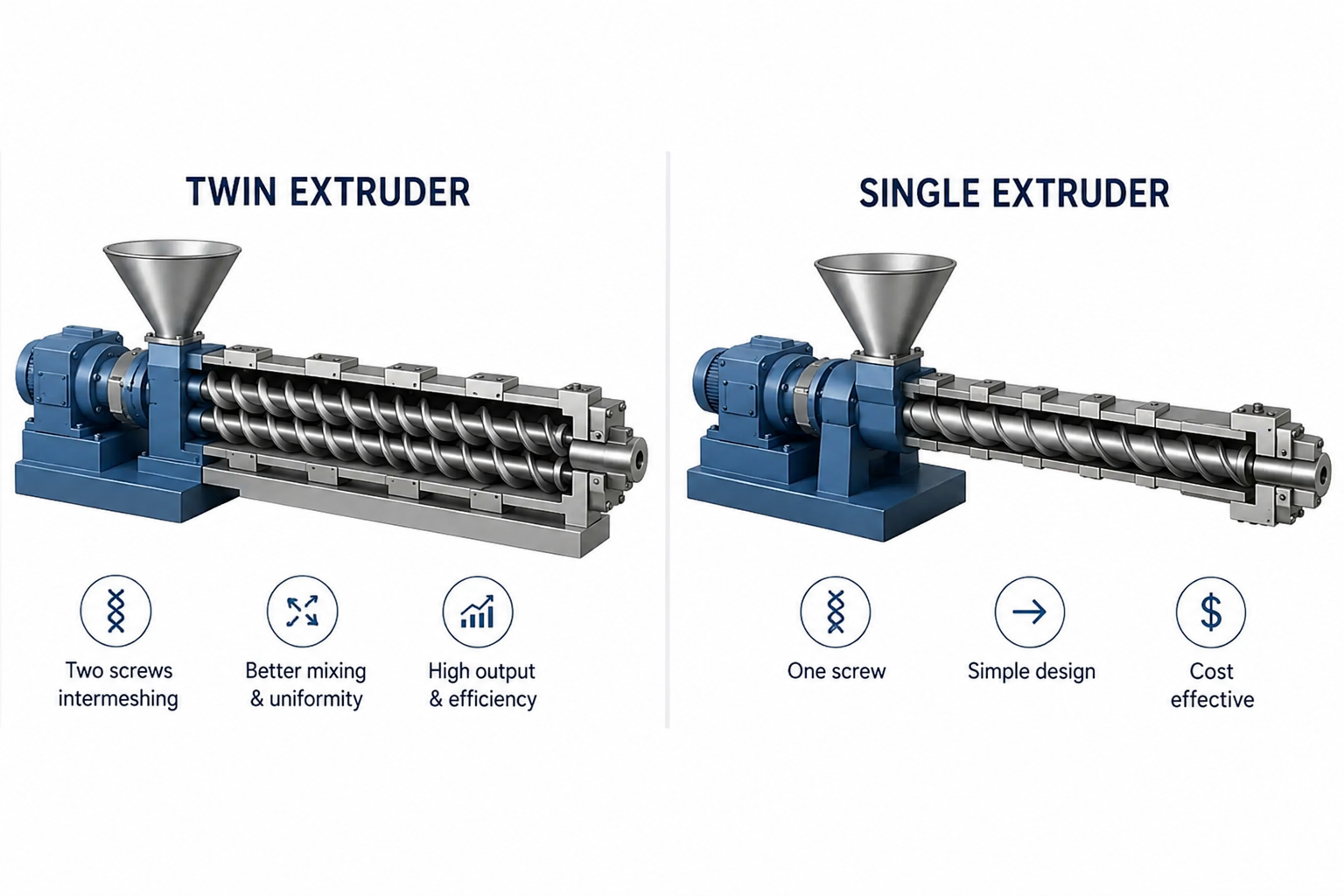
A single extruder is one of the most commonly used extrusion machines in the plastic processing industry. It operates with one rotating screw inside a heated barrel to melt, transport, and shape plastic materials.
The simple design of a single extruder makes it reliable, cost-effective, and easy to maintain. It is widely used for applications where consistent melting and shaping are required without complex material blending.
Advantages of Single Extruder Systems
- Simple machine structure
- Lower investment cost
- Easy operation and maintenance
- Suitable for standard plastic materials
- Lower energy consumption for basic applications
- Reliable production performance
Common Applications of Single Extruders
Single extruder technology is commonly used in:
- Plastic pipes manufacturing
- Film production
- Sheet extrusion
- Wire and cable coating
- Plastic profiles
- Basic packaging products
Understanding Twin Extruder Technology
A twin extruder uses two parallel or conical screws working together inside a barrel. This advanced extrusion system provides improved mixing, better material control, and higher processing flexibility compared to traditional single-screw machines.
The growing demand for engineered plastics, recycled materials, and specialized compounds has increased the popularity of twin extruder technology across multiple industries.
Industries Using Twin Extruder Technology
A twin extruder is widely used in:
- Plastic compounding
- Polymer blending
- Automotive plastic manufacturing
- Medical plastic processing
- Recycled plastic production
- Masterbatch production
- Engineering plastics
Twin Extruder And Single Extruder: Key Differences
| Feature | Single Extruder | Twin Extruder |
| Screw Design | One screw system | Two screw system |
| Mixing Ability | Standard mixing | Advanced mixing performance |
| Material Processing | Suitable for simple materials | Suitable for complex materials |
| Production Cost | Lower investment | Higher initial investment |
| Maintenance | Easier maintenance | Requires skilled maintenance |
| Energy Efficiency | Effective for basic production | Efficient for advanced processing |
| Application Range | Limited applications | Wide industrial applications |
| Additive Dispersion | Moderate | Excellent |
Why Industries Are Choosing Advanced Extrusion Solutions
Modern manufacturers are focusing on improving efficiency, reducing waste, and achieving consistent product quality. This has increased demand for advanced extrusion systems.
Key reasons industries are upgrading include:
1. Better Material Performance
Advanced extrusion machines help manufacturers achieve improved strength, durability, and stability in final products.
2. Increased Production Efficiency
Modern extrusion technology allows continuous production with reduced downtime.
3. Sustainable Manufacturing
Both twin extruder and improved single extruder systems support recycling and efficient material utilization.
4. Customized Product Development
Manufacturers can process different polymers and additives to create specialized products.
Future Trends of Twin Extruder And Single Extruder Technology
The future of extrusion technology is focused on automation, sustainability, and smart manufacturing.
Smart Extrusion Systems
Artificial intelligence, sensors, and digital monitoring systems are improving extrusion control and reducing production errors.
Sustainable Material Processing
Manufacturers are increasingly using extrusion machines for recycled plastics and environmentally friendly materials.
Energy-Efficient Designs
New-generation machines are designed to reduce power consumption while maintaining high production output.
Advanced Polymer Applications
Growing demand for lightweight automotive parts, medical products, and high-performance materials will continue driving extrusion innovation.
How to Select Between Twin Extruder And Single Extruder
Choosing the right extrusion system depends on several factors:
Consider These Points:
Material Type
Simple polymers may require a single extruder, while complex blends often need a twin extruder.
Production Requirements
High-volume and specialized production may benefit from advanced extrusion technology.
Budget Considerations
Single extruders are economical, while twin extruders provide additional processing advantages.
Product Quality Expectations
Applications requiring precise material properties often require twin-screw processing.
Expert Tips for Improving Extrusion Performance
Manufacturers can improve extrusion efficiency by following these practices:
- Regular machine maintenance
- Proper temperature control
- Selecting suitable screw designs
- Monitoring production parameters
- Using high-quality raw materials
- Training operators effectively
Frequently Asked Questions (FAQ)
1. What is a twin extruder?
A twin extruder is an extrusion machine that uses two screws to provide better mixing, processing control, and material flexibility.
2. What is a single extruder?
A single extruder is a machine that uses one screw to melt and shape plastic materials into different products.
3. Which is better, twin extruder or single extruder?
The better option depends on production needs. A single extruder is suitable for basic applications, while a twin extruder is better for complex materials and advanced processing.
4. Is a twin extruder more expensive than a single extruder?
Yes, a twin extruder generally requires higher investment because of its advanced design and processing capabilities.
5. Can a single extruder process recycled plastics?
Yes, many single extruder systems can process recycled materials, depending on material quality and machine configuration.
6. Why is twin extrusion preferred for plastic compounding?
A twin extruder provides stronger mixing and better dispersion of additives, making it ideal for compounding applications.
7. Which extruder requires more maintenance?
Twin extruders usually require more technical maintenance because of their complex screw systems.
8. Are extrusion machines energy efficient?
Modern extrusion systems are designed with energy-saving technology to reduce power consumption.
9. What industries use single extruders?
Single extruders are commonly used in pipe production, film manufacturing, profiles, and cable coating industries.
10. What industries benefit from twin extruders?
Industries such as automotive, packaging, recycling, medical plastics, and polymer manufacturing use twin extruder technology.