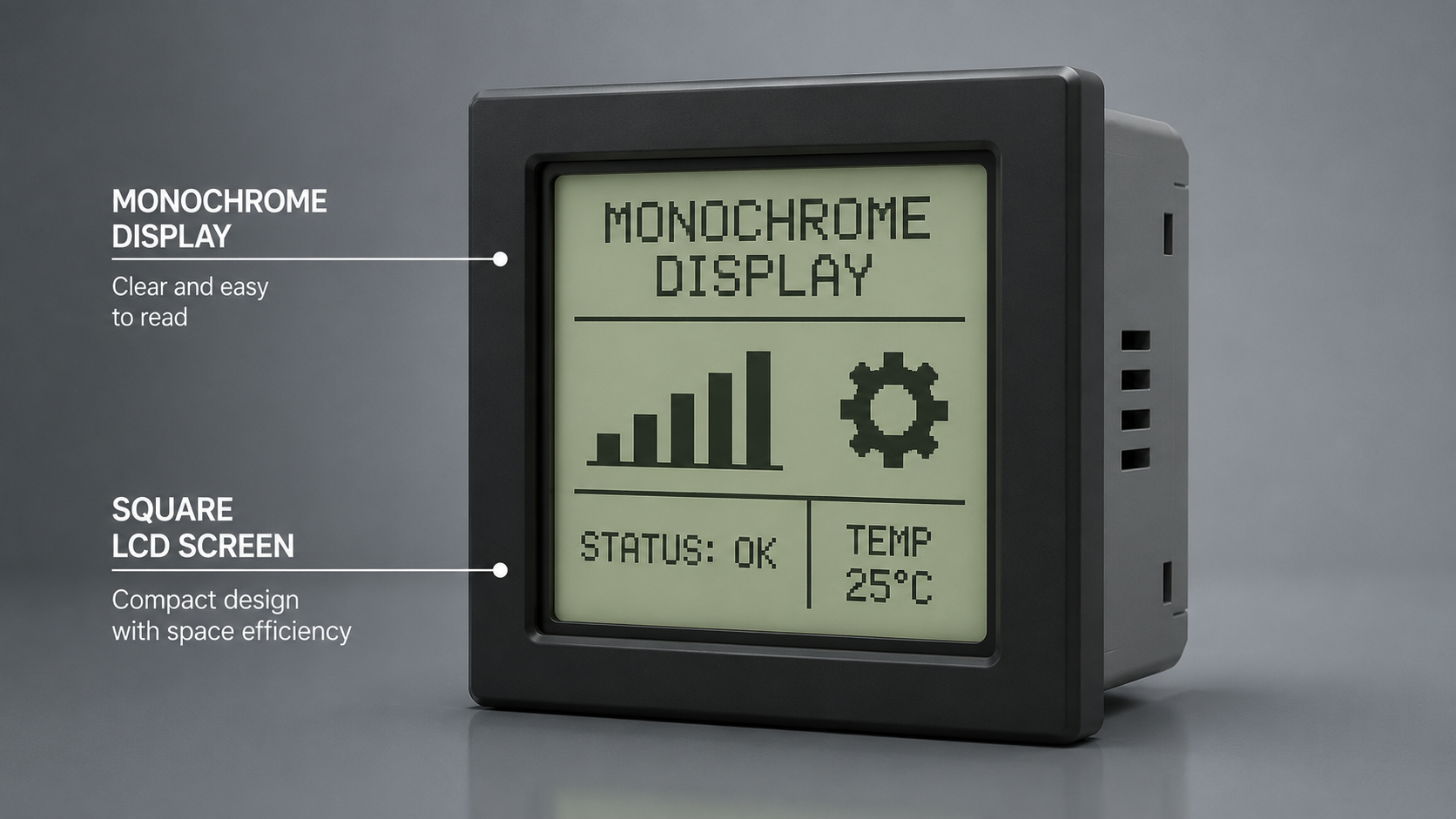
Technology moves fast, but not every innovation replaces what came before. While colorful OLED and AMOLED screens dominate smartphones and entertainment devices, the Monochrome Display continues to be the preferred solution for industries where reliability, readability, and energy efficiency matter most. Pair that with the growing popularity of the Square LCD Screen, and manufacturers have a display solution that perfectly balances performance, cost, and modern design.
Whether you’re developing industrial equipment, medical devices, smart home products, or IoT systems, understanding these display technologies can help you build better products.
What Makes a Monochrome Display Different?
A Monochrome Display shows information using one display color against a contrasting background. Instead of displaying millions of colors, it focuses on delivering crisp text, symbols, and graphics with exceptional clarity.
This simplicity offers major advantages:
- Lower power consumption
- Faster readability
- Longer operating life
- Reduced manufacturing costs
- Stable performance in harsh environments
For applications where information matters more than visual effects, monochrome technology remains one of the best choices available.
The Rising Popularity of Square LCD Screen Designs
The demand for the Square LCD Screen has increased significantly as electronic devices become smaller and more sophisticated.
Unlike traditional rectangular displays, square screens provide:
- Balanced interface layouts
- Better utilization of available space
- Modern product aesthetics
- Easier integration into compact enclosures
- Flexible UI design
Today, square LCDs are widely used in industrial automation, medical instruments, smart appliances, digital control panels, and wearable electronics.
How Does a Monochrome Display Work?
Every monochrome LCD is built around liquid crystal technology.
Inside the display:
- Liquid crystal molecules sit between two glass layers.
- Transparent electrodes apply electrical voltage.
- Polarized light passes through the liquid crystals.
- Each pixel either blocks or transmits light.
- Thousands of pixels work together to display text and graphics.
Because LCDs manipulate light instead of generating it, they require very little energy, making them ideal for battery-powered devices.
Exploring Different Monochrome Display Technologies
Not every monochrome LCD performs the same way. Manufacturers choose different technologies depending on cost, viewing angle, contrast, and operating conditions.
Twisted Nematic (TN)
TN is the most widely used monochrome LCD technology.
It offers:
- Affordable production
- Simple construction
- Fast response
- Reliable performance
Its cost-effectiveness makes it ideal for everyday industrial applications.
Super Twisted Nematic (STN)
STN technology improves optical performance compared to TN.
Benefits include:
- Better contrast
- Lower operating voltage
- Improved battery efficiency
- Enhanced readability
Many portable electronic devices rely on STN displays because they consume less energy while producing sharper images.
Film Super Twisted Nematic (FSTN)
FSTN displays include an additional optical film that improves image quality.
Advantages include:
- Higher contrast
- Sharper text
- Better background color
- Improved visual appearance
This technology is commonly used in premium industrial equipment.
Double Film STN (DFSTN)
DFSTN further enhances contrast by using two compensation films.
It provides:
- Superior readability
- Darker backgrounds
- Higher image clarity
- Professional appearance
Although more expensive, DFSTN displays deliver outstanding performance.
High Twisted Nematic (HTN)
HTN technology is designed for demanding operating conditions.
Its strengths include:
- Extremely low operating voltage
- Wide temperature tolerance
- Reliable long-term operation
Automotive manufacturers frequently choose HTN displays because of their durability.
Positive vs Negative LCD Displays
Choosing between positive and negative display modes affects both appearance and power consumption.
Positive Display
Characteristics include:
- Light background
- Dark characters
- Excellent daylight readability
- Lower energy consumption
Positive displays are ideal for battery-powered products because the backlight can often remain off.
Negative Display
Negative displays feature:
- Dark background
- Bright illuminated characters
- Premium visual appearance
- Better nighttime visibility
These displays require continuous backlighting but offer a sleek, modern look.
Understanding LCD Lighting Technologies
Lighting plays a crucial role in LCD performance.
Reflective LCD
Reflective displays rely entirely on ambient light.
Advantages:
- No backlight required
- Very low power usage
- Excellent outdoor visibility
Transmissive LCD
These displays depend on internal LED backlighting.
Benefits:
- Bright indoor performance
- Uniform illumination
- Easy nighttime viewing
Transflective LCD
Transflective displays combine both technologies.
They can:
- Use sunlight during the day
- Switch to LED backlighting at night
- Reduce overall energy consumption
This makes them ideal for portable devices.
Backlighting Technologies
Modern monochrome LCDs mainly use two backlighting methods.
Edge-Lit LED
LEDs are positioned around the edge of the display.
Benefits include:
- Thin profile
- Low manufacturing cost
- Uniform brightness
- High efficiency
Direct LED Backlighting
LEDs are mounted directly behind the display.
Advantages include:
- Higher brightness
- Better illumination consistency
- Improved image quality
Viewing Angle and Readability
Viewing angle determines how clearly users can read the display from different positions.
Higher-quality LCD technologies provide:
- Better contrast
- Reduced color shift
- Improved readability
- Comfortable viewing from multiple directions
Choosing the correct viewing angle is especially important for industrial and automotive applications.
Color Options for Monochrome Displays
Although monochrome displays use a single active color, manufacturers offer multiple color combinations.
Popular choices include:
- White
- Green
- Blue
- Amber
- Yellow-Green
- Gray
- Black
Different colors improve visibility while matching product branding and application requirements.
Segment, Character, and Graphic LCD Displays
Monochrome displays are available in several formats.
Segment LCD
Best suited for:
- Watches
- Digital clocks
- Calculators
- Thermometers
These displays offer the lowest manufacturing cost.
Character LCD
Character displays show predefined letters and numbers.
Common applications include:
- Industrial controllers
- Embedded systems
- Medical devices
- Laboratory equipment
Graphic LCD
Graphic LCDs provide complete pixel-level control.
They support:
- Logos
- Icons
- Graphs
- Images
- Custom user interfaces
They are ideal for products requiring greater design flexibility.
Where Are Monochrome Display and Square LCD Screen Used?
The combination of Monochrome Display and Square LCD Screen technology serves a wide range of industries.
Typical applications include:
- Industrial automation
- Medical diagnostics
- Automotive dashboards
- Smart home devices
- IoT sensors
- Consumer appliances
- Security equipment
- Laboratory instruments
- Retail systems
- Agricultural electronics
Their reliability and low maintenance make them suitable for continuous operation.
How to Choose the Right LCD Solution
Selecting the right display depends on several important factors.
Consider:
- Operating environment
- Power availability
- Display size
- Viewing angle
- Resolution
- Brightness
- Interface compatibility
- Budget
Matching these specifications to your application ensures long-term performance and user satisfaction.
Why These Technologies Continue to Evolve
Even with the growth of OLED and AMOLED displays, monochrome LCD technology continues to improve through:
- Higher contrast ratios
- Better optical films
- Lower operating voltages
- Enhanced LED efficiency
- Improved Square LCD Screen designs
- Smarter display controllers
- Increased durability
These advancements ensure monochrome displays remain a practical solution for next-generation electronic products.
Read more – https://newsgrow.blogspot.com/2026/07/monochrome-display-and-square-lcd.html https://blogstream.net/monochrome-display-and-square-lcd-screen-why-simplicity-is-driving-the-next-generation-of-smart-devices/