The global manufacturing industry is rapidly embracing advanced production technologies that deliver greater precision, faster turnaround times, and improved operational efficiency. Among the most influential innovations are Zinc Die Casting and precision-engineered Die Casting Mold systems, which continue to redefine how complex metal components are manufactured for today’s competitive industries.
As demand grows for lightweight, durable, and dimensionally accurate products, manufacturers are increasingly adopting zinc die casting technologies that combine engineering excellence with cost-effective mass production. From automotive systems to consumer electronics and industrial equipment, zinc die casting has become a preferred manufacturing process for businesses seeking dependable quality and consistent performance.
Manufacturers Turn to Zinc Die Casting for Superior Performance
Precision has become a defining factor in modern manufacturing. Companies require components that not only meet strict dimensional tolerances but also maintain durability throughout their service life. Zinc Die Casting answers these challenges by enabling the production of highly detailed metal parts with exceptional repeatability.
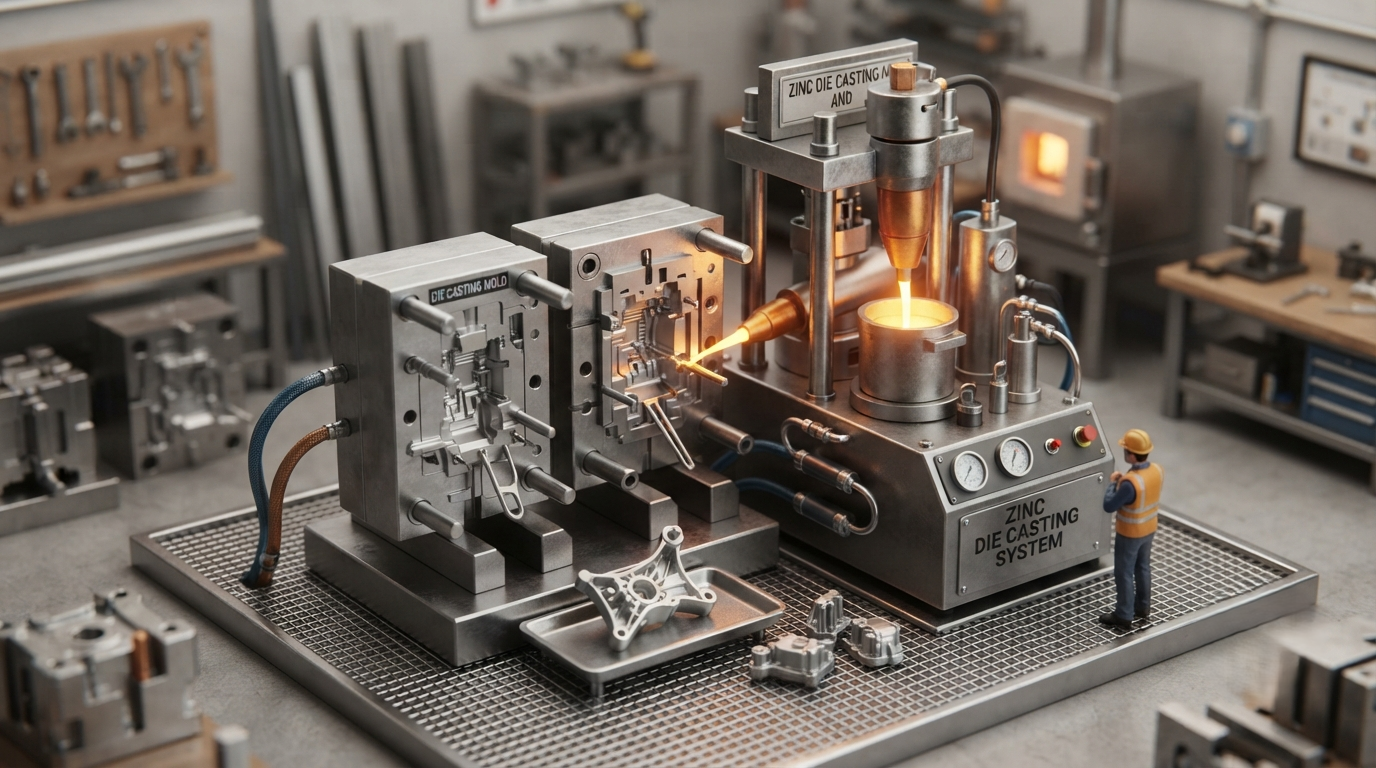
The manufacturing process involves injecting molten zinc alloy into a hardened steel mold under high pressure. This controlled process produces parts with excellent surface finishes, minimal porosity, and outstanding structural integrity while reducing the need for extensive secondary machining.
Industry specialists recognize zinc as one of the most efficient casting materials due to its excellent fluidity, corrosion resistance, strength, and ability to reproduce intricate product designs.
Advanced Die Casting Mold Technology Enhances Production Quality
Behind every successful casting operation is a carefully designed Die Casting Mold. Modern tooling technology has advanced significantly, allowing manufacturers to achieve greater accuracy, faster production cycles, and longer mold service life.
Today’s die casting molds are engineered using sophisticated CAD software, precision CNC machining, and computer-based mold flow analysis. These technologies help optimize metal distribution, cooling efficiency, vent placement, and cavity design before production begins.
Important mold features include:
- Precision-machined steel cavities
- Balanced runner systems
- Optimized gate locations
- High-efficiency cooling channels
- Advanced venting systems
- Durable ejector mechanisms
- Replaceable inserts for extended mold life
These innovations contribute to consistent production quality while reducing downtime and maintenance costs.
Industries Benefiting from Zinc Die Casting Solutions
The versatility of Zinc Die Casting has made it an essential manufacturing solution across a wide range of industries.
Common applications include:
- Automotive engine and transmission components
- Electronic device housings
- Medical equipment parts
- Telecommunications hardware
- Electrical connectors
- Home appliance components
- Architectural hardware
- Furniture accessories
- Industrial machine components
- Security and locking systems
The ability to manufacture intricate designs with exceptional precision continues to expand the adoption of zinc die casting in both established and emerging industries.
Key Advantages Supporting Industry Growth
Manufacturers continue investing in zinc die casting because of the numerous production and business benefits it provides.
Major advantages include:
- High dimensional precision
- Smooth surface finishes
- Excellent mechanical strength
- Outstanding corrosion resistance
- Reduced material waste
- Faster manufacturing cycles
- Lower machining requirements
- Long-lasting tooling
- Consistent production quality
- Cost-effective high-volume manufacturing
These benefits help organizations improve productivity while maintaining strict quality standards.
Zinc Die Casting Compared with Conventional Manufacturing
| Manufacturing Feature | Zinc Die Casting | Conventional Casting |
| Dimensional Accuracy | Excellent | Moderate |
| Surface Finish | Superior | Average |
| Production Speed | High | Lower |
| Material Utilization | Excellent | Moderate |
| Tool Life | Long | Shorter |
| Secondary Machining | Minimal | Higher |
| Production Consistency | Excellent | Variable |
The comparison demonstrates why manufacturers increasingly choose zinc die casting for precision applications requiring efficiency and reliability.
Precision Mold Design Supports Better Manufacturing Results
The effectiveness of a Die Casting Mold directly impacts product quality, production speed, and operational costs. Manufacturers invest considerable engineering expertise to ensure every mold performs efficiently throughout its production life.
Critical design considerations include:
- Optimized wall thickness for uniform solidification.
- Efficient cooling systems to shorten cycle times.
- Strategic gate placement for balanced metal flow.
- Proper venting to reduce trapped gases.
- Premium tool steel for superior durability.
- Precision machining for accurate component dimensions.
These engineering practices help minimize production defects while maximizing manufacturing efficiency.
Innovation Continues to Transform the Industry
The future of Zinc Die Casting is being shaped by digital technologies and intelligent manufacturing systems.
Emerging developments include:
- Artificial intelligence for mold optimization
- Automated casting cells
- Digital process monitoring
- Predictive maintenance solutions
- Smart factory integration
- Advanced zinc alloy development
- Sustainable recycling initiatives
- Energy-efficient melting systems
- Real-time production analytics
- High-speed quality inspection technologies
These advancements are enabling manufacturers to increase productivity while reducing environmental impact.
Frequently Asked Questions
1. What is Zinc Die Casting?
Zinc die casting is a high-pressure manufacturing process that forms precision metal components using molten zinc alloys and hardened steel molds.
2. What is a Die Casting Mold?
A die casting mold is a precision-engineered steel tool used to shape molten metal into finished products.
3. Why is zinc preferred over many other casting metals?
Zinc offers excellent castability, superior surface quality, high strength, corrosion resistance, and long tooling life.
4. Which industries commonly use zinc die casting?
Automotive, electronics, healthcare, telecommunications, industrial machinery, consumer products, and construction industries.
5. Does zinc die casting support complex product designs?
Yes. It is especially effective for manufacturing intricate components with thin walls and tight tolerances.
6. How does mold quality affect manufacturing?
A high-quality mold improves dimensional accuracy, reduces defects, extends tool life, and enhances production efficiency.
7. Is zinc die casting suitable for mass production?
Yes. It is one of the most efficient production methods for large manufacturing volumes.
8. Can zinc die-cast components receive additional finishing?
Yes. Components can be polished, painted, plated, powder-coated, or machined when necessary.
9. Is zinc environmentally sustainable?
Yes. Zinc alloys are recyclable, making the process environmentally responsible and resource-efficient.
10. What should businesses look for in a die casting manufacturer?
Manufacturers should offer advanced tooling capabilities, engineering expertise, strict quality control, modern production facilities, and reliable customer support.
Read more – https://newsgrow.blogspot.com/2026/08/aluminum-die-casting-manufacturer-and.html
https://newsgrow.blogspot.com/2026/08/die-casting-manufacturer-and-die.html
https://newsgrow.blogspot.com/2026/08/zinc-die-casting-and-die-casting-mold.html