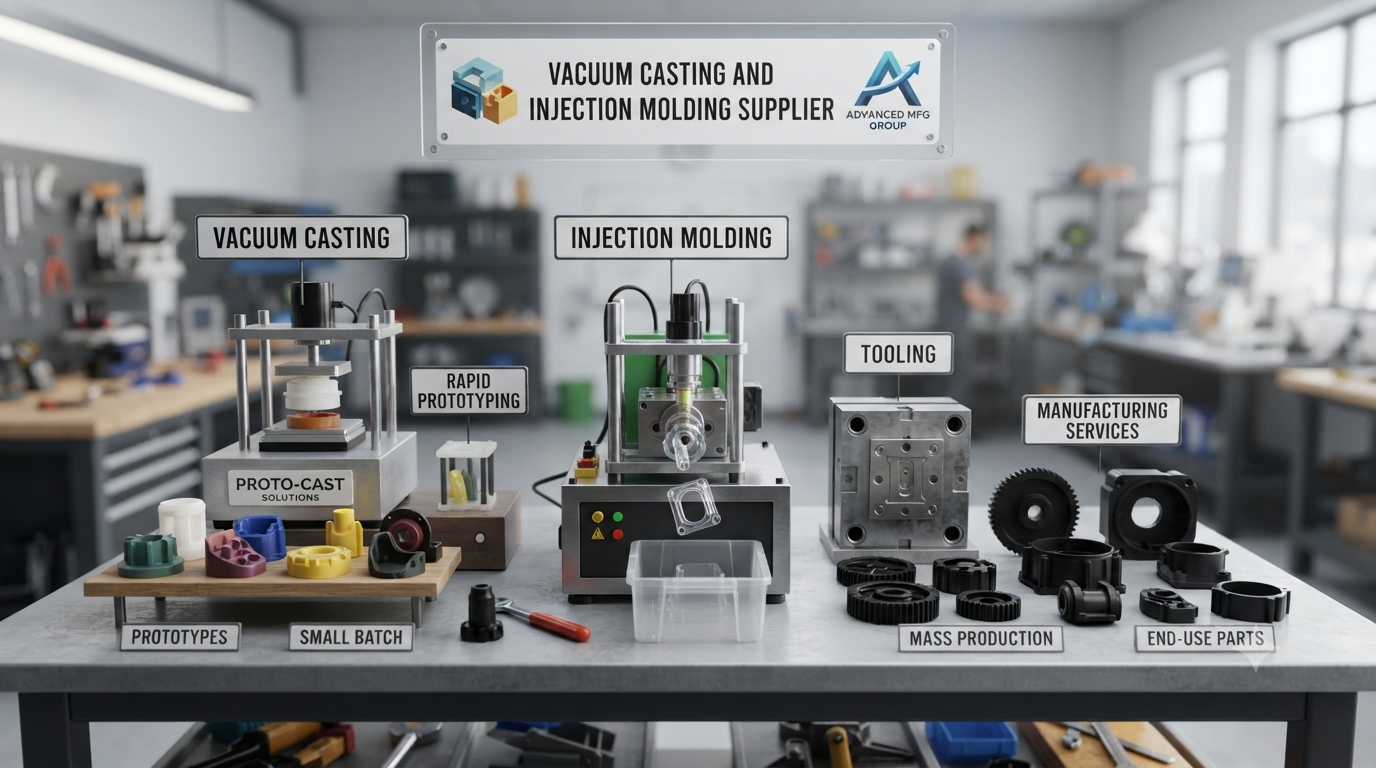
A successful plastic product rarely moves directly from a computer design to mass production. Between those stages, manufacturers need to answer practical questions: Does the product assemble correctly? Is the surface finish suitable? Will users find it comfortable? Can the design be manufactured repeatedly? And, perhaps most importantly, is it sensible to invest in permanent tooling yet?
This is why vacuum casting has become an important option for prototype and low-volume manufacturing, while choosing the right injection molding supplier is critical when a product is ready for scalable production.
Rather than asking which process is universally better, companies should determine which technology matches their current quantity, material, quality, budget and development requirements.
The Manufacturing Gap Between a Prototype and a Finished Product
Early prototypes are excellent for confirming basic dimensions and design ideas. However, there is often a significant gap between an initial prototype and a component ready for commercial production.
A company may need 20, 50 or 100 realistic components before it knows whether investing in production tooling makes commercial sense.
These parts might be needed for:
- Functional testing
- Customer trials
- Investor demonstrations
- Product photography
- Trade exhibitions
- Assembly verification
- Engineering evaluation
- Internal approval
- Limited market launches
Vacuum casting can help address this manufacturing gap.
Instead of immediately producing an expensive metal mould, manufacturers can create silicone tooling and cast a relatively small quantity of realistic parts.
A Closer Look at Vacuum Casting
Vacuum casting is based on a master pattern, typically manufactured using high-resolution 3D printing or CNC machining.
A silicone mould is created around this master. After the silicone has cured, the mould is opened and the original master is removed. The resulting cavity reproduces the geometry of the original component.
Polyurethane resin is then introduced into the silicone mould under controlled vacuum conditions.
Using a vacuum helps reduce trapped air, which is particularly important when reproducing small features, detailed surfaces and complex geometries.
After curing, the component is removed, trimmed and finished according to the project’s requirements.
Why Silicone Tooling Changes the Economics of Small Production Runs
One of the most important differences between vacuum casting and injection moulding is tooling.
Injection moulding normally requires precisely manufactured aluminium or steel moulds. Such tools are designed for repeatable production but require considerably more engineering and machining.
Vacuum casting uses silicone tooling with a shorter working life.
That limitation becomes an advantage when only a small quantity is needed. Businesses do not have to invest in long-life production tooling for a design that may still change.
This makes the process particularly relevant for start-ups, product designers and engineering teams working through development iterations.
What Happens When Production Demand Increases?
The economics begin to change when a company moves from dozens of components to hundreds, thousands or larger quantities.
At this point, the limited life and manual nature of silicone mould production can become restrictive.
An experienced injection molding supplier can provide a more scalable manufacturing solution.
Injection moulding uses controlled heat and pressure to process thermoplastic material. Molten polymer enters an engineered mould cavity, cools into the required geometry and is subsequently ejected.
Once production parameters have been established, the process can repeatedly manufacture components with a high degree of consistency.
Where the Two Technologies Differ
The following comparison provides a practical overview:
| Requirement | Vacuum Casting | Injection Moulding |
| Prototype development | Highly suitable | Possible, but tooling may be excessive |
| Low quantities | Suitable | Depends on tooling economics |
| High quantities | Limited suitability | Highly suitable |
| Tool material | Silicone | Aluminium or steel |
| Design changes | Relatively flexible | More difficult after tooling |
| Material choice | Casting resins | Wide thermoplastic selection |
| Production automation | Limited | High |
| Tool life | Relatively short | Long |
| Upfront investment | Lower | Higher |
| Repeat production | Limited | Excellent |
The most economical process therefore changes as production quantity and product maturity increase.
An Injection Molding Supplier Should Be an Engineering Partner
Finding an injection molding supplier is not simply a purchasing exercise.
A technically strong supplier should review the component before tool manufacturing begins. This helps determine whether the existing design can be moulded reliably or whether modifications should be considered.
For example, the supplier may identify:
- Walls that are unnecessarily thick
- Areas with insufficient draft
- Difficult undercuts
- Poor gate locations
- Weak structural features
- Potential sink marks
- Challenging parting lines
- Ejection difficulties
- Possible warpage
- Unnecessary tooling complexity
Identifying these concerns before manufacturing the mould can be considerably easier than correcting them afterwards.
Why DFM Can Influence Product Quality
Design for Manufacturing, or DFM, connects product design with practical manufacturing requirements.
A product can be visually attractive and functionally correct while still being difficult to injection mould.
Several design details deserve particular attention.
Wall Thickness and Material Flow
Large changes in wall thickness can affect how material fills and cools inside a mould.
Designers therefore need to consider thickness consistency alongside structural requirements.
Draft and Component Release
Vertical surfaces often require draft angles so the finished component can release effectively from the mould.
Ribs and Structural Features
Ribs can improve stiffness without simply increasing the thickness of an entire component.
Their dimensions and positions, however, need careful consideration.
Undercuts and Tool Complexity
Undercuts can require sliders, lifters or other moving mould components. They may be necessary, but unnecessary undercuts can increase tooling complexity and maintenance requirements.
Material Selection Goes Beyond Choosing a Plastic Name
An experienced injection molding supplier should also understand how different polymers behave during manufacturing and use.
Common materials include:
- ABS
- Polypropylene
- Polyethylene
- Polycarbonate
- Nylon
- POM
- PMMA
- TPU
- TPE
- Reinforced engineering polymers
The correct material depends on the application.
For example, a transparent cover may prioritise optical properties, while a mechanical gear may require wear resistance and dimensional stability. A flexible seal has completely different requirements again.
Temperature, chemicals, sunlight, impact, moisture and mechanical loads should therefore be considered before a material is finalised.
How Vacuum Casting Can Prevent Expensive Design Mistakes
Consider a manufacturer developing a new plastic enclosure for an industrial electronic device.
The CAD model appears correct, so the company could immediately commission injection mould tooling.
Instead, it produces 30 units through vacuum casting.
During field evaluation, technicians discover that the enclosure works mechanically but accessing one internal connector is inconvenient. The design team moves an opening and slightly modifies the internal geometry.
Because permanent tooling has not yet been manufactured, the design can be updated before the company makes the larger investment.
This example demonstrates the strategic value of prototype manufacturing. The purpose is not simply to create samples—it is to gather information.
When Should a Business Skip Vacuum Casting?
Although vacuum casting offers valuable flexibility, it is not automatically required for every product.
If a component has already been thoroughly validated, the geometry is stable, suitable materials are established and production quantities are substantial, moving directly towards injection moulding may make more sense.
Similarly, prototype requirements involving properties that must precisely match a specific production thermoplastic may require another prototyping approach.
Manufacturing decisions should therefore be based on technical requirements rather than automatically following the same process for every project.
How to Shortlist an Injection Molding Supplier
A quotation provides useful commercial information, but it should not be the only selection criterion.
Businesses should investigate whether the injection molding supplier can provide:
- Design and DFM support
- Tool engineering expertise
- Suitable injection moulding capacity
- Material processing knowledge
- Dimensional inspection
- Quality documentation
- Surface finishing
- Prototype manufacturing
- Secondary operations
- Assembly services
Communication is equally important. Engineering projects frequently involve drawing revisions, tolerance discussions and material decisions. Clear technical communication can therefore have a direct impact on project efficiency.
What Should Be Included in a Manufacturing Enquiry?
Sending only a product image and asking for a price rarely provides enough information for an accurate manufacturing assessment.
A stronger request should include:
- 3D CAD model
- 2D engineering drawing
- Estimated annual quantity
- Prototype quantity
- Preferred material
- Critical dimensions
- Tolerance requirements
- Surface texture
- Colour
- Functional requirements
- Assembly information
- Target schedule
The more clearly the requirements are defined, the easier it becomes for a manufacturer to recommend between vacuum casting, rapid tooling and production injection moulding.
Frequently Asked Questions
1. Is vacuum casting the same as injection moulding?
No. Vacuum casting normally uses silicone moulds and casting resin, while injection moulding uses metal tooling and thermoplastic materials.
2. Why would a manufacturer choose vacuum casting?
It is useful when realistic components are required in limited quantities without immediately investing in production tooling.
3. Can vacuum casting produce functional components?
Yes, depending on the selected resin, geometry and required operating conditions.
4. Is vacuum casting only for visual prototypes?
No. It can be used for visual models, assembly evaluation, functional prototypes, customer samples and certain low-volume requirements.
5. When should I contact an injection molding supplier?
Ideally, involve an injection molding supplier before finalising the design so manufacturability can be considered early.
6. What is the main advantage of injection moulding?
Its major advantage is repeatable and scalable manufacturing once suitable production tooling and process parameters are established.
7. Is injection moulding always cheaper?
No. Initial tooling can be expensive. Its economic advantages generally become stronger as production quantity increases.
8. Can silicone moulds produce unlimited parts?
No. Silicone tools have a limited working life that varies according to geometry, material and production conditions.
9. Why is DFM necessary?
DFM identifies potential manufacturing challenges before tooling, helping designers optimise components for practical production.
10. Can an injection molding supplier help select materials?
Yes. Experienced suppliers can provide manufacturing input based on mechanical, thermal, cosmetic and environmental requirements.
https://newsgrow.blogspot.com/2026/08/rapid-injection-molding-and-china-rapid.html
https://newsgrow.blogspot.com/2026/08/aluminum-prototype-and-sheet-metal.html
https://newsgrow.blogspot.com/2026/08/deep-information-about-sheet-metal.html
https://newsgrow.blogspot.com/2026/08/vacuum-casting-and-injection-molding.html