
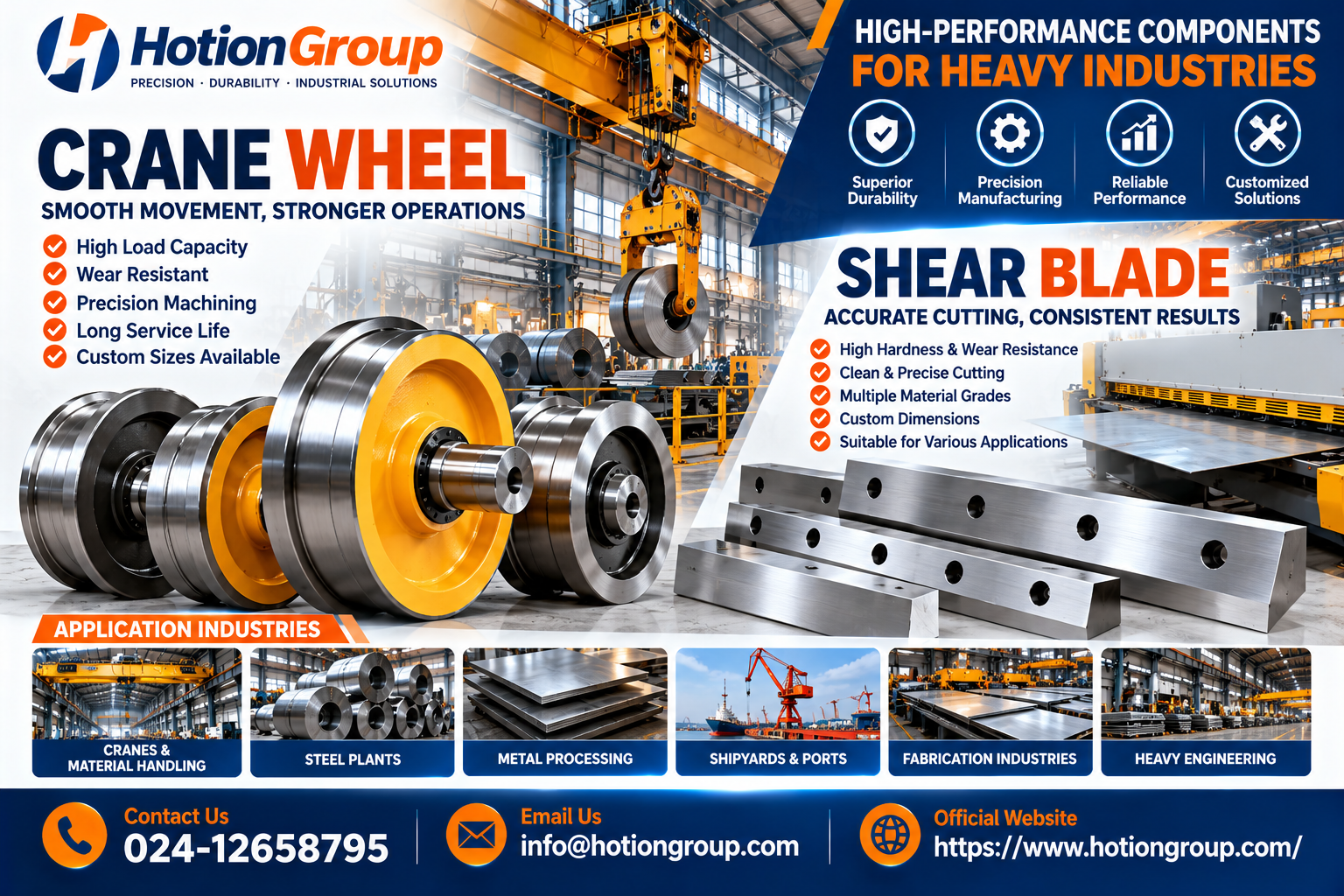
Industrial manufacturers are increasingly focusing on equipment reliability, material quality, and production efficiency. From steel processing facilities to heavy-duty material handling operations, precision-engineered machinery components are essential for maintaining consistent industrial performance.
A Crane Wheel plays an important role in supporting and guiding the movement of overhead cranes, gantry cranes, and other rail-mounted lifting equipment.
Meanwhile, a Shear Blade is a specialized cutting component used in metal processing machinery to cut steel sheets, plates, bars, and other suitable materials.
For industrial equipment manufacturers, steel processing companies, and maintenance professionals, understanding these components helps improve purchasing decisions, equipment reliability, and maintenance planning.
What Is a Crane Wheel?
A Crane Wheel is a heavy-duty mechanical component designed to support and guide the movement of cranes along compatible rails or tracks.
Crane wheels are commonly manufactured from suitable forged or cast steel materials, depending on their design and operating requirements.
Their performance depends on load capacity, material strength, dimensional accuracy, and compatibility with the crane’s rail system.
Common applications include:
- Overhead travelling cranes.
- Gantry cranes.
- Steel manufacturing plants.
- Container handling equipment.
- Industrial warehouses.
- Heavy engineering facilities.
- Port material-handling systems.
The selected wheel must be suitable for the equipment’s operating loads and movement requirements.
Why Crane Wheel Quality Matters
Crane wheels operate under repeated loading and demanding mechanical conditions.
Inadequate material selection or incorrect installation may contribute to excessive wear, unstable movement, and premature component failure.
Load-Bearing Capability
Suitable wheel construction helps support the vertical loads transmitted through the crane structure.
Wear Resistance
Appropriate materials and heat treatment can improve resistance to contact-related wear.
Movement Stability
Correct wheel geometry and rail alignment support controlled crane travel.
Equipment Reliability
Proper component selection and inspection may help reduce unexpected maintenance interruptions.
Operational Safety
Reliable wheel performance is important because crane equipment handles substantial loads.
Manufacturers should evaluate the complete crane system rather than focusing on wheel hardness alone.
Different Types of Crane Wheels
Crane wheels are available in various configurations.
Single-Flanged Wheels: Incorporate a flange on one side for specific rail-guidance applications.
Double-Flanged Wheels: Feature flanges on both sides to provide guidance in suitable crane arrangements.
Flangeless Wheels: Used in selected systems with alternative guidance arrangements.
Forged Steel Wheels: Manufactured through forging processes that can provide suitable mechanical properties.
The appropriate configuration depends on crane design, rail dimensions, operating loads, and manufacturer specifications.
What Is a Shear Blade?
A Shear Blade is an industrial cutting component used in shearing machinery to separate metal materials through controlled mechanical force.
These blades are commonly installed in equipment designed for cutting plates, sheets, strips, and bars.
Typical applications include:
- Steel plate cutting.
- Sheet metal processing.
- Metal fabrication.
- Steel service centers.
- Scrap metal processing.
- Industrial shearing machines.
- Selected rolling mill operations.
The cutting performance depends on blade material, edge geometry, hardness, toughness, and machine setup.
How Does an Industrial Shear Blade Work?
Industrial shearing machines typically use cooperating blades to cut metal through concentrated force.
The cutting process generally involves positioning the material, applying controlled pressure, and separating it along a defined cutting line.
Important operating parameters include:
Blade Clearance: The distance between cutting edges influences cut quality.
Cutting Angle: Blade geometry affects the required cutting force.
Material Thickness: Determines suitable blade and machine specifications.
Material Hardness: Influences cutting resistance and edge wear.
Machine Alignment: Supports accurate and consistent cutting.
Improper settings may contribute to excessive burr formation, dimensional errors, or premature blade damage.
Crane Wheel vs Shear Blade: Key Differences
Both are precision industrial components, but their applications are different.
| Feature | Crane Wheel | Shear Blade |
| Primary function | Supports crane movement | Cuts metal materials |
| Common machinery | Overhead and gantry cranes | Industrial shearing machines |
| Important properties | Strength, fatigue and wear resistance | Hardness, toughness and edge retention |
| Typical materials | Forged or cast steel | Tool steel and specialized alloys |
| Maintenance concern | Tread wear and alignment | Edge wear and cutting clearance |
| Major application | Material handling | Metal cutting and fabrication |
Correct selection requires understanding the operating conditions of each component.
Materials Used in Crane Wheels and Shear Blades
Material quality significantly influences industrial component performance.
Crane wheels may use carbon steel or alloy steel grades selected for strength, fatigue resistance, and suitable surface hardness.
Depending on the application, heat treatment may improve wheel tread durability.
Shear blades may be manufactured using tool steels, alloy steels, or specialized high-performance materials.
Different blade grades provide different balances of wear resistance and toughness.
A blade designed for cold sheet cutting may not be appropriate for high-temperature metal processing.
Therefore, material selection should always match the intended application.
How to Select High-Quality Industrial Components
Industrial buyers should evaluate technical specifications before purchasing machinery replacement parts.
Important considerations include:
- Equipment Compatibility: Confirm machinery model and component dimensions.
- Operating Loads: Evaluate mechanical requirements.
- Material Grade: Select appropriate strength and wear characteristics.
- Heat Treatment: Review applicable hardness requirements.
- Dimensional Accuracy: Confirm manufacturing tolerances.
- Application Conditions: Consider temperature, speed, and material properties.
- Quality Documentation: Request available inspection and material records.
- Supplier Support: Verify technical assistance and replacement arrangements.
Technical drawings and approved specifications can help reduce compatibility problems.
Common Causes of Industrial Component Failure
For a Crane Wheel, common problems include uneven tread wear, rail misalignment, excessive loading, and rolling-contact fatigue.
For a Shear Blade, premature wear may result from inappropriate cutting clearance, incorrect material selection, excessive loading, or inadequate machine alignment.
Regular inspections can identify developing problems before they affect production.
Maintenance personnel should follow the equipment manufacturer’s instructions and appropriate safety procedures.
Maintenance and Quality Control
Preventive maintenance supports operational reliability.
Crane wheel inspections may include checking tread condition, flange wear, alignment, and visible surface damage.
Shear blade inspections should assess cutting-edge condition, mounting security, and cutting performance.
Machinery must be isolated before maintenance. Crane systems present suspended-load hazards, while shearing equipment presents serious crushing and cutting hazards.
Documented inspections and replacement criteria help maintain consistent equipment performance.
Frequently Asked Questions (FAQs)
1. What is a Crane Wheel?
It is a heavy-duty component that supports and guides crane movement along compatible rails or tracks.
2. Where are crane wheels commonly used?
They are used in overhead cranes, gantry cranes, industrial warehouses, steel plants, and material-handling facilities.
3. What is a Shear Blade?
It is an industrial cutting tool used in machinery designed to separate metal sheets, plates, bars, or other suitable materials.
4. Which materials are used for crane wheels?
Crane wheels commonly use suitable carbon steels or alloy steels selected according to operating requirements.
5. Why is heat treatment important for crane wheels?
Appropriate heat treatment can improve tread hardness and resistance to certain wear conditions.
6. What materials are used for shear blades?
Shear blades may use tool steels, alloy steels, and specialized cutting materials depending on the application.
7. What causes crane wheel wear?
Rail misalignment, excessive loading, poor operating conditions, and repeated mechanical contact can contribute to wear.
8. How does blade clearance affect cutting quality?
Incorrect clearance may cause excessive burrs, poor cutting performance, or premature blade damage.
9. Can crane wheels and shear blades be customized?
Yes. Specialized manufacturers may offer application-specific dimensions, materials, and configurations.
10. How can buyers choose a reliable industrial component supplier?
They should compare material specifications, dimensional tolerances, inspection records, equipment compatibility, and technical support.
Media Contact
Industry: Heavy Engineering, Steel Processing, Material Handling & Industrial Manufacturing
Service Enquiries: Crane Wheels, Shear Blades, Heavy Machinery Components, Precision Engineering Parts & Customized Industrial Solutions
Contact Number: 024-12658795
Email: info@hotiongroup.com
Official Website: https://www.hotiongroup.com/