Most people decide whether water is good enough to use by checking three things: how it looks, how it smells and how it tastes. Unfortunately, none of these observations provides a complete picture of water quality.
A glass of water can appear crystal clear while containing high concentrations of dissolved minerals, undesirable chemical substances or microbiological contaminants. This is particularly relevant in a large urban environment where water can come from municipal networks, borewells, tankers, storage tanks and private treatment systems.
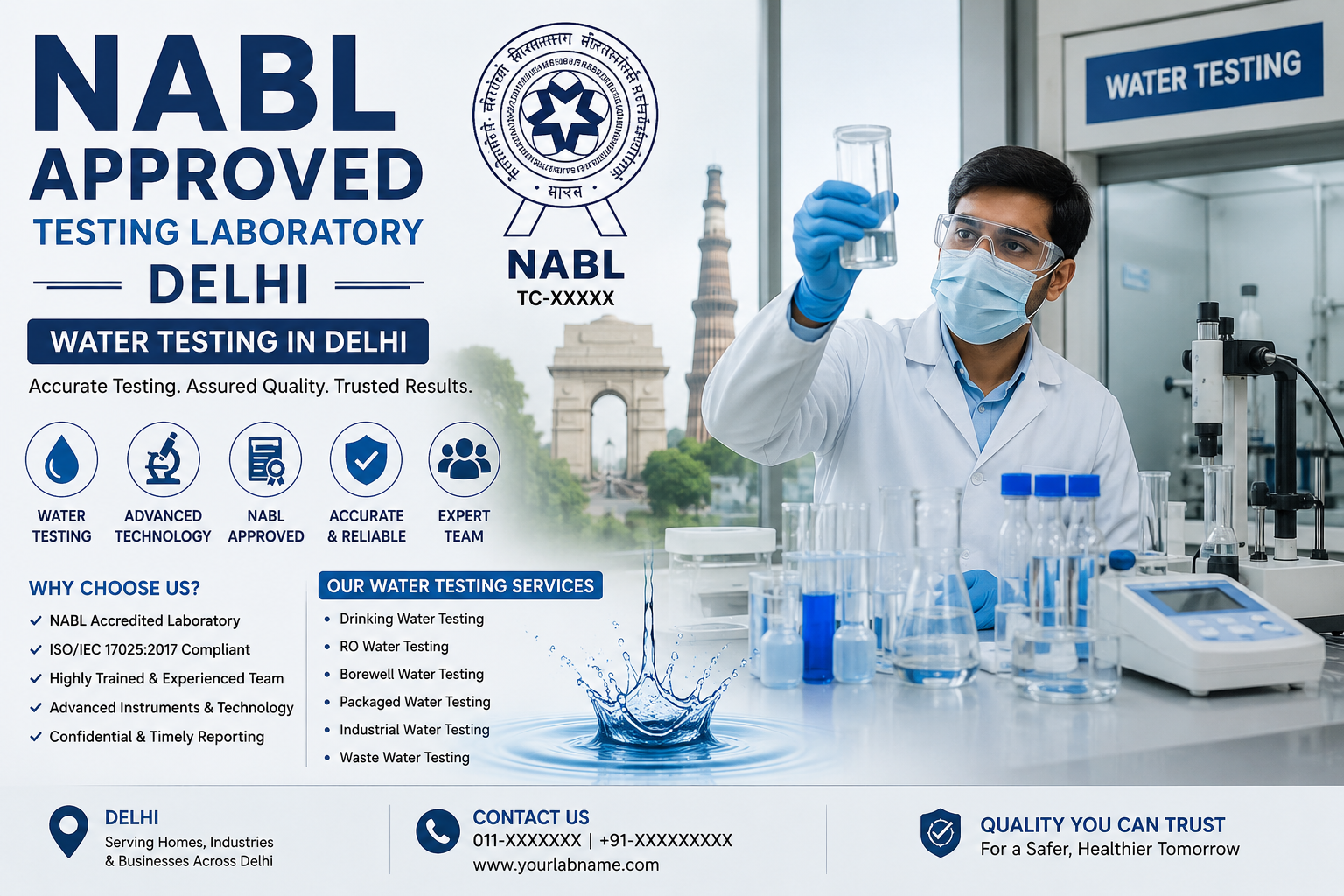
Scientific testing provides a more dependable way to understand what is actually present in a water sample. This is where a NABL approved testing laboratory Delhi becomes relevant, particularly when reliable analytical results are required for residential, commercial, institutional or industrial purposes.
The Journey of Water Matters as Much as Its Source
Water quality is not determined solely by where the water originates.
Consider a residential building receiving treated municipal water. Before reaching a kitchen tap, the water may travel through distribution pipelines, enter an underground reservoir, be pumped to an overhead tank and finally pass through the building’s internal plumbing.
At each stage, storage and distribution conditions can potentially influence water quality.
The same principle applies to tanker and borewell water. Knowing the source is useful, but testing water at the actual point where it is stored, treated or consumed can provide a more relevant picture.
For this reason, professional water testing in Delhi is often used to evaluate different points within a water supply system rather than simply testing the original source.
Why “Looks Clean” Is Not a Scientific Result
Water testing deals with characteristics that fall broadly into physical, chemical and microbiological categories.
Some problems may be noticeable. Excessive suspended particles, for example, can affect turbidity. Certain substances may influence colour, taste or smell.
Many other characteristics are impossible to evaluate accurately without laboratory analysis.
These can include:
- pH
- Total dissolved solids
- Total hardness
- Alkalinity
- Chloride
- Sulphate
- Fluoride
- Nitrate
- Iron
- Calcium
- Magnesium
- Selected heavy metals
- Microbiological indicators
Therefore, appearance should be considered an observation rather than proof of water quality.
What Makes NABL Accreditation Important?
NABL stands for the National Accreditation Board for Testing and Calibration Laboratories.
For testing laboratories, accreditation against standards such as ISO/IEC 17025 provides formal recognition of competence for specified laboratory activities.
A laboratory quality system typically addresses important areas including testing procedures, staff competence, equipment, calibration, traceability, quality assurance and reporting.
There is one distinction that customers should understand when searching for a NABL approved testing laboratory Delhi.
NABL accreditation has a defined scope.
A laboratory may perform many types of analysis, but customers requiring accredited testing should verify whether their specific test or parameter is included in the laboratory’s current accredited scope.
This small verification can make a significant difference when test reports are required for formal quality-control or compliance-related purposes.
What Can a Water Sample Reveal?
A properly planned laboratory investigation can reveal much more than a simple TDS reading.
The testing programme should be selected according to the water source and intended application.
| Type of Analysis | Examples of Parameters | What It Helps Evaluate |
| Physical | Colour, odour, turbidity | General physical characteristics |
| General chemical | pH, hardness, alkalinity | Chemical condition of water |
| Dissolved constituents | Chloride, nitrate, sulphate, fluoride | Concentration of specific substances |
| Metals | Iron, lead, arsenic and others where applicable | Presence and concentration of selected metals |
| Microbiological | Coliforms, E. coli | Microbiological quality indicators |
Not every sample requires every test. Selecting appropriate parameters is part of obtaining meaningful results.
Drinking Water Requires More Than a TDS Reading
Affordable handheld TDS meters have made TDS testing common in homes and offices.
These instruments can be useful for monitoring total dissolved solids, particularly when checking changes before and after an RO system. However, a TDS value alone cannot establish the overall quality of drinking water.
It does not provide a complete analysis of microbiological contamination or identify every individual chemical substance present in the sample.
For a broader assessment, water testing in Delhi may involve physical, chemical and microbiological parameters selected according to the testing requirement.
For drinking water in India, BIS IS 10500 is an important reference specification covering drinking-water requirements and methods of sampling and testing.
Which Types of Water Should Be Tested?
Water analysis is not restricted to tap water.
Drinking Water
Testing helps determine relevant characteristics of water intended for consumption.
Borewell and Groundwater
Groundwater composition can vary according to local geological and environmental conditions. Testing can identify its relevant mineral and chemical characteristics.
Tanker Water
When properties depend on externally supplied tanker water, laboratory analysis can provide independent information about the supplied sample.
RO-Treated Water
Testing both raw and treated water can help assess how water characteristics change through the treatment system.
Stored Water
Underground and overhead storage tanks introduce another stage between water supply and consumption. Testing can be used as part of a broader water-quality monitoring programme.
Industrial Water
Manufacturing and processing applications may have specific water-quality requirements. Testing parameters should therefore be selected according to the process rather than using a standard household drinking-water package.
A Water Test Is Only as Good as the Sample
One of the most overlooked aspects of laboratory analysis happens before the sample even reaches the laboratory.
Incorrect sampling can compromise the usefulness of sophisticated analytical testing.
Imagine collecting water in an old beverage bottle. Residues or contamination from the container could influence certain results. Microbiological samples can be particularly sensitive to collection and handling conditions.
A professional NABL approved testing laboratory Delhi should be able to provide guidance concerning:
- Correct sampling containers
- Required sample quantity
- Suitable sampling location
- Preservation requirements
- Transportation conditions
- Sample identification
- Acceptable holding time
Following these instructions helps ensure that the sample reaching the laboratory represents the water being investigated as accurately as possible.
How to Read a Water Test Report More Effectively
Receiving a laboratory report is only the beginning. The numbers need context.
A good approach is to identify the tested parameter, note the reported result and understand the relevant requirement or reference value where applicable.
Avoid interpreting one parameter in isolation.
For example, a particular TDS reading cannot tell you whether microbiological parameters are satisfactory because they represent entirely different aspects of water quality.
Where interpretation is important, seek appropriate technical guidance instead of making assumptions based on a single measurement.
When Should You Consider Water Testing?
There is no universal testing schedule that works for every property or organisation.
Testing may be particularly worth considering when:
- A new borewell is commissioned.
- The water source changes.
- Tanker water becomes the primary supply.
- Colour, odour or taste changes unexpectedly.
- A new treatment system is installed.
- Treatment performance needs to be evaluated.
- A building’s water supply requires routine monitoring.
- Specific regulatory, contractual or quality requirements apply.
Risk, source and intended use should guide testing frequency.
Choosing a Laboratory: Look Beyond the Price
Testing cost naturally matters, but the cheapest quotation should not automatically determine the laboratory selection.
Before sending a sample for water testing in Delhi, ask whether the laboratory understands your specific requirement.
Check the laboratory’s accreditation status, relevant accredited scope, available testing parameters, sample-handling instructions, analytical methods where necessary, expected turnaround and reporting format.
A technically appropriate test provides considerably more value than a long list of parameters selected without understanding the purpose of the analysis.
Frequently Asked Questions
1. Why is laboratory water testing necessary?
It provides measurable information about characteristics that may not be visible or detectable through taste and smell.
2. What is NABL?
NABL is the National Accreditation Board for Testing and Calibration Laboratories.
3. Does NABL accreditation cover all laboratory tests?
No. Accreditation applies to activities included within the laboratory’s approved scope.
4. Can borewell water be laboratory tested?
Yes. Borewell and groundwater samples can be analysed for appropriate physical, chemical and microbiological parameters.
5. Can tanker water be tested?
Yes. A representative tanker-water sample can be submitted for laboratory analysis.
6. Is TDS enough to determine drinking-water quality?
No. TDS represents only one aspect of water quality and cannot replace comprehensive chemical and microbiological analysis.
7. What is IS 10500?
IS 10500 is the Indian Standard specification associated with drinking-water requirements.
8. Can RO water be tested?
Yes. Raw and RO-treated samples can be compared to understand changes in relevant water-quality parameters.
9. Why are coliform tests conducted?
Coliform analysis is commonly used as part of microbiological evaluation of water.
10. Can water that looks clean still have quality problems?
Yes. Many dissolved substances and microorganisms cannot be identified visually.
https://newsgrow.blogspot.com/2026/08/chemical-testing-lab-in-delhi-and-water.html
https://newsgrow.blogspot.com/2026/08/bis-approved-labs-and-wood-testing-lab.html
https://newsgrow.blogspot.com/2026/08/nabl-approved-testing-laboratory-delhi.html