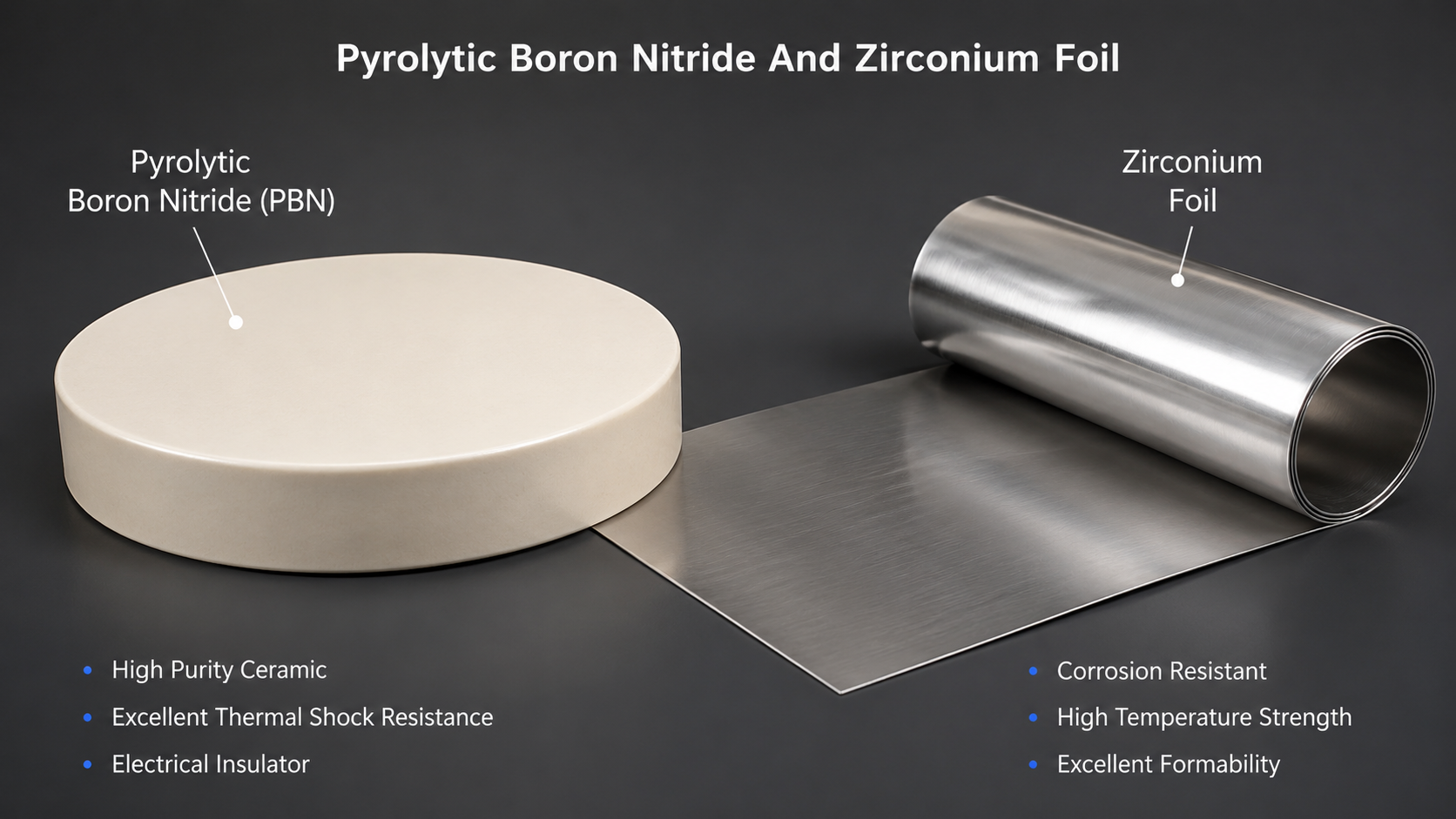
The advanced materials sector is evolving as semiconductor producers, research laboratories, vacuum-system manufacturers and high-temperature technology companies look for materials capable of meeting increasingly specialised operating requirements. Among the materials receiving attention are Pyrolytic Boron Nitride and Zirconium Foil, each offering a distinctive set of properties for precision applications.
Rather than serving as general-purpose engineering materials, PBN and zirconium foil are typically specified when conventional ceramics or metals cannot deliver the required combination of purity, thermal performance, chemical stability or specialised physical characteristics.
Their growing relevance reflects a wider industry trend: engineers are selecting materials according to highly specific operating environments instead of relying solely on traditional material categories.
High-Purity Processing Puts Pyrolytic Boron Nitride in Focus
One area influencing advanced ceramic selection is the continued requirement for cleaner and more controlled semiconductor manufacturing.
Pyrolytic Boron Nitride, widely abbreviated as PBN, is a specialised ceramic commonly produced using chemical vapour deposition. This production route differentiates it from conventional boron nitride components manufactured through powder pressing and sintering.
The resulting material can achieve very high purity without depending on conventional binders.
That characteristic is especially important in semiconductor manufacturing, crystal growth and vacuum processing, where contamination from processing equipment can potentially interfere with sensitive materials.
PBN therefore occupies a highly specialised position within the technical ceramics market.
Thermal Behaviour Creates Additional Engineering Opportunities
Purity is not the only reason Pyrolytic Boron Nitride attracts engineering interest.
The material possesses a layered structure that creates strongly directional, or anisotropic, properties. Heat can travel through the material differently depending on its orientation.
For equipment designers, this provides interesting opportunities where controlled heat distribution and electrical insulation must exist within the same component.
Other notable characteristics include:
- Excellent electrical insulation
- High-temperature stability in suitable environments
- Strong thermal-shock resistance
- High chemical stability
- Low contamination potential
- Low outgassing characteristics
- Compatibility with specialised vacuum environments
- Resistance to wetting by many molten materials
These properties have established PBN as more than simply another high-temperature ceramic.
Semiconductor Processing Remains a Key PBN Application Area
The semiconductor industry represents an important market for Pyrolytic Boron Nitride because of the material’s combination of purity and functional performance.
PBN components can be manufactured for applications including:
- Crystal-growth crucibles
- Evaporation boats
- High-temperature insulators
- Vacuum-processing fixtures
- Compound-semiconductor equipment
- Thermal management systems
- High-purity containers
- Specialised laboratory components
Crystal-growth applications are particularly notable because the material holding or surrounding a semiconductor substance must not introduce unacceptable contamination.
As semiconductor manufacturing processes become increasingly sophisticated, precise material selection across processing equipment continues to receive considerable attention.
Zirconium Foil Addresses a Different Set of Industry Requirements
While PBN developments are closely connected with advanced ceramics, Zirconium Foil represents the metallic side of specialised materials engineering.
Zirconium is recognised for its corrosion resistance, high melting temperature and relatively low neutron absorption. Manufacturing zirconium into thin foil extends its usefulness into research and precision applications where controlled thickness and surface characteristics are important.
The foil format also creates a relatively high surface-area-to-volume ratio, making it particularly useful for experiments involving interactions between the material surface and its surrounding environment.
This has positioned zirconium foil as an important research material rather than simply a thin metal sheet.
Nuclear and Surface Research Continue to Support Zirconium Use
One of zirconium’s most notable characteristics is its low neutron absorption relative to many other metals. This is an important reason zirconium-based materials have become associated with nuclear technology.
However, Zirconium Foil has applications extending beyond nuclear research.
Current and established research areas include:
- Surface science
- Corrosion evaluation
- Oxidation experiments
- Electrochemical studies
- Diffusion research
- Vacuum experiments
- Thin-film development
- High-temperature testing
- Materials characterisation
- Surface modification
Researchers can expose carefully prepared zirconium foil specimens to controlled environments and subsequently analyse changes occurring within or on the material.
For such applications, consistency in thickness, composition and surface condition can be particularly important.
PBN and Zirconium Foil Serve Different Engineering Priorities
Despite their shared classification as specialised materials, Pyrolytic Boron Nitride and Zirconium Foil are fundamentally different.
| Industry Requirement | Pyrolytic Boron Nitride | Zirconium Foil |
| Material class | Technical ceramic | Metallic material |
| Electrical behaviour | Insulating | Conductive |
| Major advantage | Purity and thermal performance | Corrosion-resistant metallic performance |
| Typical format | Crucibles and engineered components | Thin foil and sheet |
| Semiconductor processing | Strong application potential | Specialised uses |
| Surface research | Application dependent | Highly relevant |
| Nuclear research | Specialised | Important |
| Thermal characteristics | Direction dependent | Metallic conduction |
| Mechanical form | Rigid ceramic | Formable thin foil |
| Vacuum use | Specialised components | Experimental applications |
The comparison illustrates why material specifications must be based on functionality.
An application requiring electrical insulation should not automatically consider zirconium simply because it performs well at elevated temperatures. Similarly, PBN would not be selected where metallic conductivity or foil-like formability is essential.
Buyers Place Greater Emphasis on Material Specifications
The expanding use of advanced materials is also changing procurement practices.
Ordering by material name alone is often insufficient.
For Pyrolytic Boron Nitride, engineers may need to specify:
- Purity requirements
- Component dimensions
- Wall thickness
- Surface condition
- Thermal orientation
- Operating temperature
- Dimensional tolerances
For Zirconium Foil, requirements can include:
- Foil thickness
- Width and length
- Zirconium grade
- Purity
- Hafnium content where relevant
- Surface finish
- Temper
- Dimensional tolerance
Accurate specifications can reduce the risk of receiving material that is chemically correct but unsuitable for the intended process.
Frequently Asked Questions
1. Why is Pyrolytic Boron Nitride considered an advanced material?
It combines high purity with specialised thermal, electrical and chemical properties required by demanding technologies.
2. How is PBN generally manufactured?
It is commonly produced through chemical vapour deposition rather than conventional ceramic powder processing.
3. Why does semiconductor manufacturing use PBN?
Its purity, insulation properties and thermal stability make it useful where contamination control is important.
4. Is Pyrolytic Boron Nitride a conductor?
No. It is primarily used as an electrically insulating ceramic.
5. What makes Zirconium Foil different from ordinary metal foil?
It provides zirconium’s distinctive corrosion, thermal and nuclear-related characteristics in a thin metallic format.
6. Why is zirconium associated with nuclear technology?
Its relatively low neutron absorption is an important property for nuclear applications.
7. Is Zirconium Foil suitable for corrosion studies?
Yes. It is used in specialised materials and surface research involving corrosion and oxidation behaviour.
8. Are PBN and Zirconium Foil interchangeable?
No. Their electrical, structural and mechanical characteristics are fundamentally different.
9. Why does foil thickness matter?
Thickness can influence mechanical behaviour, thermal response, surface-area relationships and experimental performance.
10. What should engineers consider before ordering these materials?
Operating temperature, chemical exposure, purity, dimensions, electrical requirements, surface finish and environmental conditions should all be evaluated.
Read more – https://newsgrow.blogspot.com/2026/09/boron-nitride-crucibles-and-boron.html
https://newsgrow.blogspot.com/2026/09/pyrolytic-boron-nitride-and-zirconium.html