
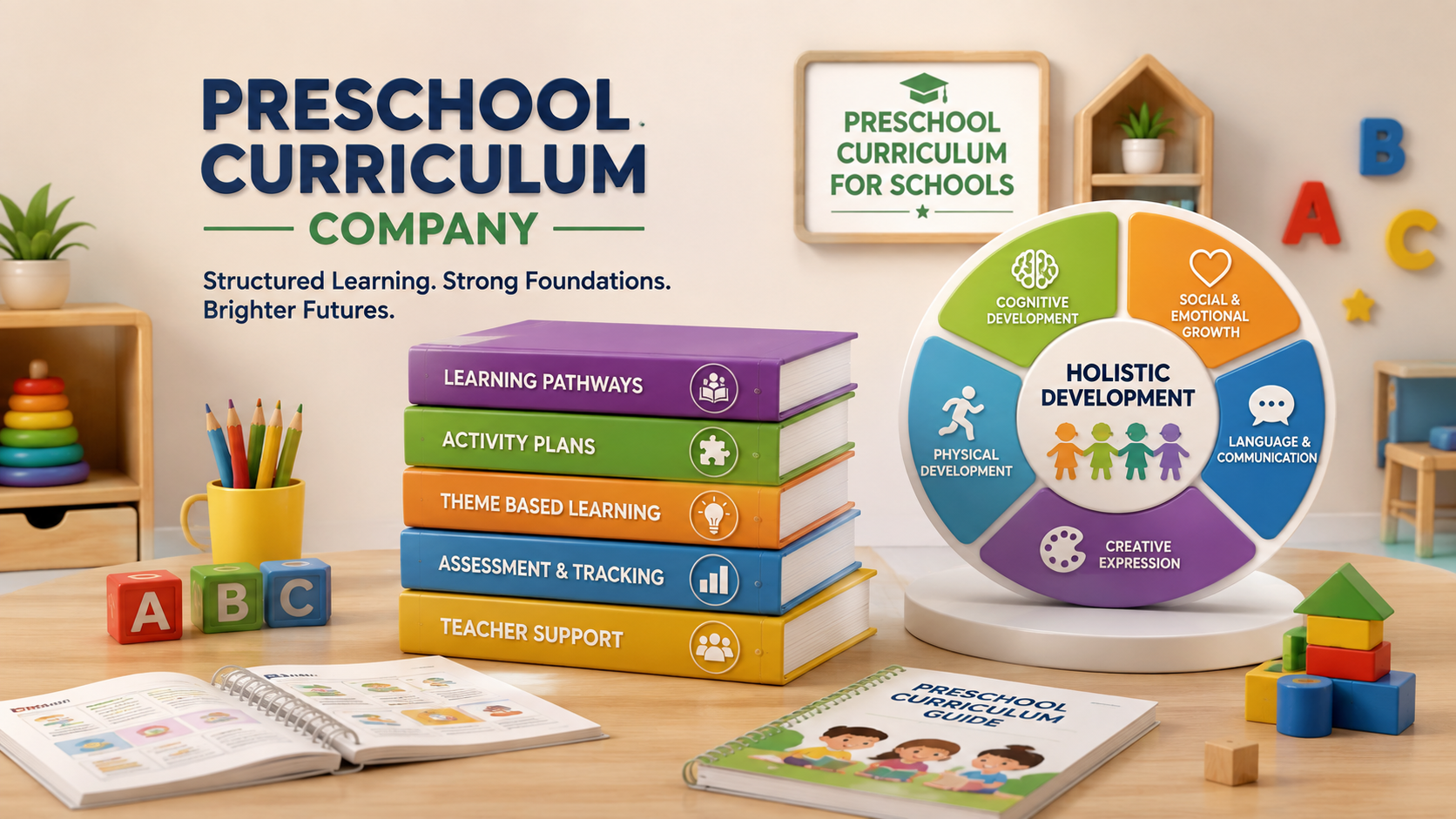
Early childhood education shapes how children think, communicate, interact, and approach learning for years to come. For schools, therefore, selecting the right curriculum is much more than choosing worksheets, books, or classroom activities. It requires a structured learning framework that respects children’s developmental stages while helping teachers create meaningful educational experiences.
A professional preschool curriculum company supports schools by designing age-appropriate learning systems that combine academics, creativity, communication, movement, social interaction, and emotional development. At the same time, an effective preschool curriculum for schools gives educators the flexibility to make learning enjoyable rather than turning preschool into an early version of primary school.
What Makes a Preschool Curriculum Truly Effective?
A strong preschool curriculum focuses on the whole child. Children between the ages of two and six learn differently from older students. They understand concepts through exploration, repetition, storytelling, movement, play, observation, and hands-on experiences.
An effective curriculum should therefore balance:
- Language and communication skills
- Early literacy and phonics
- Pre-writing and fine motor development
- Numbers and mathematical thinking
- Environmental awareness
- Social and emotional development
- Creative expression
- Music and movement
- Physical development
- Problem-solving and logical thinking
Instead of expecting young learners to memorise information, teachers should encourage children to ask questions, explore ideas, and discover answers.
Why Schools Work with a Preschool Curriculum Company
Developing an entire early-years programme internally requires considerable expertise, research, teacher training, content creation, assessment planning, and regular updates.
A specialised preschool curriculum company can bring these elements together within one organised framework.
Schools can receive structured resources such as lesson plans, activity suggestions, student books, teacher manuals, worksheets, classroom projects, assessment tools, monthly themes, and learning outcomes.
More importantly, curriculum specialists understand developmental progression. For example, children should normally develop hand control through activities such as tracing, colouring, clay modelling, sorting, and object manipulation before being expected to write extensively.
Such sequencing makes learning more developmentally appropriate.
Key Features of a Preschool Curriculum for Schools
The best preschool curriculum for schools should offer structure without making teaching rigid. Teachers need clear objectives while still having enough flexibility to adapt lessons according to children’s learning speeds and classroom situations.
Important features include:
- Age-specific learning goals
- Theme-based classroom activities
- Play-based teaching strategies
- Storytelling and conversation
- Hands-on learning experiences
- Teacher-friendly lesson planning
- Developmental assessment
- Parent engagement activities
- Creative and physical activities
- Progressive learning outcomes
Schools should also look for programmes that connect one level naturally with the next, such as preschool, nursery, lower kindergarten, and upper kindergarten.
Play-Based Learning Versus Traditional Teaching
| Approach | Play-Based Curriculum | Traditional Approach |
| Learning style | Exploration and activities | Instruction and repetition |
| Child participation | High | Moderate |
| Creativity | Strongly encouraged | Often limited |
| Teacher role | Facilitator and guide | Primarily instructor |
| Skill development | Holistic | Mainly academic |
| Classroom experience | Interactive | More structured |
Play-based education does not mean children are simply playing without purpose. Well-designed activities are connected to specific developmental outcomes.
Building blocks can teach shapes, balance, counting, teamwork, and problem-solving simultaneously. Role-playing activities can improve vocabulary, imagination, confidence, and social communication.
How Curriculum Supports Teachers
Even experienced preschool teachers benefit from organised teaching resources.
A reliable preschool curriculum company provides teachers with a clear roadmap showing what to teach, when to introduce concepts, which activities can reinforce them, and how children’s progress can be observed.
Teachers can then spend less time searching for random classroom materials and more time engaging directly with students.
Teacher support may include:
- Daily or weekly lesson plans
- Classroom activity instructions
- Story recommendations
- Learning objectives
- Teaching aids
- Assessment guidelines
- Classroom management suggestions
Consistent planning also helps maintain similar educational standards across different classrooms or school branches.
Developing School Readiness Without Academic Pressure
School readiness is often misunderstood as the ability to read, write, and calculate before entering primary school.
True readiness is much broader.
A well-designed preschool curriculum for schools helps children develop independence, listening ability, curiosity, vocabulary, motor coordination, confidence, emotional regulation, and the ability to participate in group activities.
Academic concepts are introduced gradually through enjoyable experiences.
For instance, counting can happen through toys, fruits, classroom objects, songs, or movement rather than only through worksheets.
This approach creates understanding before formal instruction becomes necessary.
Important Skills Children Should Develop
Communication Skills
Children should receive frequent opportunities to speak, listen, describe objects, participate in conversations, and express their ideas.
Cognitive Development
Puzzles, matching activities, sequencing, classification, patterns, and simple experiments strengthen reasoning abilities.
Social Development
Group games and collaborative activities teach children patience, sharing, cooperation, and respect.
Physical Development
Running, jumping, balancing, drawing, cutting, threading, and modelling strengthen both gross and fine motor skills.
Emotional Development
Teachers should help children identify emotions, develop confidence, adapt to routines, and communicate their needs appropriately.
Choosing the Right Curriculum Partner
Schools should avoid selecting a programme based only on attractive books.
Before partnering with a preschool curriculum company, evaluate the educational philosophy behind its materials.
Ask whether the curriculum:
- Matches children’s developmental stages
- Encourages activity-based learning
- Supports different learning abilities
- Includes measurable learning outcomes
- Provides practical teacher guidance
- Allows classroom flexibility
- Supports creativity and communication
- Includes meaningful assessment methods
The strongest curriculum is one teachers can practically implement every day.
Frequently Asked Questions
What is a preschool curriculum company?
It is an educational organisation that develops structured early-learning programmes, teaching resources, lesson plans, activities, assessments, and supporting materials for preschools and educational institutions.
What should a preschool curriculum include?
It should cover language, literacy, numeracy, creativity, physical development, environmental awareness, communication, cognitive skills, and social-emotional learning.
Why do schools need a structured preschool curriculum?
Structured programmes provide consistent learning objectives while helping teachers systematically develop children’s skills throughout the academic year.
Is play-based learning effective?
Yes. Purposeful play helps young children understand concepts through active participation, experimentation, communication, and real experiences.
Should preschool children receive homework?
Homework should be minimal and age-appropriate. Interactive parent-child activities are generally more meaningful than extensive written exercises.
How should preschool children be assessed?
Assessment should primarily involve observation, activity participation, developmental milestones, portfolios, conversation, and classroom performance rather than formal examinations.
Can one curriculum work for every age group?
The overall philosophy can remain consistent, but activities, expectations, vocabulary, and learning outcomes should change according to children’s ages and developmental abilities.
What is theme-based learning?
Theme-based learning connects several subjects around one topic. A theme such as animals can involve stories, counting, art, vocabulary, science, movement, and conversation.
How does curriculum help parents?
A structured programme allows parents to understand what their children are learning and provides meaningful activities that can reinforce development at home.
How can schools select the best curriculum provider?
Schools should evaluate learning philosophy, teacher support, developmental appropriateness, resources, assessment methods, flexibility, progression, and implementation support before making a decision.