
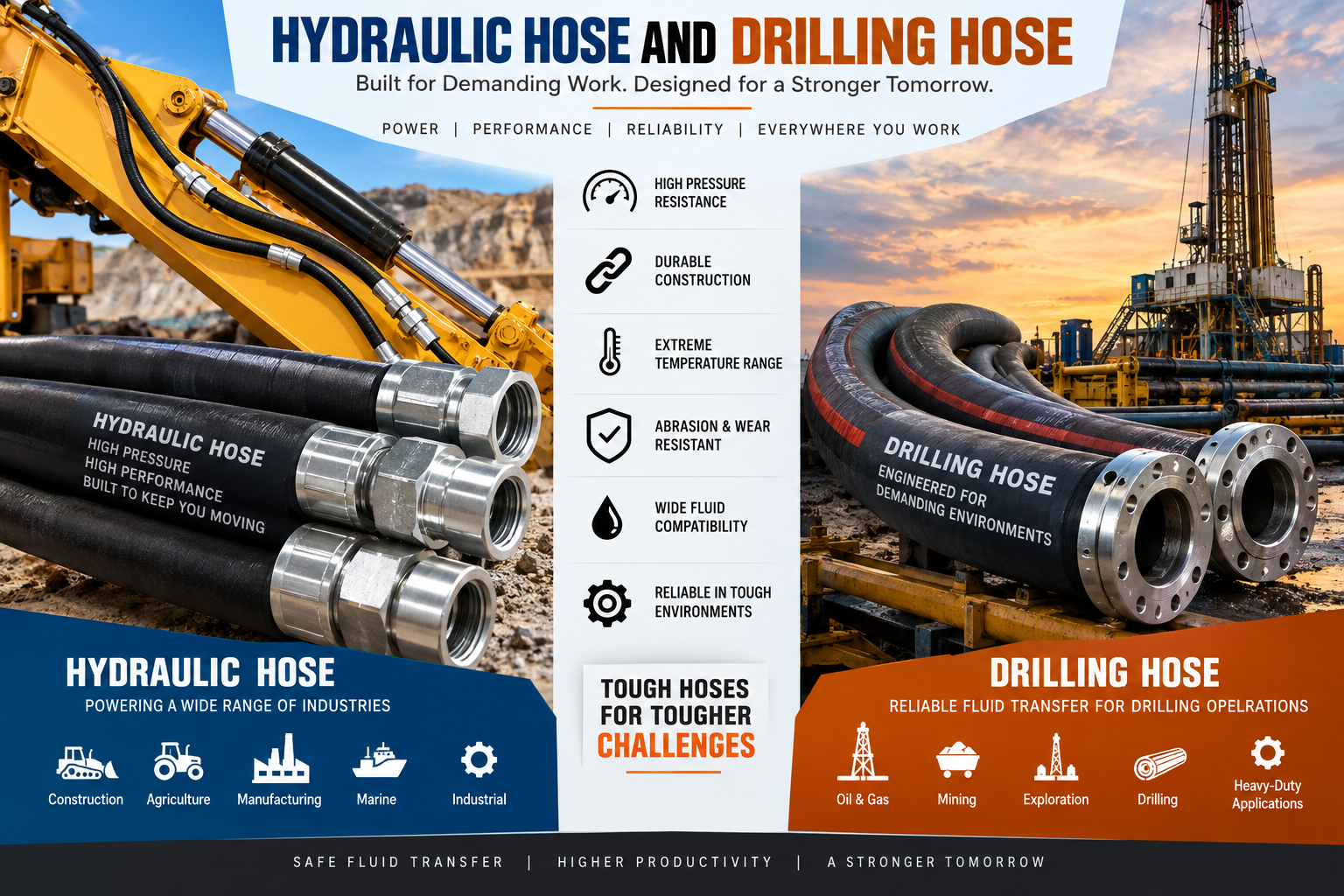
Among the most important components are Hydraulic Hose and drilling hose assemblies. Although both are designed to handle demanding operating environments, their construction, applications, pressure requirements, and performance characteristics can differ considerably.
A hydraulic hose typically transfers pressurized hydraulic fluid between pumps, valves, cylinders, motors, and other components. A drilling hose, meanwhile, is engineered for demanding drilling operations where fluids must be transported reliably despite pressure, vibration, movement, abrasion, and harsh environmental conditions.
Understanding these hoses helps equipment operators, engineers, procurement teams, and maintenance professionals select products that match actual operating requirements rather than simply choosing a hose based on dimensions or price.
Understanding the Role of a Hydraulic Hose
A Hydraulic Hose is a flexible connection designed primarily to transport hydraulic fluid under pressure. Hydraulic systems use pressurized fluid to transmit power, making hose reliability essential to overall machine performance.
Hydraulic hoses are commonly found in:
- Construction equipment
- Agricultural machinery
- Mining machines
- Manufacturing equipment
- Material-handling systems
- Mobile hydraulic equipment
- Industrial automation
- Marine applications
- Oil and gas equipment
A typical hydraulic hose consists of an inner tube, reinforcement layers, and an external protective cover. The inner tube must remain compatible with the transported fluid. Reinforcement provides pressure resistance, while the outer layer protects against abrasion, weather, oil, and other environmental factors.
Depending on the application, reinforcement may include textile braiding, steel-wire braiding, or spiral-wire construction.
What Makes a Drilling Hose Different?
A drilling hose is developed for demanding drilling environments where flexible fluid transfer must continue under challenging operating conditions. Such hoses can be used in oilfield, exploration, mineral drilling, and related industrial operations depending on their specific design and certification.
Drilling applications can involve vibration, repetitive movement, pressure fluctuations, abrasive surroundings, and exposure to oils, mud, chemicals, or weather.
Important characteristics may include:
- High-pressure capability
- Strong reinforcement
- Flexible construction
- Abrasion resistance
- Oil-resistant materials
- Secure end connections
- Resistance to environmental exposure
- Suitability for dynamic operating conditions
Not every drilling hose is suitable for every drilling operation. Pressure rating, temperature range, fluid compatibility, connection type, applicable standards, and manufacturer specifications should always be verified.
Hydraulic Hose vs Drilling Hose
Although both products transfer fluids, they are engineered around different application requirements.
| Feature | Hydraulic Hose | Drilling Hose |
| Primary purpose | Hydraulic power transmission | Fluid transfer in drilling operations |
| Common fluid | Hydraulic oil or compatible fluids | Drilling fluids based on hose specification |
| Environment | Mobile and industrial machinery | Drilling and oilfield environments |
| Reinforcement | Textile, braided wire, or spiral wire | Heavy-duty reinforced construction |
| Flexibility | Depends on hydraulic application | Designed around drilling movement requirements |
| Selection priority | Pressure, fluid, temperature, routing | Pressure, media, movement, environment, standards |
The correct product should always be selected according to its rated service conditions rather than assuming similar-looking hoses are interchangeable.
Why Pressure Rating Is Critical
Working pressure is one of the most important considerations when choosing either a Hydraulic Hose or drilling hose.
A hose must be rated for the pressure conditions of the system. Selecting a product merely because it has the correct internal diameter can create serious performance and safety problems.
Pressure-related selection should consider:
- Normal system working pressure
- Potential pressure surges
- Hose size
- Reinforcement construction
- Operating temperature
- Fitting and coupling ratings
The complete hose assembly should be evaluated because the safe operating capability can depend on the hose, fittings, couplings, installation method, and application conditions together.
Importance of Fluid and Material Compatibility
Different industrial fluids interact differently with elastomers and other hose materials. Compatibility is therefore essential for reliable service life.
Hydraulic systems may use mineral-based oils, synthetic fluids, water-glycol solutions, or other specialized media. Drilling applications may involve drilling mud and other application-specific fluids.
Using incompatible materials can contribute to swelling, cracking, softening, hardening, leakage, or premature deterioration.
Before installation, operators should confirm that the hose’s inner tube, reinforcement, cover, seals, and fittings are appropriate for the intended medium and operating conditions.
Temperature and Environmental Conditions
Temperature affects hose flexibility, materials, pressure capability, and expected service life. Both the temperature of the transferred fluid and the surrounding environment need consideration.
A Hydraulic Hose installed near an engine, furnace, exhaust component, or other heat source may require additional protection. Similarly, drilling hoses can operate in exposed locations where heat, cold, sunlight, moisture, mud, oil, and abrasive particles create demanding conditions.
Environmental evaluation should include:
- Minimum and maximum temperatures
- UV and weather exposure
- Abrasion
- Chemical contact
- Oil contamination
- Mechanical movement
- Potential external impact
Choosing the correct protective cover or additional guarding can help reduce unnecessary hose damage.
Selecting the Correct Hose Size
Hose diameter affects fluid velocity, pressure loss, efficiency, and system performance. An undersized hose can create excessive flow resistance, while inappropriate sizing can negatively influence overall operation.
Selection should consider flow rate, required internal diameter, working pressure, connection size, routing, and manufacturer recommendations.
Bend radius is equally important. Forcing a hose into a tighter bend than recommended can place unnecessary stress on the reinforcement and connection areas. Proper routing should avoid excessive twisting, stretching, rubbing, and sharp bends.
Installation Practices for Better Reliability
Even a high-quality Hydraulic Hose or drilling hose can fail prematurely when incorrectly installed.
Good installation practices include ensuring adequate hose length, respecting minimum bend-radius requirements, preventing twisting, supporting long assemblies, avoiding abrasive contact, and keeping hoses away from unnecessary heat sources.
Connections should also be inspected carefully. Correctly matched fittings and couplings are essential because incompatible components can compromise the entire assembly.
Where equipment experiences continuous movement, installation should provide sufficient flexibility without allowing uncontrolled rubbing or excessive stress.
Inspection and Preventive Maintenance
Routine inspection helps identify deterioration before it develops into a major leak or equipment shutdown.
Operators should look for:
- Cracks in the outer cover
- Abrasion or exposed reinforcement
- Fluid leakage
- Damaged fittings
- Corrosion
- Bulging or deformation
- Kinks
- Loose connections
- Heat damage
- Unusual hose movement
A hose showing significant deterioration should be evaluated and replaced according to applicable safety procedures and manufacturer recommendations. High-pressure fluid leaks can be hazardous, so damaged pressurized hoses should never be checked with bare hands.
How to Choose a Reliable Hose Supplier
A dependable supplier should provide more than a product with the correct diameter. Technical information is essential for making an informed selection.
Before purchasing, request details about working pressure, temperature limits, compatible media, construction, minimum bend radius, available fittings, testing requirements, applicable industry standards, and traceability where necessary.
For specialized drilling hose applications, documentation and compliance requirements can be particularly important.
The lowest-priced option is not automatically the most economical. Unexpected downtime, leakage, replacement labor, equipment damage, and production interruptions can make an unsuitable hose considerably more expensive over its service life.
Frequently Asked Questions
1. What is a Hydraulic Hose used for?
It transfers pressurized hydraulic fluid between components such as pumps, valves, cylinders, and motors.
2. What is a drilling hose?
It is a flexible hose designed for specified fluid-transfer duties in demanding drilling environments.
3. Can a hydraulic hose be used as a drilling hose?
Not automatically. The hose must meet the pressure, media, temperature, movement, connection, and applicable standard requirements of the drilling application.
4. Why does reinforcement matter?
Reinforcement helps the hose withstand internal pressure and mechanical stresses.
5. How do I select the correct hose diameter?
Consider system flow, pressure requirements, connections, fluid velocity, and manufacturer sizing recommendations.
6. What causes premature hydraulic hose failure?
Common contributors include abrasion, excessive heat, incorrect routing, incompatible fluids, excessive pressure, twisting, and poor installation.
7. Are all drilling hoses suitable for the same pressure?
No. Pressure ratings vary by hose design, size, construction, and manufacturer specifications.
8. How often should hoses be inspected?
Inspection frequency should reflect equipment usage, operating severity, applicable standards, and manufacturer maintenance recommendations.
9. Why is minimum bend radius important?
Excessive bending can stress the hose structure and shorten service life.
10. Should fittings be considered when selecting a hose?
Yes. Hose and fitting compatibility is essential for a properly engineered and reliable assembly.