
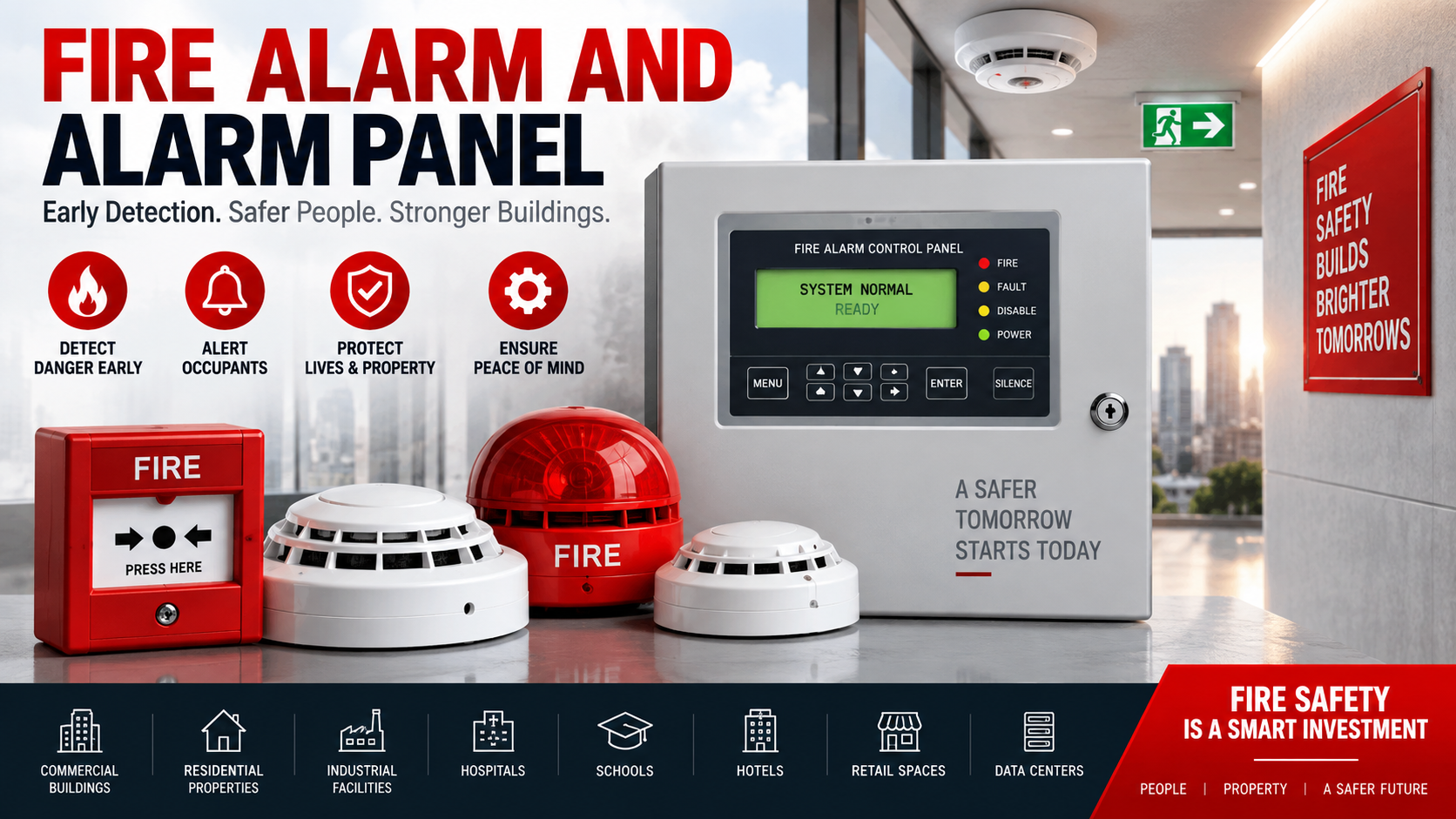
Fire safety is an essential part of protecting people, property, equipment, and business operations. Among the most important components of a modern fire protection system are the fire alarm and alarm panel. These devices work together to identify potential fire conditions, alert occupants, and help responsible personnel take action before an emergency becomes more dangerous.
Modern fire detection technology has advanced considerably. Today’s systems can combine smoke detectors, heat detectors, manual call points, sounders, visual indicators, monitoring modules, and intelligent control equipment into one coordinated safety network. Understanding how these components work can help building owners, facility managers, consultants, and contractors choose a suitable solution.
What Is a Fire Alarm?
A fire alarm system is designed to detect or receive indications of a possible fire and provide warnings to building occupants. Depending on the system design, an alarm may be initiated automatically through detectors or manually through a call point or pull station.
A typical system can include:
- Smoke detectors
- Heat detectors
- Manual call points
- Alarm sounders and bells
- Strobes or visual notification devices
- Input and output modules
- Control and monitoring equipment
- Backup power supplies
The objective is not simply to produce a loud warning. A properly designed system provides early notification so occupants can follow evacuation procedures and trained personnel can investigate and respond appropriately.
Why Fire Alarm Systems Matter
A fire can develop quickly, and delayed detection may reduce the time available for safe evacuation and emergency response. A properly selected fire alarm system provides continuous monitoring of designated areas and can detect warning conditions even when a building has limited occupancy.
Fire detection systems are commonly installed in offices, factories, warehouses, hotels, hospitals, educational facilities, shopping centres, residential complexes, data centres, and other commercial or industrial properties.
Important benefits include early warning, faster evacuation, centralized monitoring, improved emergency coordination, and better protection of valuable assets.
The appropriate system should always be selected and installed according to the building’s risk profile and applicable fire-safety requirements.
What Is an Alarm Panel?
The alarm panel, often called a fire alarm control panel, acts as the central control point of the fire detection system. Field devices communicate their status to the panel, which interprets signals and initiates programmed responses.
For example, when a smoke detector identifies conditions that meet its alarm criteria, it sends a signal to the control equipment. The panel may then activate sounders and visual alarms, display the affected zone or device, record the event, and operate configured interfaces.
An alarm panel can also indicate faults such as wiring problems, power failures, device communication issues, or other supervised conditions, depending on system capabilities.
How Fire Alarm and Alarm Panel Work Together
The relationship between the fire alarm devices and alarm panel can be understood as a coordinated communication process.
- A detector or manual device identifies or reports an emergency condition.
- The signal is transmitted to the alarm panel.
- The panel processes the incoming information.
- The affected zone or device is identified where supported.
- Notification appliances are activated according to the programmed logic.
- Occupants receive audible or visual warnings.
- Responsible personnel investigate and follow the site’s emergency procedure.
Some installations can also interface with other building safety systems when specifically designed and permitted to do so.
Conventional and Addressable Alarm Panels
Two widely used approaches are conventional and addressable fire detection systems.
| Feature | Conventional System | Addressable System |
| Identification | Typically identifies a zone | Can identify individual devices |
| Installation | Suitable for many smaller applications | Often selected for larger or complex sites |
| Troubleshooting | Zone-based investigation | More precise device information |
| Expansion | Depends on available zones | Often offers flexible expansion |
| Monitoring | Basic system information | More detailed status information |
| Initial complexity | Generally lower | Generally higher |
A conventional alarm panel divides a property into detection zones. When an alarm occurs, personnel can determine the affected zone but usually need to inspect that area to locate the initiating device.
An addressable system assigns identification to compatible field devices. This can provide more precise information about where an event originated and can improve maintenance and investigation efficiency.
Key Features to Consider in an Alarm Panel
Choosing an alarm panel should be based on system requirements rather than price alone. Important considerations include the number of zones or loops required, compatible devices, battery backup requirements, expansion possibilities, event history, user interface, fault monitoring, and integration capabilities.
For larger facilities, consider features such as:
- Individual device identification
- Event logging
- Networkable panels
- Programmable cause-and-effect functions
- Remote annunciation
- Supervised inputs and outputs
- Expansion modules
- Clear alarm and fault indications
Compatibility is especially important. Detectors, modules, notification devices, and control equipment should be selected as part of an engineered system rather than assembled from unrelated components without verification.
Choosing the Right Fire Alarm Solution
The right fire alarm configuration depends on the building rather than a universal specification. A small office and a multi-storey hospital have very different detection, notification, monitoring, and evacuation requirements.
Before selecting equipment, evaluate building size, occupancy type, floor layout, environmental conditions, fire risks, evacuation strategy, future expansion, maintenance requirements, and applicable codes or standards.
Professional system design is particularly important for complex or high-occupancy buildings. Detection device placement, alarm audibility, visual notification, wiring, standby power, zoning, and system interfaces all require careful planning.
Installation and Maintenance Are Equally Important
Even high-quality equipment cannot compensate for poor installation or neglected maintenance. Fire detection equipment should be installed, commissioned, inspected, and maintained by appropriately qualified professionals according to applicable requirements and manufacturer instructions.
Maintenance programs commonly involve checking detectors, manual devices, sounders, indicators, panel functions, power supplies, batteries, circuits, and system records.
Building owners should also ensure that faults are investigated rather than simply reset repeatedly. Persistent fault indications may point to wiring problems, damaged devices, battery issues, contamination, or communication failures.
Reducing False and Unwanted Alarms
Unwanted alarms can disrupt business operations and may cause occupants to become less responsive to future warnings. Correct system design and maintenance can help reduce these events.
Common causes may include dust, steam, unsuitable detector selection, contamination, construction activity, environmental conditions, damaged equipment, and incorrect installation.
Reducing unwanted alarms starts with selecting appropriate detection technology for each environment. A detector suitable for an office may not necessarily be appropriate for a dusty workshop, commercial kitchen, or industrial processing area.
Smart Fire Detection for Modern Buildings
Modern fire alarm technology increasingly supports intelligent monitoring, detailed diagnostics, programmable system behaviour, and centralized management. Addressable devices can provide more precise information, while networked panels can coordinate protection across larger buildings or multiple sections of a facility.
However, advanced functionality should support—not replace—good fire-safety engineering. Reliable detection, clear notification, correct installation, dependable backup power, and regular maintenance remain fundamental.
Frequently Asked Questions
1. What is the main purpose of a fire alarm?
Its primary purpose is to provide early warning of a potential fire condition so appropriate emergency procedures can begin.
2. What does an alarm panel do?
It receives and processes signals from connected devices and controls system indications, notifications, and programmed outputs.
3. What is an addressable fire alarm system?
It is a system capable of identifying compatible devices individually, providing more precise event information.
4. What is a conventional alarm panel?
A conventional panel generally organizes detection devices into zones and identifies the affected zone during an alarm.
5. Which system is suitable for large buildings?
Addressable systems are commonly considered for larger or more complex properties because of their detailed identification and expansion capabilities.
6. Can an alarm panel detect system faults?
Yes. Depending on its design, it can supervise circuits, power supplies, devices, and communication paths and indicate abnormal conditions.
7. Do fire alarm systems need backup batteries?
Fire alarm control equipment commonly incorporates standby power arrangements according to applicable system requirements.
8. Why are regular inspections important?
Inspection and testing help identify damaged, contaminated, disconnected, or malfunctioning components before an emergency occurs.
9. Can fire alarms be used in warehouses?
Yes, but detector selection and system design should consider ceiling height, storage arrangements, environmental conditions, and specific fire risks.
10. How do I choose the correct alarm panel?
Consider building size, required zones or loops, device quantity, system compatibility, expansion requirements, monitoring needs, and applicable safety standards.