Plastic manufacturers increasingly need equipment capable of delivering consistent output while maintaining material properties and production efficiency. The single extruder and twin extruder represent two important approaches to continuous extrusion.
Although both systems transport material through a barrel, their internal processing behavior differs significantly.
Single Extruder for Continuous Production
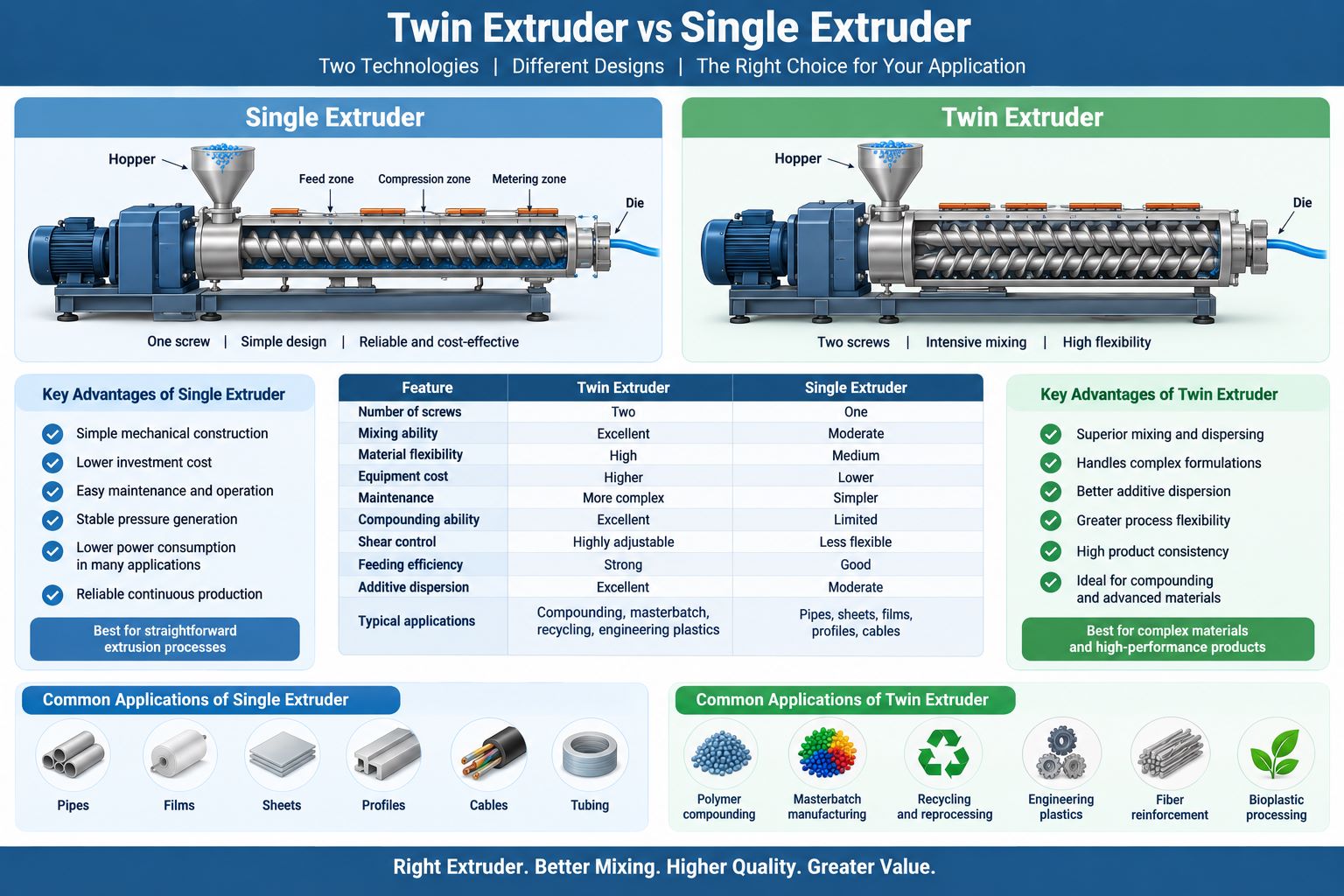
Single-screw extrusion is based on a simple concept: one screw rotates continuously and moves material from the feed zone toward the die.
Different sections of the screw help accomplish feeding, compression, melting, and metering. The exact configuration varies according to the material being processed.
Its simplicity makes the technology suitable for many established applications where aggressive mixing is unnecessary.
Twin Extruder for Complex Formulations
Twin-screw systems provide greater processing flexibility because two screws interact with the material.
Different screw elements can generate controlled mixing and shear. Manufacturers can therefore develop configurations specifically for demanding compounds.
Applications include engineering compounds, masterbatch, filled plastics, modified polymers, and selected recycling processes.
Understanding Material Mixing
Mixing is one of the clearest distinctions between these technologies.
A single extruder provides useful homogenization during melting and conveying. However, formulations containing high concentrations of additives or difficult-to-disperse ingredients can require more intensive processing.
A twin extruder can generate distributive and dispersive mixing through carefully arranged screw elements.
Comparing Production Characteristics
| Requirement | Single Extruder | Twin Extruder |
| Standard extrusion | Excellent application | Possible |
| Advanced compounding | More limited | Widely used |
| Mixing control | Moderate | High |
| Mechanical simplicity | Higher | Lower |
| Configuration flexibility | Moderate | Extensive |
| Maintenance complexity | Lower | Higher |
Actual results vary according to machine and material design.
Applications Across Industries
Single-screw machines are regularly found in pipe, profile, film, sheet, tubing, and coating lines.
Twin-screw machines are commonly associated with:
- Masterbatch
- Polymer modification
- Filler compounds
- Reinforced plastics
- Color compounds
- Reactive processing
- Specialty blends
This distinction demonstrates why understanding the intended product is more useful than selecting machinery based only on advertised output.
Frequently Asked Questions
1. What is polymer extrusion?
It is a continuous process where material is conveyed and processed before passing through a die.
2. Why use two screws?
Two screws can improve conveying, mixing, and formulation control.
3. Is a single extruder useful for plastic profiles?
Yes, depending on polymer and production requirements.
4. Can twin-screw machines make masterbatch?
Yes. Masterbatch is a major application.
5. Does extrusion require heating?
Most polymer extrusion involves controlled thermal input and mechanical energy.
6. Is higher screw speed always better?
No. Optimum speed depends on material and process requirements.
7. What is residence time?
It describes how long material remains inside the processing system.
8. Why is temperature control important?
Incorrect temperatures can affect melting, stability, quality, and material properties.
9. Can extrusion equipment handle recycled material?
Many machines can, with suitable configuration and feed preparation.
10. How should equipment be selected?
Selection should be based on actual material trials, product specifications, capacity, and processing requirements.
Conclusion
Choosing between a single extruder and twin extruder requires a complete understanding of material behavior and production objectives. Manufacturers should compare processing flexibility, mixing requirements, output, operating costs, and future product plans before investing.