
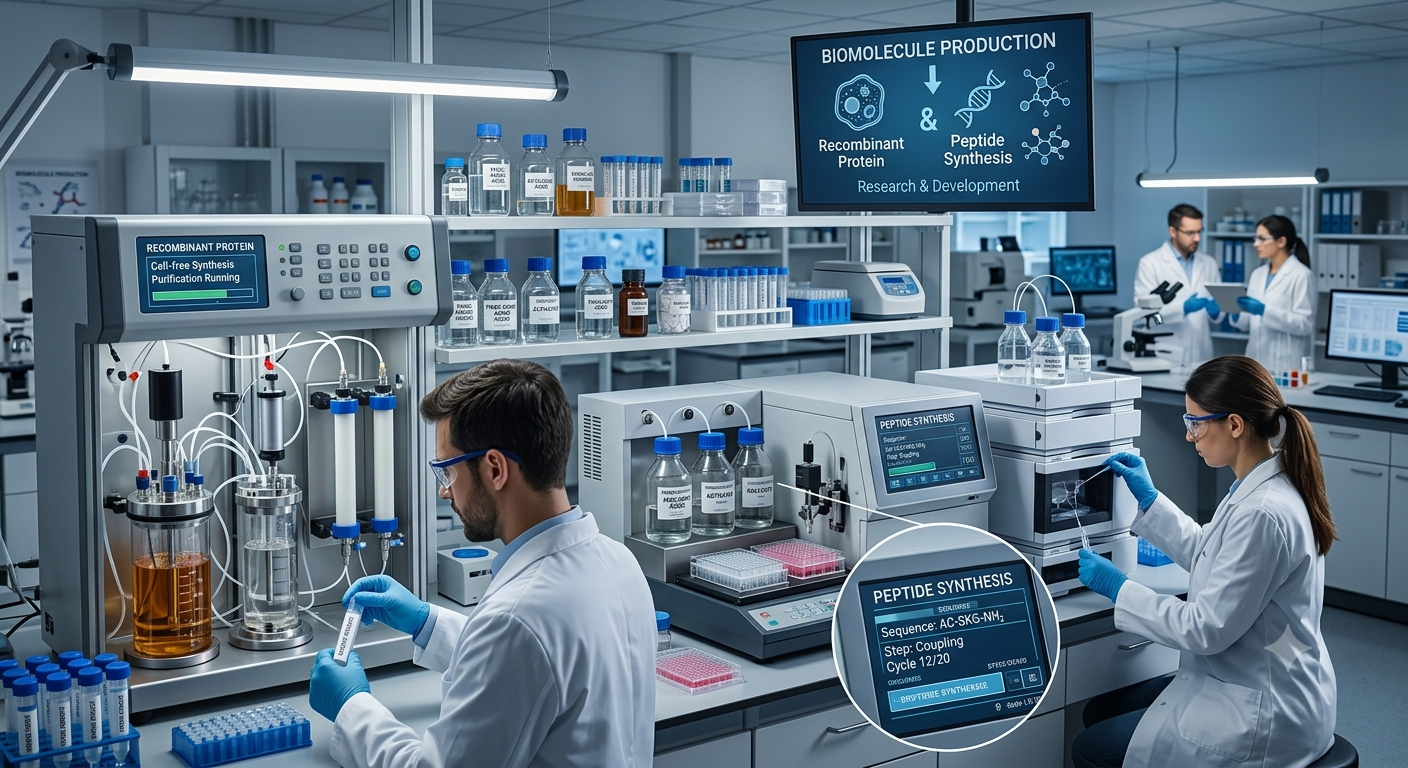
A recombinant protein is generally produced by introducing genetic instructions into a suitable expression system, enabling biological cells or cell-free systems to manufacture the desired protein. Peptide synthesis, by contrast, commonly involves assembling amino acids into a predetermined sequence through controlled chemical or biological methods.
Understanding these technologies helps researchers select an appropriate approach based on molecular size, complexity, modification requirements, purity targets, and intended application.
Understanding Recombinant Protein Production
A recombinant protein is produced using recombinant DNA technology. Researchers create a DNA construct containing the sequence encoding a target protein and use an appropriate expression platform to generate that protein.
Common expression systems include:
- Bacterial systems
- Yeast
- Insect cells
- Mammalian cells
- Plant-based platforms
- Cell-free expression systems
The best platform depends on the characteristics of the target molecule. Relatively simple proteins may be produced efficiently using bacterial expression, while proteins requiring complex folding or specific post-translational modifications may require eukaryotic systems.
Recombinant technology has become important because it can provide controlled and scalable access to proteins that may otherwise be difficult to isolate directly from natural biological sources.
How Recombinant Protein Technology Works
Recombinant protein production involves several carefully controlled stages. The precise workflow varies according to the expression platform and target protein, but the overall process generally begins with identifying or designing the gene sequence associated with the desired molecule.
A typical development workflow includes:
- Selecting the target protein sequence.
- Designing a suitable expression construct.
- Introducing the construct into an expression platform.
- Evaluating protein expression.
- Recovering the expressed material.
- Purifying the target protein.
- Characterizing identity, purity, structure, or biological activity.
Purification is particularly important because an expression system produces many molecules besides the target protein. Appropriate downstream processing is therefore required to obtain material suitable for the intended research or development application.
What Is Peptide Synthesis?
Peptide synthesis is the controlled production of peptides composed of amino acids connected through peptide bonds. Peptides are generally shorter than conventional proteins and can be designed to reproduce specific biological sequences, binding regions, epitopes, or functional motifs.
Chemical synthesis is widely used because it provides substantial control over peptide sequence and composition. Solid-phase peptide synthesis is a commonly established approach in which peptide assembly occurs on a solid support through sequential chemical reactions.
Depending on the application, synthesized peptides may also incorporate selected modifications or specialized amino acid building blocks. This flexibility makes peptide technology particularly valuable for discovery research and molecular design.
Key Applications of Recombinant Proteins
Recombinant proteins support numerous areas of biotechnology and life-science research. Their importance extends from laboratory investigation to pharmaceutical and diagnostic development.
Common applications include:
- Studying protein structure and function
- Developing research reagents
- Supporting antibody research
- Investigating protein interactions
- Developing diagnostic assays
- Screening potential therapeutic candidates
- Supporting vaccine and biologics research
- Producing selected enzymes and growth factors
A major advantage of recombinant production is its suitability for proteins whose biological activity depends on a larger or more complex molecular structure.
Important Applications of Peptide Synthesis
Modern peptide synthesis supports research across immunology, proteomics, drug discovery, diagnostics, and biochemical analysis. Researchers can design peptides around a specific sequence rather than producing an entire protein when only a particular region is required.
Applications commonly include:
- Antigen and antibody research
- Peptide-based assay development
- Protein-interaction studies
- Biomarker research
- Drug discovery
- Structure-function investigations
- Epitope mapping
- Proteomics research
- Diagnostic development
- Development of reference or analytical materials
Synthetic peptides are particularly useful when researchers require precise control over amino acid sequence or targeted chemical modifications.
Recombinant Protein vs Peptide Synthesis
The two technologies should not necessarily be considered competing methods. They frequently solve different biological and research problems.
| Factor | Recombinant Protein | Peptide Synthesis |
| Typical molecule | Protein | Peptide |
| Production principle | Biological expression | Controlled sequence assembly |
| Sequence length | Often suited to larger molecules | Commonly suited to shorter sequences |
| Folding | Can support complex protein structures | Usually less relevant for short peptides |
| Modifications | Depends on expression system | Selected modifications may be designed |
| Scalability | Can be highly scalable | Depends on sequence and chemistry |
| Common use | Functional protein research | Targeted sequence research |
Selection should therefore be based on the scientific objective rather than simply choosing one technology over another.
Quality Considerations in Protein and Peptide Production
Quality is critical for both recombinant proteins and synthetic peptides. Researchers need confidence that the supplied material matches the intended molecular identity and is appropriate for its proposed application.
Important considerations can include:
- Molecular identity
- Purity
- Sequence confirmation
- Solubility
- Stability
- Biological activity where relevant
- Aggregation state
- Appropriate analytical characterization
Quality requirements should reflect the intended use. A material used for exploratory laboratory research may have different specifications from one intended for regulated diagnostic or therapeutic development.
Choosing the Right Production Strategy
Selecting between a recombinant protein and peptide synthesis begins with understanding the molecule and the research question.
A recombinant approach may be appropriate when a project requires a relatively large protein, functional folding, biological activity, or expression-dependent modifications. Peptide synthesis can be attractive when researchers need a shorter sequence, specific region of a protein, customized amino acid composition, or selected chemical modification.
Cost, required quantity, timeline, purity, solubility, sequence complexity, downstream testing, and characterization requirements should also be considered before a production strategy is finalized.
Role in Drug Discovery and Biotechnology
Recombinant proteins and synthetic peptides contribute to different stages of modern drug discovery. Recombinant proteins can serve as biological targets, assay components, antigens, enzymes, or functional research materials.
Synthetic peptides allow scientists to investigate smaller functional regions and molecular interactions without necessarily working with complete proteins. They can also support candidate screening and peptide-based therapeutic research.
Using both technologies strategically gives biotechnology researchers greater flexibility when studying biological mechanisms and evaluating potential therapeutic approaches.
Future of Recombinant Protein and Peptide Technologies
Advances in molecular biology, automation, analytical science, expression technology, and computational design continue to expand what is possible.
Improved expression platforms can make recombinant production more efficient, while developments in peptide chemistry are supporting increasingly sophisticated sequences and modifications. Better purification and analytical technologies are also helping researchers evaluate molecular identity and quality with greater confidence.
The growing integration of computational protein design and biotechnology may further accelerate the development of customized proteins and peptides for highly specific research applications.
Frequently Asked Questions
1. What is a recombinant protein?
It is a protein produced using recombinant genetic technology in an appropriate biological or cell-free expression system.
2. What is peptide synthesis?
It is the controlled creation of a defined peptide sequence from amino acid building blocks.
3. Are peptides and proteins the same?
Both consist of amino acids, but peptides are generally shorter, while proteins are typically larger and may form complex three-dimensional structures.
4. Why are recombinant proteins important?
They provide researchers with access to defined proteins for functional studies, assays, diagnostics, and biotechnology development.
5. What is solid-phase peptide synthesis?
It is an established chemical approach in which a peptide is assembled stepwise while attached to a solid support.
6. Which expression systems can produce recombinant proteins?
Common options include bacteria, yeast, insect cells, mammalian cells, plants, and cell-free platforms.
7. Can synthetic peptides be customized?
Yes. Depending on technical feasibility, researchers can specify sequences and selected modifications for particular applications.
8. How is the quality of recombinant proteins evaluated?
Evaluation can involve identity, purity, molecular characteristics, stability, and functional testing depending on the intended use.
9. Where are synthetic peptides commonly used?
They are widely used in biochemical research, immunology, assay development, proteomics, diagnostics, and drug discovery.
10. How should researchers choose between the two approaches?
The decision should consider sequence length, molecular complexity, folding, modifications, required quantity, purity, application, and analytical requirements.