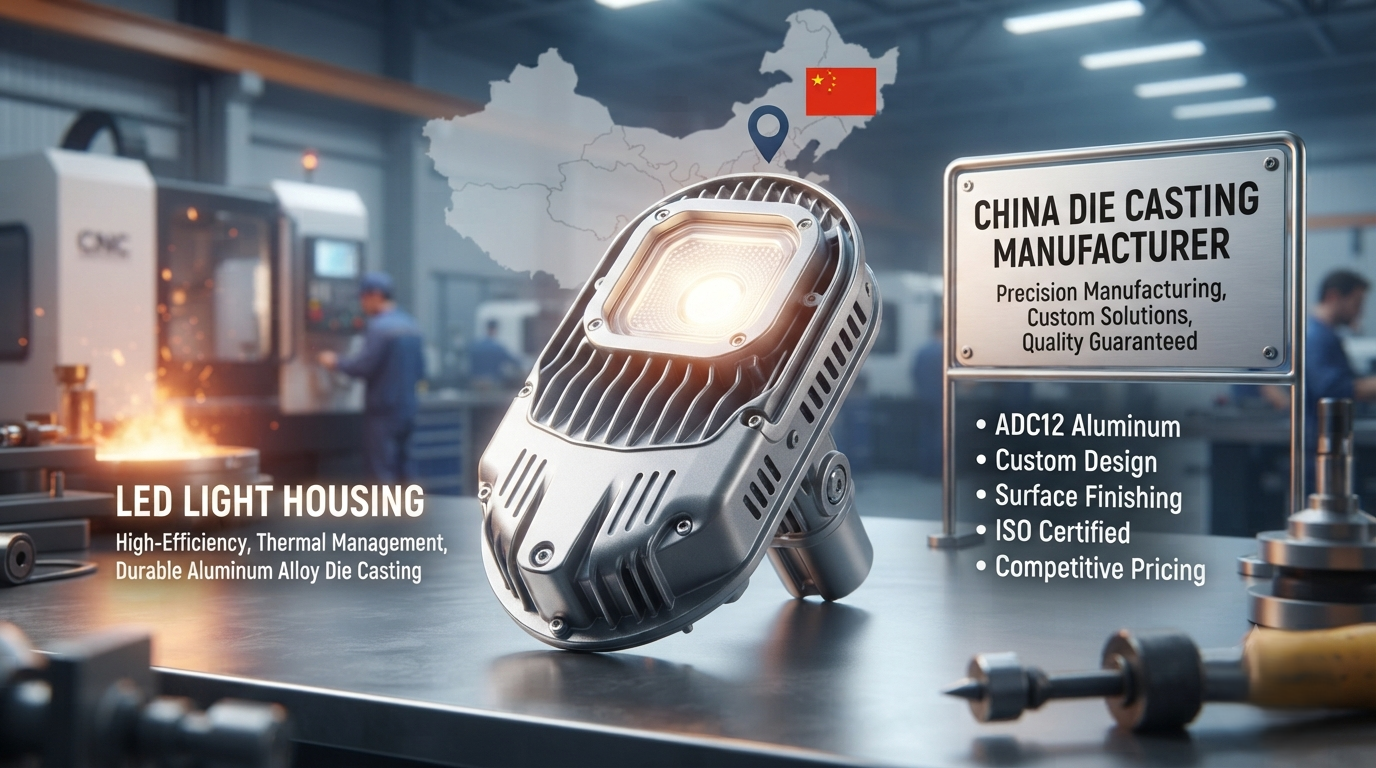
The physical housing surrounding an LED system plays a major role in heat management, durability, electrical safety, appearance, and service life. For this reason, selecting high-quality LED light housing has become an important consideration for lighting manufacturers, commercial projects, industrial facilities, and outdoor illumination applications.
At the same time, businesses worldwide increasingly work with an experienced China Die Casting Manufacturer to produce aluminum lighting enclosures with accurate dimensions, reliable thermal performance, and cost-effective mass production. Die casting is especially suitable for LED lighting because it can create complex shapes, cooling fins, mounting points, and decorative surfaces in a single manufacturing process.
What Is LED Light Housing?
An LED light housing is the structural enclosure that protects LED chips, drivers, lenses, wiring, and other internal components. It provides mechanical protection while helping the lighting system dissipate the heat produced during continuous operation.
Most professional LED housings are manufactured from aluminum alloys because aluminum combines lightweight construction, corrosion resistance, strength, and excellent thermal conductivity.
Common applications include:
- LED street lights
- Floodlights
- High-bay lights
- Tunnel lights
- Garden lights
- Industrial lighting
- Architectural lighting
- Outdoor wall lights
- Commercial lighting fixtures
A professionally engineered housing also improves the appearance of the finished lighting product, making it suitable for both functional and decorative applications.
Why Die Casting Is Ideal for LED Light Housing
Die casting allows molten metal, generally aluminum alloy, to be injected into a precision steel mold under high pressure. Once the metal cools and solidifies, manufacturers obtain a strong component with consistent dimensions and excellent surface quality.
For LED light housing, this process offers several advantages.
First, cooling fins can be integrated directly into the housing design. These fins increase the available surface area and help transfer heat from the LED module to the surrounding air.
Second, die casting supports complex product designs. Mounting holes, cable areas, driver compartments, decorative details, ribs, and structural features can often be created within one component.
Finally, the process is highly repeatable, making it suitable for large-volume LED lighting production.
Role of a China Die Casting Manufacturer
An experienced China Die Casting Manufacturer can support customers throughout product development, from initial design evaluation to tooling, casting, machining, finishing, inspection, packaging, and mass production.
Professional manufacturers typically evaluate several factors before beginning production:
- Component dimensions and wall thickness
- Aluminum alloy selection
- Thermal management requirements
- Mold structure and draft angles
- Casting pressure and temperature
- Machining tolerances
- Surface treatment requirements
- Expected annual production volume
Designing these factors correctly helps minimize porosity, shrinkage, deformation, cracking, and dimensional problems.
Importance of Thermal Management
Heat is one of the biggest challenges in LED lighting systems. Although LEDs consume less electricity than conventional lighting technologies, they still generate heat during operation.
If this heat cannot escape efficiently, the LED junction temperature may increase. Excessive temperatures can reduce brightness, affect color consistency, damage electronic components, and shorten product life.
A well-designed LED light housing acts as a heat-dissipation structure. Aluminum transfers heat away from the LED board while carefully designed fins release heat into the surrounding environment.
Manufacturers can improve thermal performance through:
- Optimized cooling-fin geometry
- Suitable aluminum alloys
- Proper housing thickness
- Efficient contact between PCB and housing
- Thermal interface materials
- Improved airflow around the enclosure
Thermal simulation can also be performed before tooling to identify potential overheating problems.
Aluminum Alloys Used for Die Casting
The selection of aluminum alloy affects strength, casting performance, corrosion resistance, machining, and thermal characteristics.
| Factor | Importance for LED Housing |
| Thermal conductivity | Helps remove heat from LED components |
| Mechanical strength | Protects internal components |
| Corrosion resistance | Supports outdoor applications |
| Castability | Enables complex housing designs |
| Machinability | Supports drilling and precision finishing |
| Surface quality | Improves coating and appearance |
A reliable China Die Casting Manufacturer selects the alloy according to product requirements instead of using the same material for every project.
Surface Finishing Options
Surface treatment improves both the appearance and environmental resistance of die-cast lighting components.
Powder coating is one of the most popular finishes for LED light housing because it provides a uniform appearance and additional protection against moisture and corrosion.
Other possibilities may include painting, polishing, electrophoresis, anodizing where suitable, shot blasting, and customized decorative coatings.
Outdoor lighting products may require additional corrosion-resistant treatment when they are installed in coastal, humid, industrial, or chemically aggressive environments.
Quality Control in LED Housing Production
Consistent quality is essential because even small dimensional errors can create assembly, sealing, or thermal-management problems.
A professional China Die Casting Manufacturer may use dimensional inspection equipment, gauges, pressure testing, surface inspection, alloy testing, machining inspection, and production sampling.
Important quality checks include:
- Dimensional accuracy
- Flatness
- Thread quality
- Surface defects
- Porosity
- Coating thickness
- Assembly compatibility
- Water-resistant sealing areas
Stable manufacturing processes reduce rejected parts and improve final lighting reliability.
Die Casting Compared With Other Manufacturing Methods
| Manufacturing Method | Production Speed | Complex Shapes | Large Volume | Typical Cost |
| Die Casting | High | Excellent | Excellent | Low per unit at scale |
| CNC Machining | Low | Good | Limited | Higher |
| Extrusion | High | Limited | Excellent | Moderate |
| Sheet Metal | Moderate | Moderate | Good | Moderate |
For complex aluminum lighting enclosures produced in high quantities, die casting often offers an effective balance between design freedom, productivity, quality, and unit cost.
Choosing the Right Manufacturing Partner
When sourcing LED light housing, price should not be the only deciding factor. Manufacturing capability can directly influence product quality and long-term supply reliability.
Evaluate whether the supplier provides tooling design, die casting, CNC machining, finishing, inspection, packaging, and engineering assistance.
You should also confirm:
- Available die-casting machine capacity
- Mold-making capability
- Quality-control procedures
- Material traceability
- Production capacity
- Customization options
- Prototype support
- Communication efficiency
- Export experience
A technically capable China Die Casting Manufacturer should understand both the casting process and the functional requirements of LED lighting products.
FAQ About LED Light Housing and Die Casting
1. What material is commonly used for LED light housing?
Aluminum alloys are commonly used because they provide good heat dissipation, lightweight construction, durability, and corrosion resistance.
2. Why does LED housing need cooling fins?
Cooling fins increase surface area, allowing heat to dissipate more efficiently into the surrounding air.
3. Is die casting suitable for outdoor LED lights?
Yes. Die-cast aluminum is widely used for street lights, floodlights, garden lights, and other outdoor fixtures when combined with suitable sealing and surface treatments.
4. Can LED housing be customized?
Yes. A China Die Casting Manufacturer can develop customized molds according to drawings, 3D models, dimensions, mounting requirements, and desired appearance.
5. What is the benefit of aluminum LED housing?
It offers an excellent combination of thermal conductivity, mechanical strength, relatively low weight, and manufacturing flexibility.
6. Can die casting produce complex lighting designs?
Yes. Die casting can manufacture detailed geometries, cooling fins, ribs, mounting areas, and integrated structural features.
7. Is CNC machining required after die casting?
Some components require CNC machining for precision holes, threads, sealing surfaces, or dimensional tolerances.
8. What finishing is suitable for outdoor LED housing?
Powder coating is commonly selected because of its appearance, durability, and protection against environmental exposure.
9. Is die casting economical for large orders?
Yes. Although tooling requires an initial investment, the cost per component generally becomes more economical as production quantity increases.
10. How should I select a die casting supplier?
Evaluate engineering expertise, tooling capability, quality systems, production equipment, materials, finishing options, delivery capacity, and communication.