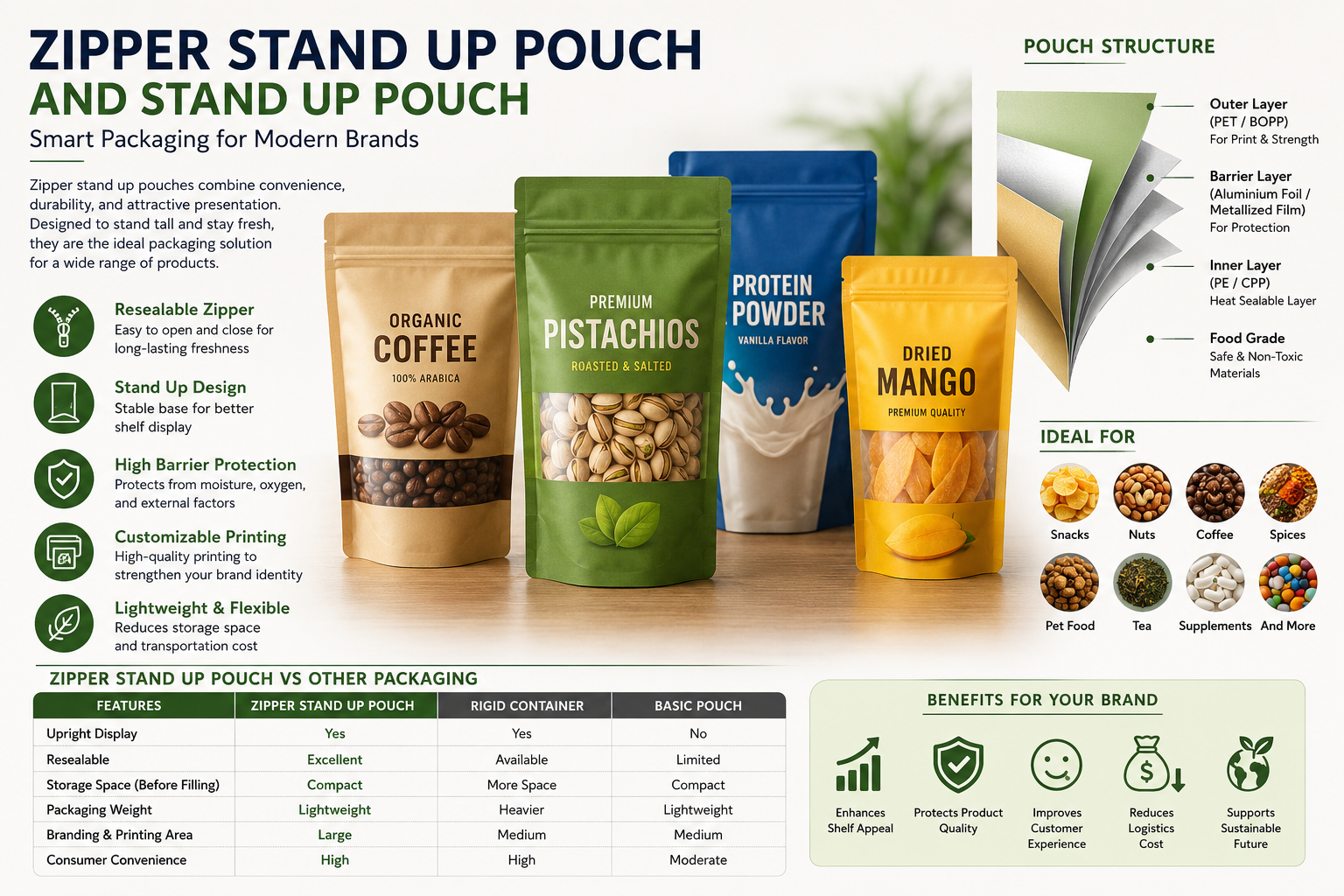
A well-designed Stand Up Pouch combines flexibility with strong shelf presentation. Its bottom gusset allows the package to remain upright, while optional zipper closures make repeated opening and closing convenient for consumers. For brands looking to balance visual appeal, practicality, and product protection, stand-up flexible packaging offers several advantages.
What Is a Zipper Stand Up Pouch?
A zipper stand up pouch is flexible packaging designed with a bottom gusset that expands when filled. This structure creates a stable base, enabling the pouch to stand vertically on retail shelves.
The addition of a resealable zipper makes the package particularly useful for products consumed over multiple occasions. Customers can open the pouch, remove the required quantity, and seal the remaining contents again.
These pouches can be manufactured using different laminated films and barrier materials depending on product requirements. Transparent windows, matte surfaces, glossy finishes, metallic effects, printing, tear notches, and hang holes can also be incorporated into the design.
Why Stand Up Pouch Packaging Is Growing in Popularity
Modern consumers value packaging that is easy to handle, store, carry, and reuse. A Stand Up Pouch addresses many of these expectations while giving manufacturers a large printable surface for branding.
Compared with bulky rigid containers, flexible pouches can also require less storage space before filling. Their lightweight construction may help businesses simplify transportation and warehousing.
Important advantages include:
- Strong shelf visibility
- Convenient resealable options
- Lightweight packaging construction
- Custom printing possibilities
- Multiple barrier-material choices
- Easy storage for consumers
- Suitable formats for different product quantities
- Flexible shapes and dimensions
These characteristics make stand-up pouches useful for both established manufacturers and growing consumer brands.
How Zipper Packaging Improves Consumer Convenience
Convenience is one of the biggest reasons businesses choose a zipper stand up pouch.
Traditional packaging may require consumers to transfer the product into another container after opening. A zipper pouch can eliminate this extra step.
Easy Opening and Closing
Many pouches combine a tear notch with a resealable zipper. Consumers tear the sealed upper section and then use the zipper for subsequent access.
Better Everyday Storage
The upright structure helps organize products inside kitchen cabinets, refrigerators, drawers, retail displays, and storage areas.
Useful for Repeated Consumption
Products such as nuts, coffee, snacks, dried fruit, pet treats, powders, and confectionery may not be consumed immediately. Resealable packaging makes handling these products considerably easier.
Common Applications of Stand Up Pouches
The flexibility of a Stand Up Pouch allows manufacturers to package many different types of dry, semi-solid, and selected liquid products.
Common applications include:
- Snacks and namkeen
- Dry fruits and nuts
- Tea and coffee
- Spices and seasonings
- Protein and nutrition powders
- Pet food and treats
- Confectionery
- Bakery ingredients
- Personal care products
- Household and cleaning products
The actual pouch structure should always be selected according to the characteristics of the packed product, expected shelf life, filling process, transportation conditions, and applicable packaging requirements.
Material and Barrier Considerations
Choosing an attractive design is important, but packaging performance depends greatly on material selection.
Different products may require protection against moisture, oxygen, light, aroma loss, or external contamination. Therefore, manufacturers often use multilayer structures where each layer performs a specific function.
For example, the outer layer may support printing and durability, while internal layers may provide sealing performance and product protection.
| Packaging Requirement | Possible Packaging Feature |
| Moisture protection | Moisture-barrier structure |
| Aroma retention | High-barrier laminate |
| Product visibility | Transparent window |
| Premium appearance | Matte or metallic finish |
| Repeated opening | Resealable zipper |
| Easy initial opening | Tear notch |
| Shelf display | Stable bottom gusset |
Packaging suppliers should evaluate the actual product before recommending a specific structure.
Branding Opportunities with Custom Stand Up Pouches
Packaging is often the first physical interaction customers have with a product. A customized Stand Up Pouch gives brands substantial space for visual communication.
Companies can display:
- Brand logos
- Product names
- Ingredients
- Usage instructions
- Nutritional information
- Certifications
- Promotional messages
- QR codes
- Contact details
Modern printing techniques can reproduce detailed graphics and distinctive brand identities across pouch surfaces.
Smaller brands can use professional packaging to create stronger retail presence, while established companies can develop consistent designs across multiple product ranges.
Zipper Stand Up Pouch vs Traditional Packaging
Businesses should compare packaging formats according to their individual requirements rather than selecting a package solely on appearance.
| Feature | Zipper Stand Up Pouch | Traditional Rigid Pack |
| Resealable option | Commonly available | Depends on closure |
| Weight | Generally lightweight | Usually heavier |
| Printable area | Large flexible surface | Varies |
| Storage before filling | Space efficient | Requires more volume |
| Shelf presentation | Stands upright | Usually stands upright |
| Shape customization | Highly flexible | More restricted |
| Product protection | Depends on laminate | Depends on material |
Neither format is universally suitable. Product compatibility, machinery, logistics, regulations, consumer expectations, and budget must all be considered.
Choosing the Right Stand Up Pouch
Before ordering packaging, businesses should carefully define their requirements.
Consider these factors:
- Determine the product weight and dimensions.
- Understand moisture and oxygen sensitivity.
- Select suitable barrier properties.
- Decide whether a zipper is necessary.
- Choose matte, gloss, transparent, or metallic presentation.
- Confirm printing requirements.
- Evaluate filling and sealing equipment.
- Test prototypes before bulk production.
Testing is especially important because packaging that works for one product may not perform equally well for another.
Frequently Asked Questions
What is a zipper stand up pouch?
A zipper stand up pouch is flexible packaging with a bottom gusset and resealable zipper that allows the pouch to stand upright.
What products can be packed in stand-up pouches?
They are commonly used for snacks, coffee, tea, dry fruits, spices, powders, confectionery, pet treats, and other suitable products.
Are stand-up pouches resealable?
They can be. Manufacturers can add press-to-close zipper systems depending on packaging requirements.
Can stand-up pouches have transparent windows?
Yes. Transparent sections can be incorporated to allow consumers to view the product.
Can businesses print their branding on the pouch?
Yes. Custom graphics, logos, product information, and branding can be printed on compatible pouch materials.
What is the purpose of the bottom gusset?
The gusset expands after filling and helps create the base that allows the pouch to stand.
Are zipper pouches suitable for food?
They can be produced for food packaging when appropriate food-contact materials and manufacturing requirements are followed.
Can different pouch sizes be manufactured?
Yes. Dimensions can normally be customized according to product quantity, filling requirements, and branding needs.
What finishes are available?
Common options include glossy, matte, transparent, metallic, and combinations of different visual effects.
How do I select the correct pouch material?
Consider product sensitivity, shelf-life objectives, sealing conditions, distribution environment, and applicable regulatory requirements. A packaging specialist can recommend an appropriate structure.