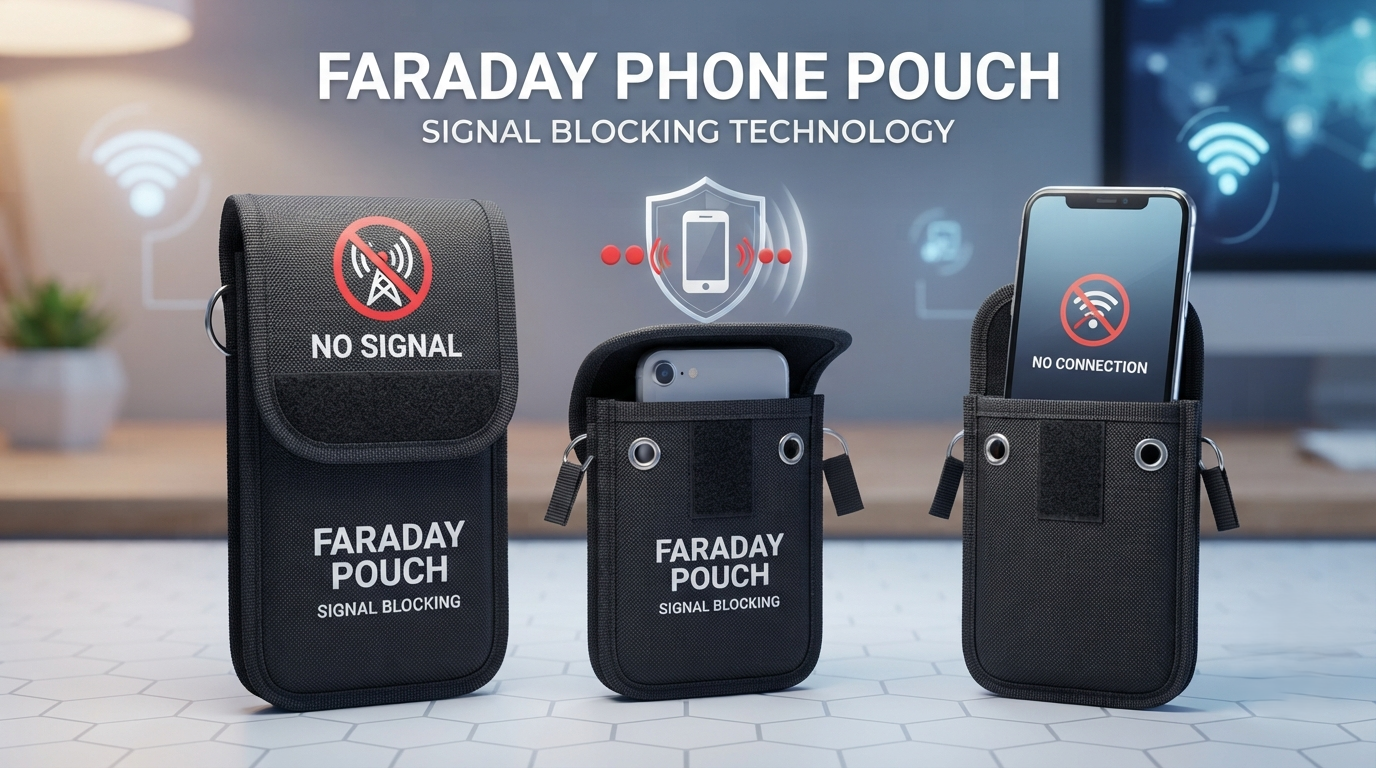
Smartphones stay connected almost continuously through cellular networks, Wi-Fi, Bluetooth, GPS, NFC, and other wireless technologies. While this connectivity is useful, there are situations where users may want to temporarily isolate a phone from surrounding wireless signals. A faraday phone pouch is designed specifically for this purpose.
A properly constructed Signal Blocking Phone Pouch uses conductive shielding materials to reduce or prevent radio-frequency signals from reaching a smartphone. It can be useful for privacy, travel, security procedures, device testing, and controlled environments where wireless communication needs to be restricted temporarily.
Understanding a Faraday Phone Pouch
A faraday phone pouch is a protective enclosure made with radio-frequency shielding materials. The concept is based on a Faraday cage, where conductive material surrounds an electronic device and restricts electromagnetic signals from passing through.
Unlike airplane mode, which depends on the phone’s software settings, a signal-blocking pouch works through physical shielding.
Depending on its construction and supported frequency range, a quality pouch may reduce communication involving:
- Cellular networks
- Wi-Fi connections
- Bluetooth devices
- GPS signals
- NFC communication
- RFID frequencies
However, actual blocking performance differs between products.
Why People Use Signal Blocking Phone Pouches
The main reason for using a Signal Blocking Phone Pouch is temporary wireless isolation. Instead of switching off several connectivity settings individually, users can place the phone inside the pouch and close it correctly.
This can be useful when someone wants to prevent a mobile device from automatically communicating with nearby networks.
Common situations include:
- Business meetings where wireless devices must remain disconnected.
- Travel where temporary phone isolation may be preferred.
- Digital-forensics procedures involving mobile devices.
- Security testing and controlled technology environments.
- Privacy-focused storage of mobile phones.
- Research facilities where wireless communication needs to be limited.
A faraday phone pouch can therefore serve both everyday users and professionals.
How Signal Blocking Technology Works
Modern phones send and receive radio-frequency energy. Cellular towers, wireless routers, Bluetooth accessories, navigation satellites, and NFC readers all depend on electromagnetic communication.
A signal-blocking pouch usually contains layers of conductive fabric, metallic fibers, or specialized shielding materials.
These materials interfere with wireless signals by reflecting or absorbing electromagnetic energy.
When the phone is completely enclosed, communication becomes significantly more difficult.
The Closure Is Just as Important as the Material
One of the most overlooked parts of a Signal Blocking Phone Pouch is its opening.
Even if the fabric provides strong shielding, an improperly closed pouch may leave a path for signals to enter.
Common closure systems include:
- Fold-over shielding flaps
- Magnetic closures
- Hook-and-loop systems
- Double-layer sealing designs
- Multi-fold protective openings
For consistent results, the phone must fit comfortably inside while allowing the pouch to close completely.
Faraday Phone Pouch vs Airplane Mode
Many users wonder why they should use a faraday phone pouch when smartphones already provide airplane mode.
The two solutions work differently.
| Feature | Faraday Phone Pouch | Airplane Mode |
| Physical signal isolation | Yes | No |
| Depends on software | No | Yes |
| Phone can remain powered | Yes | Yes |
| Wi-Fi may remain available | Normally blocked | Can be re-enabled |
| Bluetooth may remain available | Normally blocked | Can be re-enabled |
| Designed for controlled isolation | Yes | Limited |
Airplane mode is convenient for everyday use, while a Signal Blocking Phone Pouch provides an additional physical isolation layer.
What to Check Before Buying a Faraday Phone Pouch
Not every pouch delivers the same performance. Buyers should look beyond appearance and marketing claims.
Important considerations include:
Frequency Coverage
Check which wireless frequencies the pouch is designed to block.
A modern smartphone may communicate through several technologies, so broader frequency coverage can be important.
Shielding Performance
Manufacturers may provide attenuation measurements in decibels. Clear testing information is usually more useful than claims such as “100% signal blocking.”
Secure Closure
A strong shielding pouch should have a closure system that minimizes gaps.
Correct Size
The phone should fit inside without forcing the flap or seal open.
Remember that a protective phone case can increase the required internal dimensions.
Build Quality
Frequent opening, folding, carrying, and bending can gradually damage low-quality shielding material.
Durable stitching and reinforced conductive layers can improve product life.
How to Test a Signal Blocking Phone Pouch
Testing a new Signal Blocking Phone Pouch is an important step.
Place the phone inside and close the pouch according to the manufacturer’s instructions.
Then try:
- Calling the phone from another device
- Sending a text message
- Checking Wi-Fi connectivity
- Testing Bluetooth connection
- Checking whether navigation signals are available
Repeat the test in different environments because wireless signal strength can vary significantly.
A pouch that works in an area with weak cellular coverage should also be tested where signal strength is stronger.
Does a Faraday Phone Pouch Protect Your Data?
A faraday phone pouch helps control wireless communication, but it should not be confused with complete data security.
The pouch does not automatically:
- Encrypt your files
- Remove malware
- Stop someone who knows your password
- Protect weak online accounts
- Replace device updates
- Prevent physical access to an unlocked phone
For stronger privacy, signal isolation should be combined with secure passwords, encryption, multi-factor authentication, updated software, and sensible device management.
Who May Need a Signal Blocking Phone Pouch?
Different users may benefit from this type of product.
Business professionals can use one during confidential meetings.
Travelers may use one when they want their phone temporarily disconnected.
Security professionals can use shielding bags while testing communication systems.
Digital-forensics teams may use specialized versions when handling electronic evidence.
Privacy-conscious individuals may simply prefer a physical way to disconnect their phone without turning it off.
Frequently Asked Questions
1. What is a faraday phone pouch?
A faraday phone pouch is a conductive shielding enclosure designed to reduce wireless communication between a smartphone and external networks.
2. Can it block mobile signals?
A properly designed pouch can significantly reduce or block cellular communication when correctly sealed.
3. Will it stop Wi-Fi?
Many pouches are designed to block Wi-Fi frequencies, but users should confirm the manufacturer’s specifications.
4. Can Bluetooth work inside the pouch?
Usually not if the pouch effectively covers Bluetooth frequencies.
5. Does it block GPS?
Some products can attenuate GPS signals, depending on their shielding range and construction.
6. Will notifications arrive while the phone is inside?
If wireless communication is successfully blocked, online notifications normally cannot reach the phone until connectivity returns.
7. Does the pouch damage a phone?
Normal use should not damage a smartphone when the pouch is appropriately sized and constructed.
8. Can I keep the phone switched on?
Yes. The phone can remain powered while stored inside.
9. Does every Faraday pouch block 5G?
No. Buyers should verify that the product supports the relevant 5G frequency ranges.
10. How often should the pouch be tested?
Periodic testing is recommended, especially after extensive use or visible wear.