
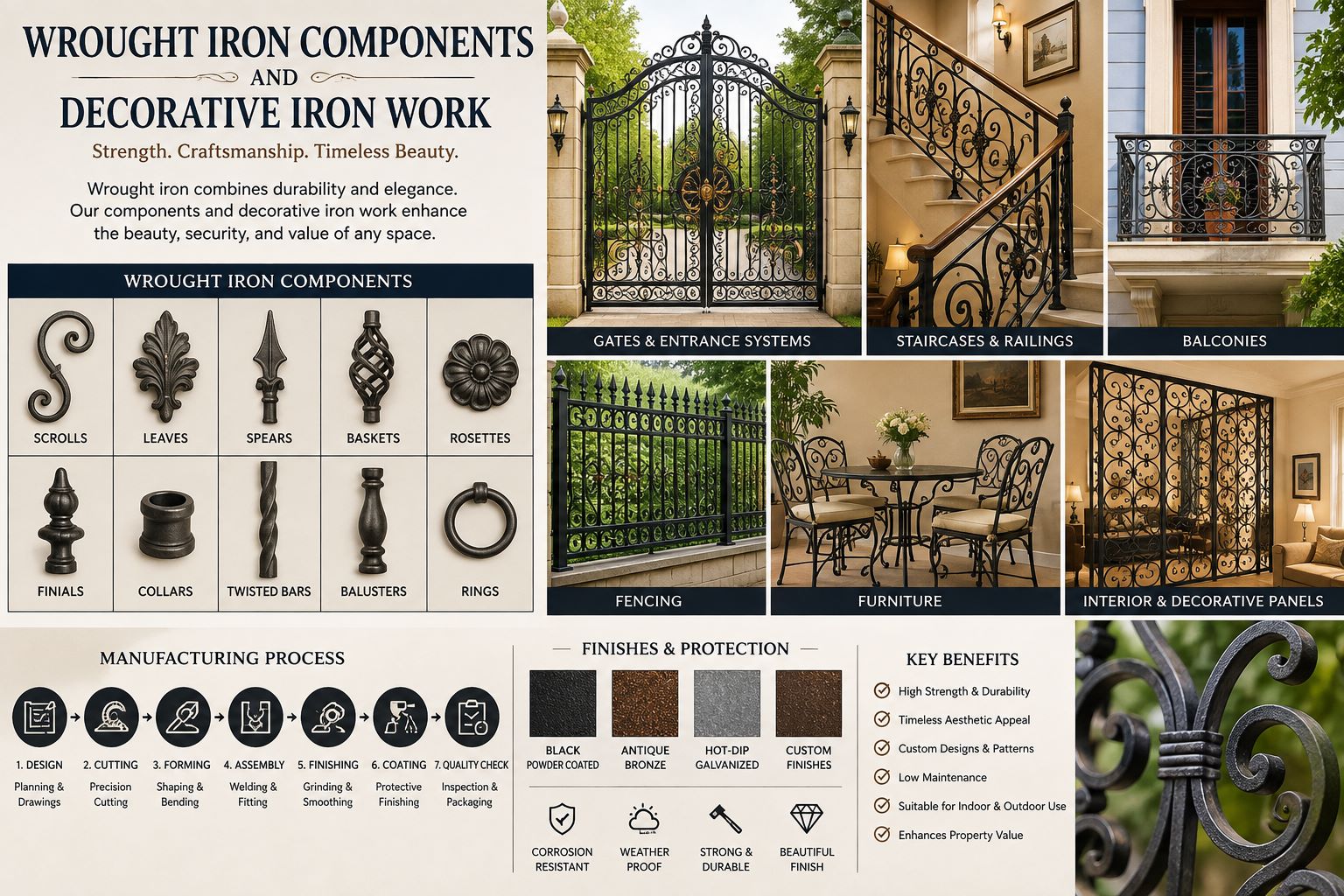
The architectural metal industry is undergoing a noticeable transformation as demand for wrought iron components and decorative iron work continues to expand across residential, commercial, hospitality, and landscape projects. Manufacturers that once relied heavily on manual forging are increasingly combining traditional craftsmanship with digital design, precision machinery, modern coatings, and customized production.
Industry professionals say the shift is not eliminating traditional ironwork. Instead, it is changing how ornamental metal products are designed, manufactured, and supplied.
From elaborate entrance gates to minimalist balcony railings, decorative metalwork is finding new applications in both classical and contemporary architecture.
Traditional Wrought Iron Craftsmanship Built the Foundation
For centuries, wrought iron was shaped by skilled blacksmiths working with simple tools and intense heat.
Iron bars were heated in furnaces before being manually hammered, twisted, curved, punched, or flattened. Each scroll, leaf, flower, basket, and ornamental bar required individual attention.
Traditional wrought iron components commonly included:
- Decorative scrolls
- Forged leaves
- Iron flowers
- Rosettes
- Spearheads
- Finials
- Twisted bars
- Ornamental baskets
- Decorative rings
- Balusters
Because most work was completed manually, decorative pieces often showed small variations. Rather than being considered defects, these variations became part of the handmade identity of traditional ironwork.
Historic Buildings Increased Demand for Decorative Iron Work
Architectural history demonstrates that decorative iron work was never used solely for appearance.
Iron gates provided security while decorative balconies offered both protection and visual character. Railings helped improve safety around staircases, terraces, and elevated areas.
Historic applications included palaces, villas, churches, government buildings, gardens, public spaces, and private residences.
Ornamental iron was particularly valued because fabricators could combine practical construction requirements with artistic patterns.
Large gates often featured floral scrolls and spearheads, while staircases incorporated decorative balusters and handrails.
Modern Manufacturing Is Changing Production Methods
The industry has changed considerably with the introduction of advanced fabrication machinery.
Today, manufacturers can use mechanical bending equipment, laser cutting systems, CNC machines, welding technology, and specialized forming equipment to produce decorative components.
Modern production makes it easier to achieve consistent dimensions across larger quantities.
This has become especially important for commercial projects requiring hundreds of matching wrought iron components.
Current production methods may include:
- Digital design preparation
- Material cutting
- Bending and forming
- Forging or pressing
- Welding and assembly
- Grinding and finishing
- Surface preparation
- Protective coating
- Final inspection
- Packaging and installation preparation
These steps allow manufacturers to combine efficiency with customized design.
Decorative Iron Work Moves Into Contemporary Architecture
One of the most significant changes in the market is the growing use of decorative iron work in modern architecture.
Ornamental iron is no longer associated only with elaborate traditional gates.
Contemporary designers are using simpler profiles, geometric patterns, clean lines, and controlled decorative features.
Popular modern applications now include:
- Entrance gates
- Balcony railings
- Staircases
- Interior partitions
- Garden fences
- Privacy screens
- Pergolas
- Decorative wall panels
- Furniture
- Architectural façades
Iron can also be combined with glass, wood, stone, marble, concrete, brass, or stainless steel.
This ability to work alongside other materials is helping decorative iron adapt to changing architectural trends.
Industry Shifts From Heavy Decoration to Personalized Design
Manufacturers are seeing increased interest in customization.
In earlier decades, customers often selected from standard catalogs containing fixed patterns. Modern buyers increasingly want designs created specifically for a particular property.
This has encouraged manufacturers to provide customized dimensions, decorative patterns, finishes, motifs, and component combinations.
Digital design technology has made customization more practical.
Designers can prepare detailed drawings before fabrication begins, helping customers understand how gates, railings, or panels may appear after installation.
Traditional and Modern Production Compared
| Industry Area | Traditional Method | Modern Direction |
| Designing | Hand sketches | Digital CAD designs |
| Forming | Manual forging | Precision machinery |
| Pattern Production | Individual pieces | Repeatable components |
| Customization | Labor intensive | Digitally controlled |
| Quality Checking | Manual measurement | Precision inspection |
| Finishing | Basic paint systems | Advanced coatings |
| Production Scale | Small batches | Flexible large batches |
| Design Style | Highly ornamental | Traditional and modern |
| Waste Control | Limited planning | Optimized cutting |
| Customer Preview | Physical samples | Digital visualization |
The two approaches are not necessarily competing. Many manufacturers are combining them.
Technology Creates New Possibilities for Wrought Iron Components
Digital production technology is expected to play an even greater role in the future of wrought iron components.
Laser cutting systems can produce detailed panels, while CNC equipment can improve repeatability.
Three-dimensional modeling can help architects evaluate dimensions and proportions before production begins.
Advanced software may also help manufacturers calculate material requirements and optimize cutting arrangements.
These improvements can reduce waste, improve accuracy, and shorten production cycles.
Sustainability Becomes an Industry Priority
Environmental responsibility is also becoming a bigger issue within metal manufacturing.
Companies are increasingly examining how materials are purchased, processed, coated, and recycled.
Future decorative iron work production may place greater emphasis on:
- Recycled metal content
- Efficient material cutting
- Reduced scrap
- Energy-efficient machinery
- Durable protective coatings
- Longer product lifecycles
- Recyclable packaging
- Responsible waste management
Iron and steel can be recycled, giving ornamental metalwork an advantage when products are properly recovered at the end of their useful life.
Durability is another important factor. A well-manufactured decorative structure that remains functional for decades can reduce the need for frequent replacement.
Artificial Intelligence Could Influence Decorative Metal Design
The next major change could come from artificial intelligence and advanced design platforms.
AI-assisted tools may eventually help designers generate patterns based on architectural styles, panel dimensions, spacing, or customer preferences.
For example, software could produce multiple gate concepts using geometric, floral, classical, or minimalist themes.
Designers would still need to evaluate manufacturing feasibility, structural requirements, materials, and installation conditions.
The technology is more likely to support experienced professionals than completely replace their expertise.
Future Trends Point Toward Simpler and Smarter Designs
Industry trends suggest that decorative iron will continue evolving toward a combination of minimalism and personalization.
Traditional scrolls and floral patterns are likely to remain important for classical architecture, restoration projects, luxury villas, and heritage properties.
Modern developments may increasingly use:
- Geometric panels
- Minimalist railings
- Laser-cut screens
- Nature-inspired motifs
- Mixed glass and iron
- Matte finishes
- Modular components
- Customized entrance gates
- Contemporary balcony panels
- Personalized decorative symbols
The growing variety of styles could expand the market further by allowing decorative iron to fit almost any architectural concept.
Market Opportunities Expand Across Multiple Sectors
Demand for wrought iron components is not limited to residential construction.
Hotels, resorts, restaurants, shopping developments, office projects, landscape contractors, furniture manufacturers, and architectural restoration specialists can all use ornamental metal products.
Manufacturers capable of supplying both standardized and customized components may be well positioned to serve this broader market.
Consistency, production capacity, finishing quality, customization, and delivery reliability will likely remain important purchasing factors.
Frequently Asked Questions
1. What are wrought iron components?
They are decorative or structural metal pieces used to manufacture gates, railings, fences, balconies, furniture, and architectural structures.
2. What is decorative iron work?
Decorative iron work refers to ornamental metal fabrication designed to provide both functionality and visual appeal.
3. Is decorative iron still popular?
Yes. It continues to be used in traditional and modern architectural projects.
4. What components are commonly used?
Scrolls, leaves, flowers, finials, spearheads, baskets, collars, rings, and balusters are common examples.
5. Has modern technology changed iron manufacturing?
Yes. CNC machines, laser cutting, digital design, advanced welding, and modern finishing have improved production.
6. Can wrought iron components be customized?
Yes. Sizes, designs, patterns, finishes, and component combinations can be modified for specific projects.
7. Is ironwork suitable for modern buildings?
Yes. Minimalist and geometric decorative designs can complement modern architecture.
8. Can decorative iron be combined with glass?
Yes. Iron and glass are frequently combined in modern railings, staircases, balconies, and partitions.
9. Is decorative iron sustainable?
Recycled materials, efficient manufacturing, long product life, and responsible waste management can improve sustainability.
10. What is the future of decorative iron work?
The sector is expected to move toward digital customization, automation, sustainable production, precision manufacturing, and increasingly personalized architectural designs.