
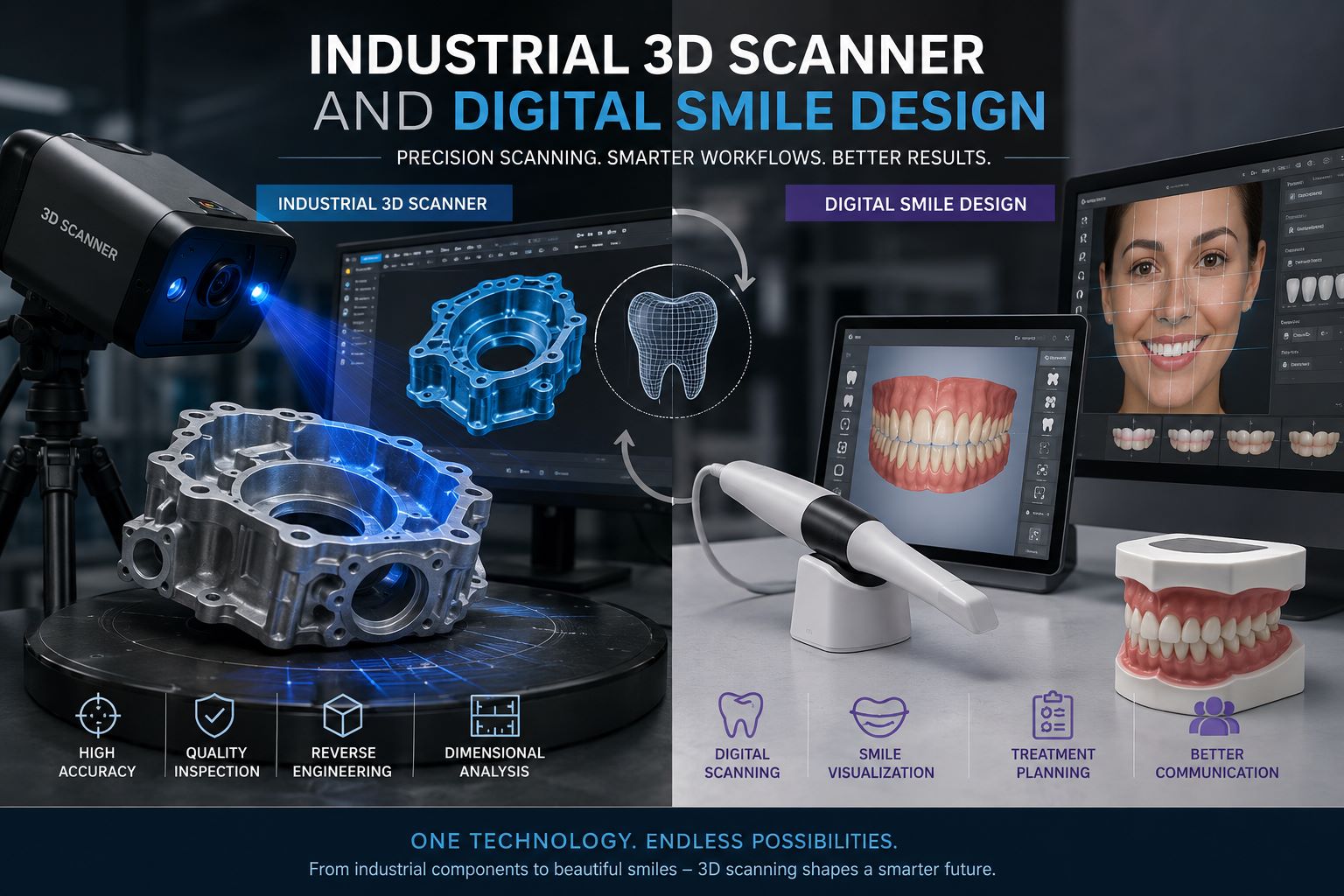
Digital technology is transforming how professionals capture real-world details and plan accurate results. Two strong examples are the industrial 3D scanner and digital smile design. One serves manufacturing while the other supports dentistry, yet both rely on precise data, 3D visualization, and computer-assisted planning.
An industrial 3D scanner converts physical objects into measurable digital geometry. Digital smile design combines scans, photographs, facial information, and software to visualize a proposed smile.
What Is an Industrial 3D Scanner?
An industrial 3D scanner is a metrology tool used to capture the shape, size, contours, and surface details of physical components. Depending on the system, it may use laser lines, structured light, cameras, or triangulation to collect 3D coordinates. These coordinates form a point cloud that can be processed into a mesh or compared with CAD data.
ZEISS explains that structured-light scanners project patterns onto a surface and use cameras to calculate 3D coordinates, while laser scanners capture changing surface geometry as a laser moves across a component.
Common applications include:
- Dimensional inspection
- Reverse engineering
- Prototype verification
- Tool and die inspection
- CAD-to-part comparison
- Automotive measurement
The main advantage is capturing complex freeform surfaces efficiently.
How Industrial 3D Scanning Improves Manufacturing
Manufacturers need speed and reliable inspection. An industrial 3D scanner helps engineers compare manufactured parts against design specifications.
A typical workflow includes:
- Prepare and position the component.
- Capture scans from required angles.
- Align the scan data.
- Build and clean the digital mesh.
- Compare the scan with CAD geometry.
- Generate dimensional reports.
This process may reveal warpage, dimensional errors, or assembly mismatch. It also supports reverse engineering when no usable CAD file exists.
What Is Digital Smile Design?
Digital smile design is a digitally assisted approach to aesthetic and restorative dental planning. It uses facial photographs, videos, intraoral scans, and software to evaluate how proposed tooth shapes, proportions, and positions relate to the patient’s face.
Published digital workflows describe combining facial records, intraoral scans, CAD tools, 3D models, and trial restorations before final fabrication.
The technology may support veneers, crowns, implants, orthodontics, and full-mouth rehabilitation. It does not replace diagnosis; digital smile design adds a visual planning layer.
How Digital Smile Design Improves Communication
A major benefit of digital smile design is easier visualization. Technical dental descriptions can be hard to imagine, while digital simulations make proposed changes clearer.
A typical workflow may include:
- Facial and intraoral photography
- Video of natural expressions
- Intraoral scanning
- Smile proportion analysis
- Digital tooth setup
- CAD/CAM planning
- Mock-up testing
- Final restoration production
Digital records also help dentists, specialists, and laboratory technicians coordinate treatment. Published workflows show how scans, photographs, and CAD/CAM tools can be combined for planning and fabrication.
Industrial 3D Scanner vs Digital Smile Design
| Factor | Industrial 3D Scanner | Digital Smile Design |
| Main field | Manufacturing | Dentistry |
| Input | Physical components | Teeth, face, scans, photos |
| Output | Point cloud, mesh, inspection data | Digital smile plan |
| Purpose | Measurement and verification | Aesthetic treatment planning |
| Software | CAD inspection, reverse engineering | Dental CAD, smile simulation |
| Benefit | Geometric analysis | Visualization and planning |
Despite serving different industries, both technologies convert physical reality into digital information that can be measured, reviewed, shared, and used for production.
Choosing the Right Digital Workflow
When selecting an industrial 3D scanner, consider accuracy, scan volume, component size, surface properties, portability, calibration, software compatibility, and technical support. A scanner for small precision parts may not suit large castings.
For digital smile design, dental practices should consider scanner compatibility, image quality, CAD/CAM integration, laboratory workflow, staff training, data handling, and patient communication.
In both fields, software integration matters as much as hardware. Data is most useful when it moves smoothly into inspection, CAD, manufacturing, or treatment-planning systems.
Key Benefits of 3D Digital Technologies
The industrial 3D scanner and digital smile design reflect a broader shift toward data-driven workflows.
Key benefits include:
- Faster geometry capture
- Better visualization
- Stronger documentation
- Easier collaboration
- Digital comparison and simulation
- Reduced manual measurement
Results still depend on scanning technique, calibration, software settings, operator skill, and professional interpretation.
Frequently Asked Questions
1. What does an industrial 3D scanner measure?
It captures surface geometry, contours, dimensions, and spatial coordinates.
2. Is industrial 3D scanning accurate?
Accuracy depends on scanner type, calibration, environment, surface, and procedure.
3. Can a 3D scanner create CAD data?
It can produce point clouds or meshes that may be converted into CAD-compatible geometry.
4. Which industries use industrial 3D scanners?
Automotive, aerospace, tooling, energy, research, and precision manufacturing are common users.
5. What is digital smile design used for?
It helps plan and visualize aesthetic or restorative dental changes.
6. Does digital smile design guarantee results?
No. Outcomes depend on diagnosis, materials, treatment execution, and patient factors.
7. Does digital smile design use 3D scanning?
Many workflows use intraoral scans and may also include facial scans, photographs, and video.
8. Can patients preview their smile?
Depending on the workflow, patients may see a simulation or test a physical mock-up.
9. Are industrial and dental scanners the same?
No. They are designed for different surfaces, software, environments, and professional requirements.
10. Why is 3D data useful in both fields?
It helps professionals evaluate shape, proportion, alignment, deviation, and spatial relationships.