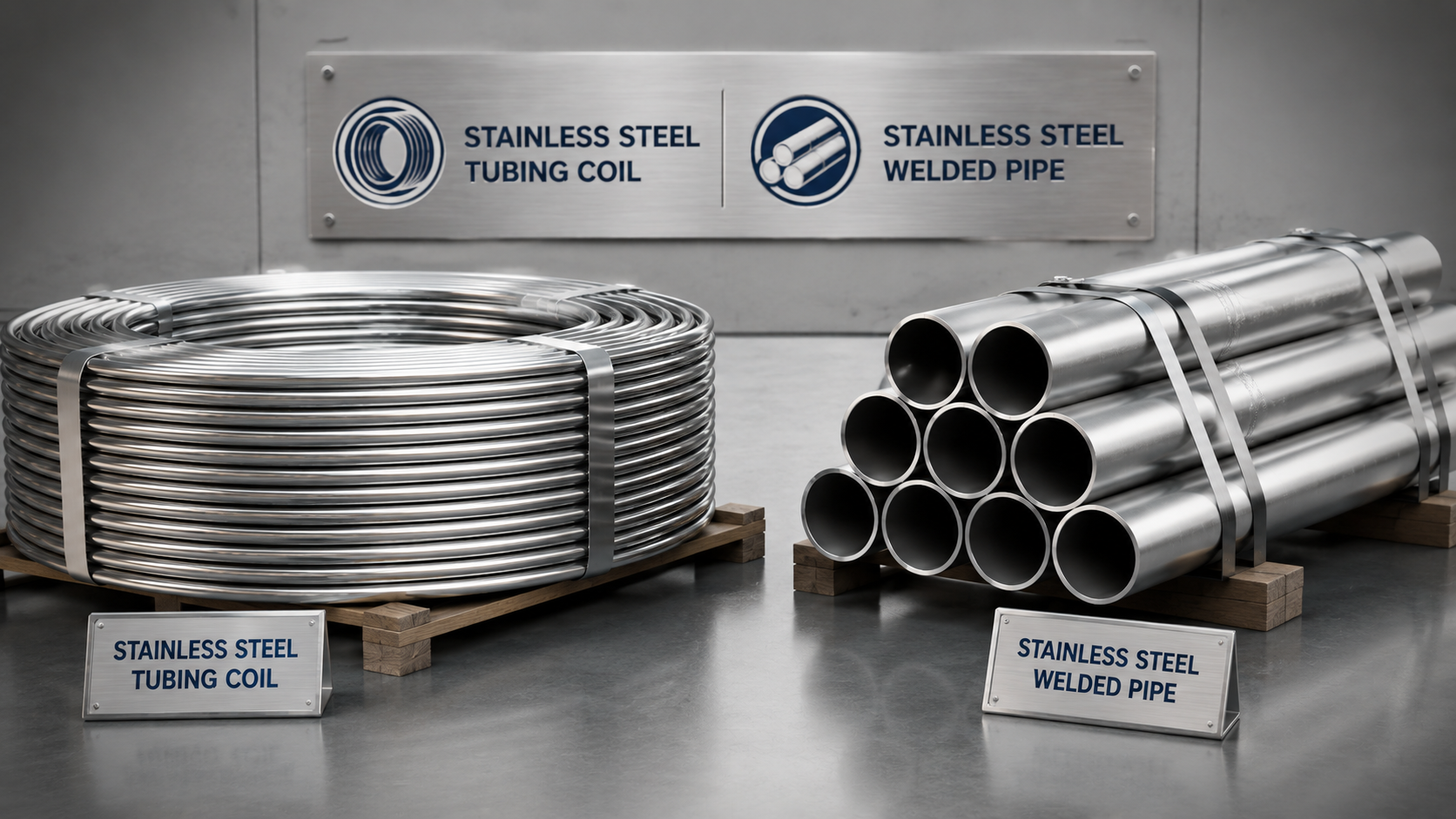
Stainless steel has become one of the most dependable materials for modern industrial piping, fluid transfer, instrumentation, heat exchange, and structural applications. Among its many forms, Stainless Steel Tubing Coil and Stainless Steel Welded Pipe are widely selected because they combine corrosion resistance, mechanical strength, durability, and fabrication flexibility.
Although both products are manufactured from stainless steel, their construction, dimensions, installation methods, and applications are different. Understanding these differences helps engineers, contractors, manufacturers, and procurement teams choose the right stainless steel product for specific operating conditions.
What Is Stainless Steel Tubing Coil?
A Stainless Steel Tubing Coil is a continuous length of stainless steel tube supplied in coiled form instead of conventional straight lengths. Depending on the manufacturing requirement, tubing coils can be produced in different outer diameters, wall thicknesses, grades, surface finishes, and coil lengths.
Continuous tubing reduces the number of joints required during installation. This is especially valuable in applications where leakage prevention, cleanliness, pressure stability, and installation efficiency are important.
Common stainless steel grades used for tubing coils include:
- 304 and 304L stainless steel
- 316 and 316L stainless steel
- Duplex stainless steel
- Specialized corrosion-resistant alloys
Among these, 316L stainless steel tubing coil is particularly popular in aggressive environments because molybdenum improves resistance to chloride-related corrosion.
How Stainless Steel Tubing Coil Is Manufactured
Production begins with carefully selected stainless steel material that meets the required chemical composition and mechanical properties.
Material Forming
The stainless steel is formed into tubing with controlled outside diameter and wall thickness. Depending on the specification, the tubing may be seamless or welded.
Heat Treatment
Solution annealing may be performed to restore corrosion resistance and optimize mechanical characteristics after forming.
Surface Treatment
Pickling, passivation, bright annealing, or polishing can be used depending on the final application.
Coiling and Inspection
The finished tubing is carefully wound into coils while maintaining dimensional stability. Manufacturers may perform hydrostatic, pneumatic, eddy-current, dimensional, and surface inspections according to applicable requirements.
Major Advantages of Stainless Steel Tubing Coil
Using a Stainless Steel Tubing Coil offers several operational advantages.
- Long continuous lengths reduce connections and fittings.
- Fewer joints can decrease potential leakage points.
- Stainless steel provides excellent corrosion resistance.
- Flexible installation is possible across complex piping routes.
- Smooth internal surfaces support efficient fluid movement.
- Stainless steel performs across a wide temperature range.
- Properly specified coils provide long operating life.
These properties make tubing coils useful where conventional short straight tubes could require excessive fittings or welding.
Common Applications of Stainless Steel Tubing Coil
Stainless steel coils are used across numerous industries, including:
- Oil and gas instrumentation
- Chemical processing systems
- Hydraulic and pneumatic equipment
- Heat exchangers
- Refrigeration systems
- Food processing facilities
- Pharmaceutical plants
- Petrochemical installations
- Automotive systems
- Marine applications
- Control and measurement lines
A continuous stainless steel coil tube is especially valuable for instrumentation because engineers can create long runs while minimizing mechanical connections.
What Is Stainless Steel Welded Pipe?
Stainless Steel Welded Pipe is generally manufactured by forming stainless steel strip or plate into a cylindrical shape and joining the edges through a controlled welding process.
Modern welding technology enables manufacturers to create pipes with consistent dimensions, strong weld seams, and reliable mechanical performance.
Welded pipes are available in numerous sizes, schedules, wall thicknesses, stainless steel grades, and finishes. They are commonly used for fluid transportation as well as architectural and industrial systems.
Stainless Steel Welded Pipe Manufacturing Process
Manufacturing typically starts with stainless steel coil, sheet, or plate.
The material passes through forming equipment that progressively shapes it into a round pipe. The edges are then welded using an appropriate process.
The welded area may subsequently undergo:
- Weld bead treatment
- Heat treatment
- Sizing
- Straightening
- Pickling
- Passivation
- Polishing
- Non-destructive testing
High-quality manufacturing control is essential because weld integrity can directly affect pressure performance and service reliability.
Benefits of Stainless Steel Welded Pipe
Stainless Steel Welded Pipe provides an effective balance between performance, availability, dimensional consistency, and manufacturing economy.
Important advantages include:
- Excellent resistance to corrosion
- Good dimensional accuracy
- Availability in large diameters
- Attractive surface finish
- Strong mechanical properties
- Good weldability and fabrication characteristics
- Long service life
- Easy maintenance
- Suitability for hygienic applications
Large-diameter welded stainless steel pipe can also be more practical to manufacture than equivalent seamless products.
Stainless Steel Tubing Coil vs Stainless Steel Welded Pipe
Selecting between the two products depends on installation requirements and operating conditions.
| Feature | Stainless Steel Tubing Coil | Stainless Steel Welded Pipe |
| Supply form | Continuous coil | Straight pipe lengths |
| Joint requirement | Lower | Depends on pipeline length |
| Typical size | Smaller diameters | Small to very large diameters |
| Flexibility | High | Relatively rigid |
| Installation | Convenient for long routed lines | Ideal for conventional pipelines |
| Common use | Instrumentation and control systems | Process and fluid pipelines |
| Leakage points | Potentially fewer | More joints on long installations |
| Large diameter availability | Limited | Excellent |
Neither product is universally better. The correct choice depends on pressure, temperature, fluid chemistry, dimensions, fabrication requirements, and applicable standards.
Choosing the Correct Stainless Steel Grade
Material grade significantly influences performance.
304 stainless steel provides good general corrosion resistance and is frequently used in food processing, water systems, architectural applications, and general industrial environments.
316 stainless steel contains molybdenum, improving performance in chloride-containing and more corrosive conditions.
Low-carbon grades such as 304L and 316L are often preferred where extensive welding is involved because their reduced carbon content helps minimize sensitization-related corrosion risks.
More demanding environments may require duplex, super duplex, or higher-alloy stainless steels.
Important Factors Before Purchasing
Before ordering Stainless Steel Tubing Coil or Stainless Steel Welded Pipe, buyers should clearly define:
- Stainless steel grade
- Outside diameter
- Internal diameter when relevant
- Wall thickness or schedule
- Required coil or pipe length
- Operating pressure
- Operating temperature
- Fluid or chemical being transported
- Surface finish
- Heat-treatment requirement
- Testing requirements
- Required manufacturing standard
Choosing material based only on price can increase lifecycle costs when the operating environment requires better corrosion resistance or mechanical performance.
Quality Testing and Inspection
Reliable stainless steel products should undergo appropriate quality control.
Depending on specifications, testing may include dimensional inspection, chemical analysis, tensile testing, hardness testing, hydrostatic testing, eddy-current examination, ultrasonic testing, visual inspection, and intergranular corrosion testing.
Documentation such as material test certificates can provide traceability for chemical composition and mechanical properties.
FAQ About Stainless Steel Tubing Coil and Welded Pipe
1. What is Stainless Steel Tubing Coil?
It is stainless steel tubing supplied as a long continuous coil for applications requiring flexible routing and fewer joints.
2. Where is stainless steel coil tubing commonly used?
It is frequently used in instrumentation, hydraulics, heat exchangers, chemical plants, oil and gas systems, and refrigeration equipment.
3. What is Stainless Steel Welded Pipe?
It is pipe manufactured by forming stainless steel material into a cylindrical shape and welding its longitudinal edges together.
4. Is welded stainless steel pipe corrosion resistant?
Yes. Properly manufactured welded stainless steel pipe provides excellent corrosion resistance when the correct grade is selected.
5. Which grade is better, 304 or 316?
304 is suitable for many general applications, while 316 normally provides better resistance in chloride-containing or more corrosive environments.
6. Why is 316L commonly used for tubing?
Its molybdenum content improves corrosion resistance, while its low carbon content makes it suitable for many welded applications.
7. Can stainless steel tubing withstand high pressure?
Yes, but pressure capability depends on grade, diameter, wall thickness, temperature, manufacturing method, and applicable design standard.
8. Why use tubing in continuous coils?
Continuous lengths can reduce fittings, installation time, and potential leakage points.
9. Can welded pipes be used for large pipelines?
Yes. Stainless Steel Welded Pipe is widely available in larger diameters for industrial piping applications.
10. How should stainless steel tubing and pipes be selected?
Selection should consider corrosion conditions, pressure, temperature, dimensions, fabrication requirements, regulatory standards, and expected service life.