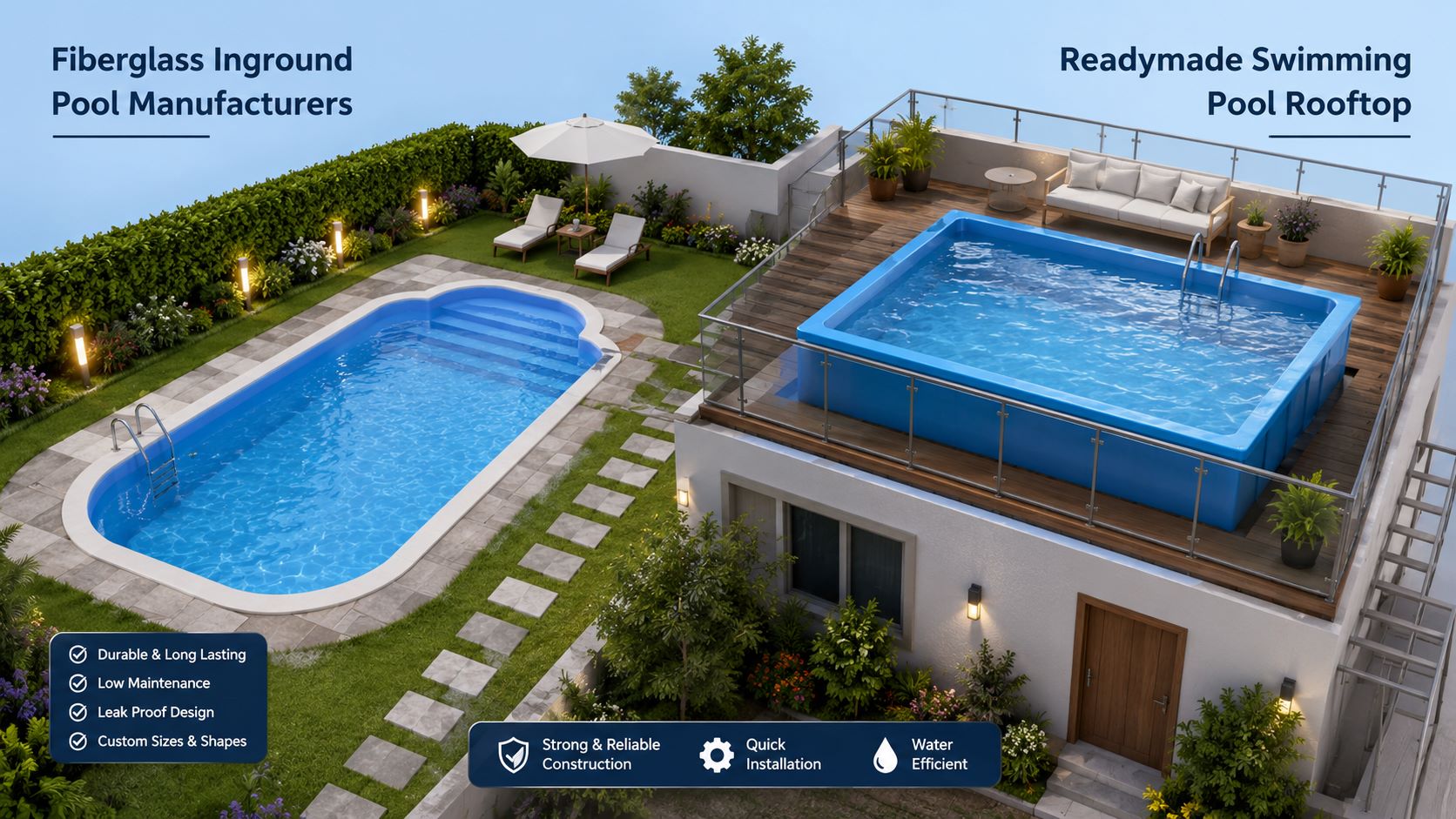
Modern swimming pool construction is changing rapidly as homeowners, hotels, resorts, farmhouses, and commercial properties look for faster, stronger, and more practical alternatives to traditional concrete pools. Two solutions receiving increasing attention are fiberglass inground pool manufacturers and readymade swimming pool rooftop systems.
Fiberglass pools provide factory-controlled quality, smooth finishes, faster installation, and comparatively simple maintenance. Rooftop readymade pools, meanwhile, allow property owners to create premium recreational spaces even where ground-level construction is difficult. Understanding their design, installation, structural requirements, costs, and maintenance can help buyers select a solution suited to their property.
What Are Fiberglass Inground Swimming Pools?
Fiberglass inground pools are prefabricated swimming pool shells manufactured using multiple layers of fiberglass reinforcement, resin, protective coatings, and finishing materials. Unlike conventional concrete pools that are constructed entirely at the project location, fiberglass pools are largely manufactured under controlled factory conditions.
Professional fiberglass inground pool manufacturers usually provide different shapes, dimensions, depths, colours, steps, seating arrangements, and integrated features.
Once the site is prepared, the prefabricated shell is transported and positioned inside the excavated area.
Important benefits include:
- Faster installation compared with many traditional pools
- Smooth and comfortable internal surfaces
- Strong resistance against common water-related deterioration
- Lower dependence on extensive on-site civil construction
- Easier cleaning and routine maintenance
- Attractive modern finishes
- Consistent factory-manufactured dimensions
These advantages make fiberglass technology suitable for residential villas, resorts, hotels, clubs, farmhouses, wellness centres, and recreational developments.
How Fiberglass Inground Pool Manufacturers Build Pool Shells
Reliable fiberglass inground pool manufacturers focus heavily on manufacturing quality because the shell becomes the primary structure holding thousands of litres of water.
A typical production process may involve several carefully controlled stages.
Mold Preparation and Surface Finishing
Manufacturing begins with a professionally designed mold that determines the pool’s final dimensions, curves, steps, seating areas, and overall appearance.
A surface coating is applied to produce a smooth swimming surface while protecting the underlying composite layers.
Fiberglass Reinforcement
Multiple fiberglass and resin layers are added to create structural strength. Manufacturers may reinforce high-stress areas such as corners, steps, walls, and equipment connection points.
Quality Inspection
The finished shell should be inspected for thickness consistency, surface quality, structural defects, dimensional accuracy, and finishing standards before dispatch.
Why Manufacturing Quality Matters
Poor-quality fiberglass construction can potentially cause surface defects, deformation, premature deterioration, or maintenance problems. Buyers should therefore evaluate the manufacturer’s production process rather than selecting a pool based only on appearance or price.
Understanding Readymade Swimming Pools for Rooftops
A readymade swimming pool rooftop solution is a prefabricated or modular swimming pool designed for installation on terraces, rooftops, podiums, or elevated structural areas.
These pools can be particularly valuable in cities where land availability is limited.
However, rooftop swimming pools require significantly more structural planning than ordinary garden pools because water is extremely heavy.
For example, a pool containing several thousand litres of water creates a substantial permanent load on the building structure. The pool itself, swimmers, equipment, decking, pipelines, and accessories add further weight.
Therefore, structural approval should always come before installation.
Major Benefits of a Readymade Swimming Pool Rooftop System
The popularity of readymade swimming pool rooftop solutions is connected with their flexibility and shorter construction process.
Major advantages can include:
- Reduced dependence on extensive concrete pool construction.
- Faster installation after structural and site preparation.
- Efficient use of otherwise underutilised rooftop areas.
- Modern designs suitable for luxury properties.
- Different sizes for residential and commercial applications.
- Potentially easier future replacement or modification depending on the system.
Compact rooftop pools can transform terraces into premium leisure areas while maintaining efficient use of valuable property space.
Fiberglass Inground Pool vs Rooftop Readymade Pool
| Feature | Fiberglass Inground Pool | Readymade Rooftop Pool |
| Installation Location | Ground level | Terrace or rooftop |
| Construction Method | Prefabricated fiberglass shell | Prefabricated or modular system |
| Excavation | Usually required | Usually not required |
| Structural Analysis | Site-dependent | Essential |
| Installation Speed | Generally fast | Generally fast after approvals |
| Space Requirement | Requires available land | Uses rooftop space |
| Maintenance | Relatively simple | Depends on system and equipment |
| Ideal Applications | Villas, resorts, farmhouses | Hotels, homes, apartments |
Neither system is universally better. The appropriate choice depends on building structure, available area, pool size, intended usage, budget, accessibility, and long-term maintenance requirements.
Important Factors Before Choosing a Manufacturer
Selecting experienced fiberglass inground pool manufacturers is as important as choosing the pool itself.
Before finalising a supplier, evaluate:
- Manufacturing experience
- Fiberglass layering process
- Material specifications
- Available sizes and shapes
- Structural reinforcement
- Surface finishing quality
- Filtration equipment
- Plumbing design
- Installation support
- Warranty conditions
- After-sales service
Ask the manufacturer for technical specifications rather than relying only on catalogue photographs.
Rooftop Structural Safety and Waterproofing
Structural engineering is one of the most important aspects of a readymade swimming pool rooftop project.
A qualified structural engineer should evaluate the building’s slab, columns, beams, foundation, proposed pool location, water capacity, equipment load, and occupancy conditions.
Waterproofing also requires careful planning.
Leakage from a rooftop pool can affect ceilings, walls, reinforcement, electrical systems, and occupied floors below. Proper drainage, waterproof membranes, plumbing connections, overflow management, and maintenance access should therefore form part of the initial design.
Never assume that an empty rooftop can automatically support a swimming pool.
Essential Swimming Pool Equipment
Even a high-quality pool shell requires properly sized equipment to maintain healthy and visually clear water.
Typical components include:
- Circulation pump
- Swimming pool filter
- Skimmer or overflow system
- Main drain
- Return inlets
- Electrical control panel
- Pool lights
- Chemical treatment system
- Cleaning accessories
Optional upgrades may include heating systems, automatic dosing, saltwater chlorination, waterfalls, massage jets, underwater lighting, smart controls, and automated covers.
Maintenance Requirements
Regular maintenance protects water quality and pool equipment.
Owners should routinely:
- Test water chemistry.
- Maintain correct disinfectant levels.
- Clean filters according to manufacturer recommendations.
- Remove surface debris.
- Inspect pumps and circulation systems.
- Check plumbing for leakage.
- Clean pool walls and floors.
- Monitor water level and clarity.
Fiberglass surfaces are generally smooth, which can simplify routine cleaning compared with highly porous surfaces.
Frequently Asked Questions
1. What is a fiberglass inground swimming pool?
It is a factory-manufactured fiberglass pool shell installed inside a prepared excavation at ground level.
2. Are fiberglass pools durable?
High-quality fiberglass pools can provide long service life when properly manufactured, installed, operated, and maintained.
3. How fast can a fiberglass pool be installed?
Installation is generally faster than traditional concrete construction, although actual timelines depend on excavation, access, plumbing, landscaping, approvals, and site conditions.
4. Can a readymade pool be installed on every rooftop?
No. Structural capacity must first be evaluated by a qualified engineer.
5. Is waterproofing necessary for rooftop pools?
Yes. Professional waterproofing and drainage planning are extremely important for protecting the building.
6. Which pool requires less construction work?
Prefabricated pools usually require less on-site construction than fully customised reinforced-concrete swimming pools.
7. Can rooftop pools include lighting?
Yes. Suitable waterproof underwater lighting and surrounding architectural lighting can be integrated into many systems.
8. Can fiberglass pools have customised shapes?
Manufacturers usually offer several predefined molds, while custom manufacturing possibilities vary between suppliers.
9. What filtration system should I choose?
The correct filtration system depends on pool volume, usage frequency, circulation requirements, environment, and water-treatment strategy.
10. How should I select fiberglass inground pool manufacturers?
Compare manufacturing standards, materials, technical documentation, installation expertise, warranties, completed projects, equipment specifications, and after-sales service.