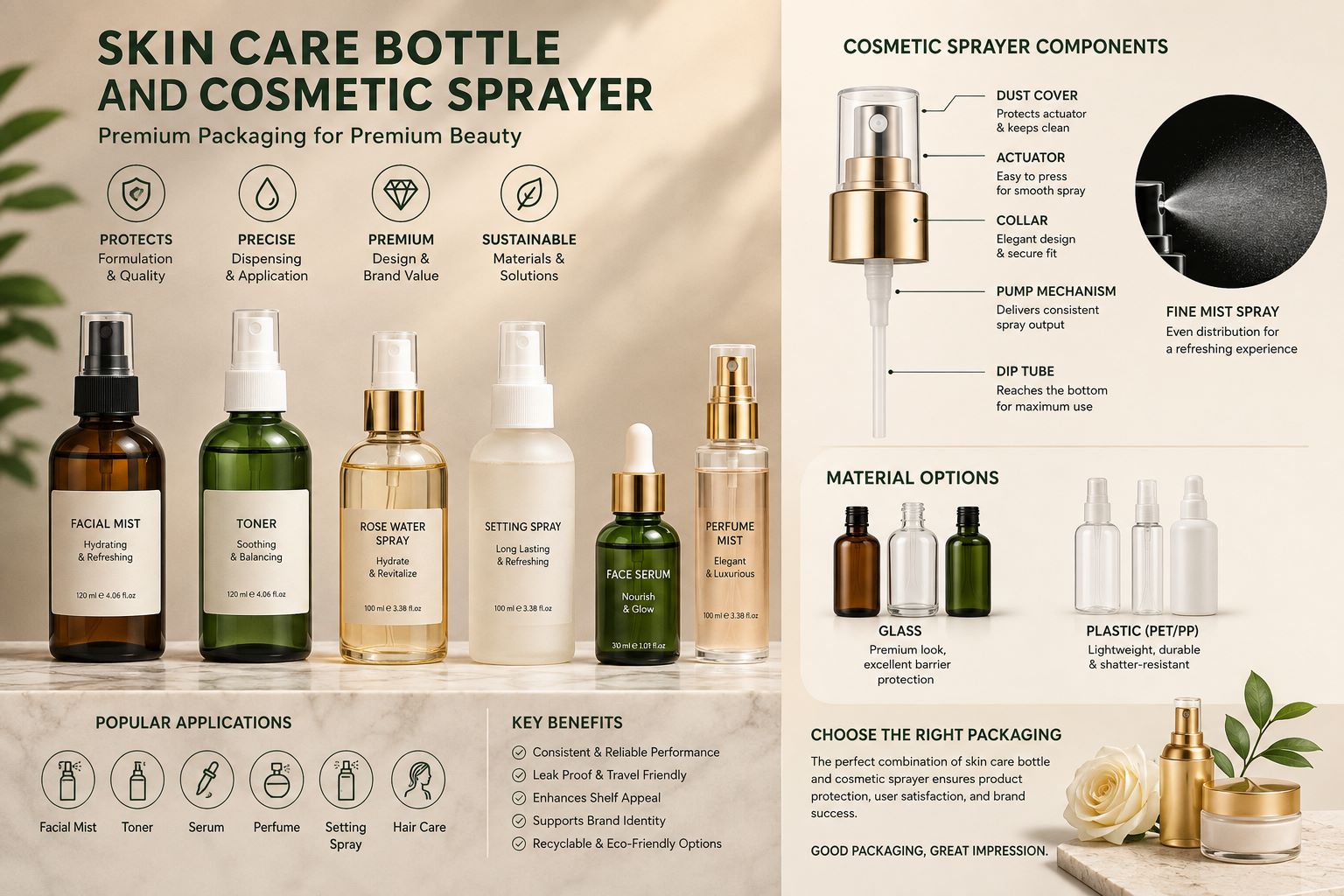
Beauty packaging has evolved far beyond simple product storage. Today, consumers expect packaging to protect the formula, provide convenient application, support hygiene, and visually represent the quality of a brand. A well-designed skin care bottle and reliable cosmetic sprayer can significantly influence how customers experience serums, toners, facial mists, lotions, fragrances, and other personal care formulations.
For cosmetic manufacturers, private-label brands, salons, and beauty startups, selecting suitable packaging is an important product-development decision. Material compatibility, dispensing accuracy, leak resistance, appearance, sustainability, and user convenience must all be considered before choosing the final packaging solution.
Understanding the Importance of Skin Care Packaging
A skin care bottle serves as the primary protective container between a cosmetic formulation and the external environment. Depending on the product, exposure to air, moisture, sunlight, microorganisms, or temperature fluctuations may reduce product quality.
Quality cosmetic packaging helps preserve formulation integrity while supporting convenient daily application.
Common products packed in skincare bottles include:
- Facial serums
- Moisturizers
- Toners
- Cleansing oils
- Essential oil blends
- Hair serums
- Body lotions
- Facial treatments
- Sunscreen formulations
- Liquid beauty products
Packaging also contributes strongly to brand perception. Premium finishes, ergonomic shapes, clear labeling areas, and attractive closure systems can make products look more professional on retail shelves and e-commerce platforms.
Popular Materials Used for Skin Care Bottles
Manufacturers generally select packaging materials according to formula compatibility, product positioning, transportation requirements, and cost.
Glass bottles offer a premium appearance and excellent chemical resistance for many formulations. Amber, blue, frosted, and opaque glass can also provide additional visual differentiation.
Plastic bottles made from PET, HDPE, PP, or similar materials are lightweight and practical. They can be suitable for products requiring durability during transportation.
Why Material Compatibility Matters
The packaging material should remain stable when continuously exposed to the product inside.
Formulations containing oils, alcohol, botanical extracts, acids, fragrances, or active ingredients may require compatibility testing before commercial production. Testing can help identify discoloration, swelling, leakage, cracking, or chemical interaction between the formula and packaging.
What Is a Cosmetic Sprayer?
A cosmetic sprayer is a dispensing system designed to transform liquid products into controlled droplets or a fine mist. It normally includes a pump mechanism, actuator, closure, dip tube, and nozzle.
Sprayers are commonly used for:
- Facial mist
- Setting spray
- Body spray
- Hair mist
- Toner
- Fragrance
- Hydrating spray
- After-sun products
- Aromatherapy solutions
- Personal care liquids
The quality of the spray mechanism directly affects the consumer experience. An inconsistent nozzle may create oversized droplets, uneven application, clogging, or leakage.
Fine Mist Versus Standard Spray
Different cosmetic products require different spray patterns.
| Feature | Fine Mist Sprayer | Standard Sprayer |
| Droplet size | Very fine | Medium to larger |
| Coverage | Wide and even | More concentrated |
| Best use | Facial mist, fragrance | Hair and body products |
| Application feel | Soft and luxurious | Direct and practical |
| Product delivery | Controlled mist | Higher output |
A premium cosmetic sprayer should provide consistent output throughout the expected product lifecycle.
Key Features of a High-Quality Skin Care Bottle
Selecting the right skin care bottle requires more than choosing an attractive shape.
Important characteristics include:
- Strong leak resistance during storage and transportation.
- Appropriate barrier properties for the formulation.
- Comfortable shape for consumer handling.
- Accurate neck dimensions for closure compatibility.
- Sufficient decoration and labeling area.
- Reliable performance across normal temperature conditions.
- Compatibility with pumps, caps, droppers, and sprayers.
Brands selling products online should pay particular attention to closure security because packages may experience vibration, pressure, and repeated movement during shipping.
Choosing the Correct Bottle Capacity
Packaging capacity depends primarily on product type and usage frequency.
Small bottles between 10 ml and 30 ml are popular for concentrated serums, oils, and travel products. Medium bottles around 50 ml to 100 ml are frequently used for toners, facial sprays, lotions, and treatments. Larger containers may be appropriate for body-care and professional-use products.
How Skin Care Bottles and Sprayers Work Together
The performance of a skin care bottle depends partly on the dispensing component attached to it. A beautifully manufactured container will still create a poor customer experience if its pump or sprayer does not function correctly.
Bottle neck size, closure thread, dip-tube length, gasket design, and sprayer output should therefore be evaluated together.
For spray products, the dip tube should reach close to the bottom of the bottle without creating unnecessary bending that could restrict liquid flow.
Packaging Testing Before Production
Beauty brands should conduct packaging tests before approving large production quantities.
Testing may include:
- Leakage testing
- Drop testing
- Compatibility testing
- Spray-output testing
- Closure torque testing
- Transportation simulation
- Label adhesion testing
- Temperature stability checks
These evaluations help reduce complaints, returns, damaged shipments, and unnecessary packaging waste.
Sustainable Cosmetic Packaging Considerations
Environmental responsibility has become increasingly important within beauty packaging.
Brands may explore recyclable plastics, lightweight bottle designs, refillable systems, reusable glass containers, mono-material components, and reduced secondary packaging.
However, sustainability should not compromise product protection. Packaging that fails prematurely can create additional waste from damaged formulas, replacements, and transportation.
The most practical approach combines material efficiency, durability, recyclability, and reliable functionality.
Customization and Branding Opportunities
A customized skin care bottle can strengthen visual identity and improve product recognition.
Common decoration options include:
- Screen printing
- Label application
- Hot stamping
- Frosted finishing
- Metallic decoration
- Embossed branding
- Custom colors
- Matte or glossy coatings
A matching cosmetic sprayer can further create a coordinated premium appearance. Brands can select compatible actuator styles, closure finishes, and cap designs according to their desired market position.
FAQs About Skin Care Bottles and Cosmetic Sprayers
1. What is the best bottle for skincare products?
The ideal bottle depends on the formulation, required protection, dispensing method, branding goals, and expected shelf life.
2. Are glass bottles suitable for facial serums?
Yes. Glass is widely used for serums, especially when premium presentation and strong material compatibility are priorities.
3. What products use cosmetic sprayers?
Facial mists, toners, fragrances, hair sprays, setting sprays, body mists, and similar liquid formulations commonly use sprayers.
4. What makes a sprayer produce fine mist?
Nozzle design, pump construction, liquid viscosity, and output volume influence mist quality.
5. Can cosmetic bottles be customized?
Yes. Manufacturers commonly offer customized colors, printing, labeling, finishes, closures, and packaging shapes.
6. Why does a cosmetic sprayer sometimes clog?
Clogging may occur when formulas contain particles, high-viscosity ingredients, crystallizing substances, or incompatible ingredients.
7. How should bottle size be selected?
Choose capacity according to dosage, usage frequency, product category, pricing strategy, and customer expectations.
8. Are plastic skincare bottles recyclable?
Some plastic bottles are recyclable, depending on the resin type, component construction, and local recycling infrastructure.
9. Why is leakage testing necessary?
Leak testing helps confirm that the bottle, closure, gasket, and dispensing system remain secure during handling and transportation.
10. Should packaging samples be tested before bulk ordering?
Yes. Sample evaluation and compatibility testing can identify problems before investing in large-scale production.