
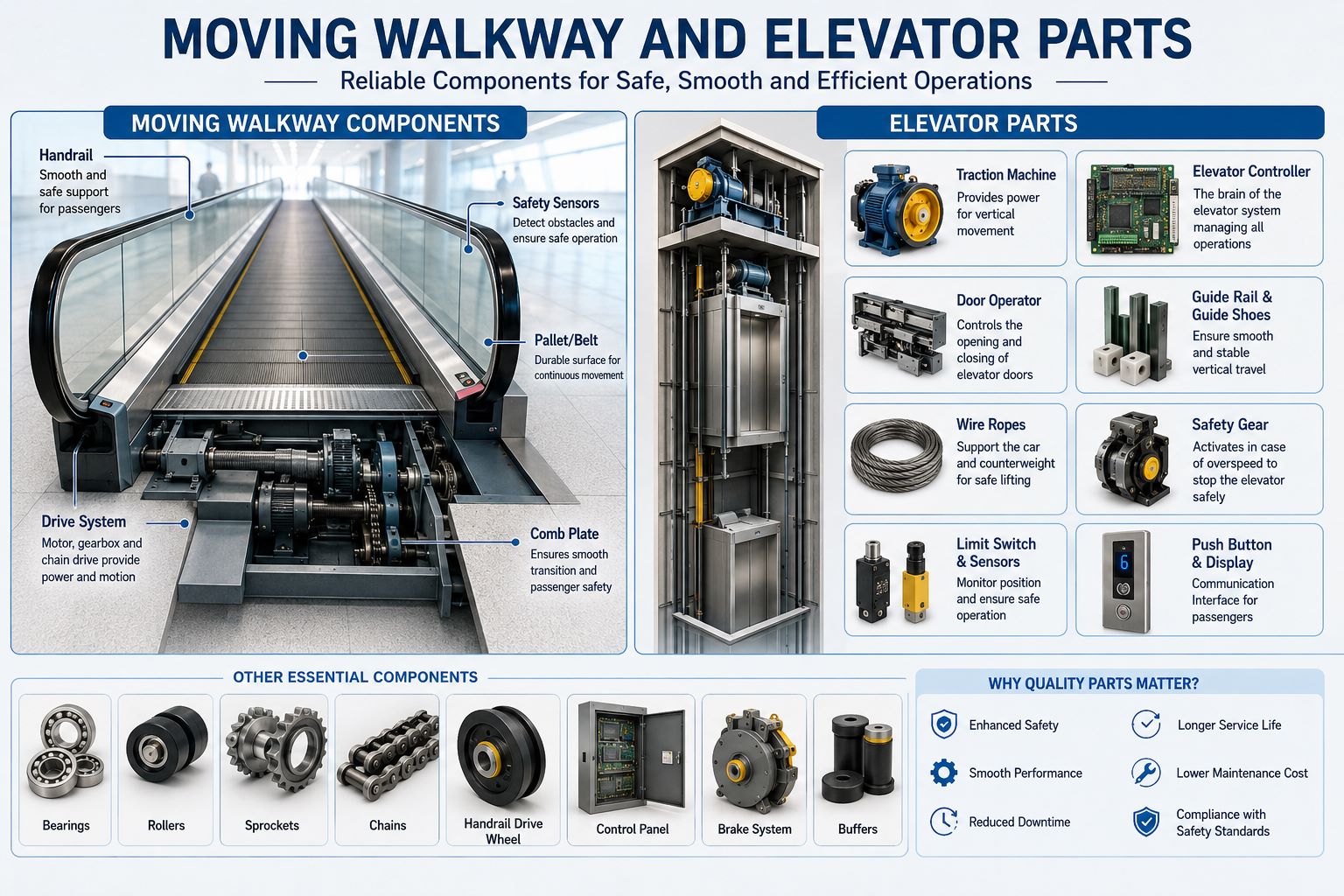
From airports and shopping malls to hospitals, metro stations, hotels, and commercial towers, moving walkway systems and elevator parts play an essential role in improving accessibility, convenience, and passenger flow.
Although elevators and moving walkways perform different functions, both rely on carefully engineered mechanical, electrical, and safety components. Understanding these components helps building owners, facility managers, contractors, and maintenance teams make better decisions about installation, servicing, modernization, and replacement.
Understanding a Moving Walkway System
A moving walkway, also called a travelator or moving sidewalk, is a continuously moving transportation platform designed to carry passengers horizontally or along a slight incline.
Unlike an escalator, which uses individual steps, most moving walkways feature a flat belt or connected metal pallets. They are especially useful in locations where people need to travel long distances while carrying luggage, shopping bags, or other items.
Typical applications include:
- Airports and railway terminals
- Shopping centres
- Exhibition halls
- Metro stations
- Large hospitals
- Commercial complexes
- Passenger terminals
Modern walkway systems are designed around safety, durability, energy efficiency, and smooth passenger movement.
Important Moving Walkway Components
Every moving walkway contains multiple interconnected parts that must operate accurately together.
Drive System
The drive system supplies the mechanical power required to move the walkway. It commonly includes an electric motor, gearbox, drive chains, sprockets, and related transmission components.
A properly maintained drive mechanism provides consistent movement while reducing excessive vibration and noise.
Pallets or Moving Belt
Depending on the design, the passenger surface may consist of metal pallets or a reinforced belt.
These components must provide excellent grip because passengers may be carrying luggage or using carts while travelling.
Handrail and Balustrade
The handrail moves at approximately the same speed as the walkway surface, helping passengers maintain stability. Balustrades provide structural protection along both sides.
Other important components include:
- Handrail drive units
- Entry guides
- Rollers
- Comb plates
- Safety sensors
- Bearings
- Control panels
- Emergency stop switches
Regular inspection of these components supports safer long-term operation.
Understanding Elevator Parts and Their Functions
Elevators contain numerous mechanical and electrical components that work together to transport passengers or goods vertically.
High-quality elevator parts influence ride comfort, operating reliability, energy consumption, stopping accuracy, and passenger safety.
Elevator configurations vary depending on whether the installation uses traction, machine-room-less, hydraulic, or other lifting technology.
Essential Elevator Parts Used in Modern Buildings
Elevator Motor and Traction Machine
The traction machine generates the force needed to raise and lower the elevator car. In modern systems, energy-efficient gearless motors are increasingly common.
They offer advantages such as:
- Lower energy consumption
- Reduced maintenance
- Smooth operation
- Less mechanical noise
- Accurate speed control
Elevator Controller
The controller acts as the operational brain of the system.
It processes information from buttons, sensors, door equipment, and safety devices before determining elevator movement.
Modern controllers can manage floor selection, acceleration, deceleration, door timing, fault detection, and group elevator coordination.
Door Operator
Among frequently serviced elevator parts, door components are particularly important because elevator doors operate many times every day.
The door system may include:
- Door motor
- Rollers
- Hangers
- Tracks
- Sensors
- Belts
- Interlocks
- Door panels
Proper door maintenance can reduce breakdowns and improve passenger safety.
Moving Walkway vs Elevator Systems
| Feature | Moving Walkway | Elevator |
| Primary movement | Horizontal or inclined | Vertical |
| Passenger flow | Continuous | Batch transportation |
| Common location | Airports and malls | Multi-storey buildings |
| Main surface | Belt or pallets | Elevator cabin |
| Typical drive | Motor and transmission | Traction or hydraulic |
| Accessibility | Continuous entry | Controlled entry |
| Maintenance need | Preventive | Preventive and regulatory |
Both systems require dependable components and scheduled inspections to maintain reliable performance.
Why Quality Components Matter
Choosing reliable elevator parts and moving walkway components is more important than simply reducing initial purchasing costs.
Poor-quality replacement parts may cause premature wear, increased vibration, incorrect alignment, frequent downtime, or safety-related problems.
Reliable components can provide:
- Better equipment availability.
- More consistent passenger movement.
- Longer service life.
- Reduced unexpected repair expenses.
- Improved ride quality.
- Better compatibility with safety systems.
Whenever components are replaced, specifications should match the technical requirements of the existing transportation system.
Preventive Maintenance for Reliable Performance
Maintenance is essential for both elevators and moving walkways.
Technicians should regularly inspect drive equipment, electrical connections, sensors, emergency systems, rollers, lubrication points, braking systems, and passenger contact surfaces.
A practical maintenance program should include cleaning, lubrication, adjustment, component inspection, performance testing, and timely replacement of worn elevator parts.
Maintenance records are also valuable because they help facility teams identify recurring problems before major failures occur.
Choosing the Right Spare Parts Supplier
A dependable component supplier should provide more than competitive pricing.
Consider suppliers based on:
- Product quality
- Technical specifications
- Compatibility information
- Manufacturing standards
- Spare-part availability
- Technical support
- Packaging quality
- Delivery reliability
For critical transportation equipment, component selection should always prioritize safety, compatibility, and long-term performance.
Frequently Asked Questions
1. What is a moving walkway?
A moving walkway is a continuously moving platform used to transport passengers horizontally or at a slight incline.
2. Where are moving walkways commonly installed?
They are widely installed in airports, malls, railway stations, terminals, hospitals, and large commercial facilities.
3. What are the most important elevator parts?
Important elevator parts include motors, controllers, door operators, traction equipment, guide rails, brakes, sensors, ropes, and safety devices.
4. How frequently should elevator components be inspected?
Inspection frequency depends on equipment usage, manufacturer recommendations, local regulations, and maintenance requirements.
5. Why are elevator door parts important?
Doors operate repeatedly throughout the day, making proper adjustment and maintenance essential for reliability and passenger protection.
6. Can worn elevator parts increase energy consumption?
Yes. Poorly maintained motors, rollers, bearings, and drive components may increase resistance and reduce operating efficiency.
7. What is a comb plate in a moving walkway?
A comb plate is located near the entrance and exit where the moving surface transitions into the stationary landing area.
8. Are moving walkway parts replaceable?
Yes. Rollers, pallets, handrails, chains, sensors, bearings, and several other components can be replaced when worn or damaged.
9. What causes elevator breakdowns?
Common causes include worn components, electrical faults, door problems, poor maintenance, sensor issues, and controller failures.
10. How can equipment service life be increased?
Scheduled maintenance, proper lubrication, routine inspections, correct adjustment, and timely replacement of damaged components can increase service life.