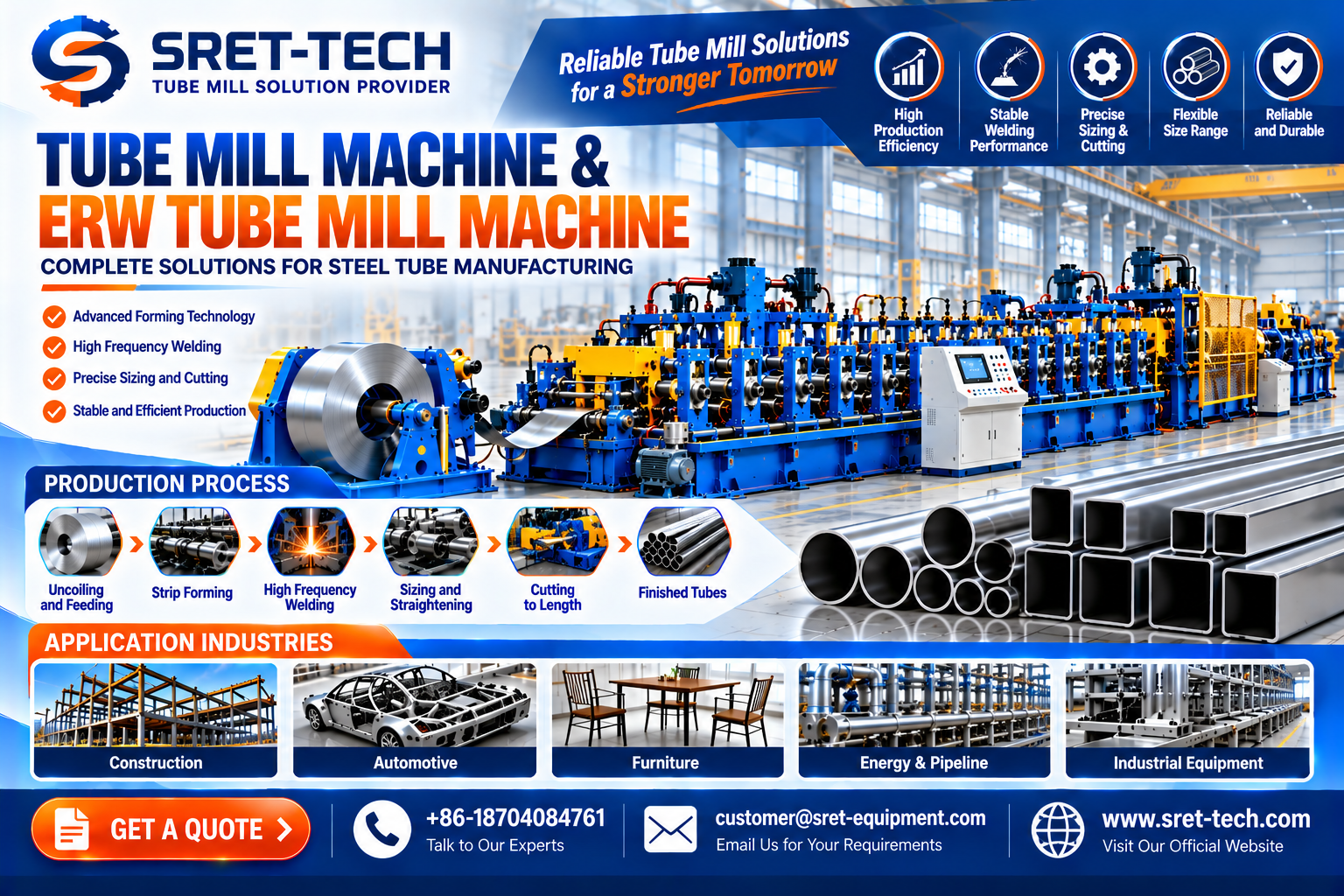
As steel tube demand continues across construction, automotive, furniture, energy, infrastructure, and industrial manufacturing, producers are placing greater emphasis on advanced Tube Mill Machine and ERW Tube Mill Machine systems that can deliver stable forming, reliable welding, precise sizing, flexible production, and consistent long-term performance.
Modern tube-making equipment is increasingly designed as an integrated production solution rather than a collection of separate machines. From coil handling and strip forming to welding, straightening, cutting, and automation, every stage must work in coordination to maintain quality and productivity.
What Is a Tube Mill Machine?
A Tube Mill Machine is industrial equipment used to manufacture tubes or pipes from flat steel strip or coil.
The material is gradually formed into a tubular shape through multiple roll stands. The edges are then joined, after which the tube is sized, straightened, and cut to the required length.
Depending on machine configuration, manufacturers may produce:
- Round tubes
- Square tubes
- Rectangular tubes
- Structural hollow sections
- Furniture tubing
- Automotive tubes
- Industrial pipe products
The ideal equipment depends on the required diameter, wall thickness, steel grade, tube profile, production speed, and welding process.
How a Tube Mill Machine Works
A modern Tube Mill Machine typically follows a continuous production sequence.
Uncoiling and Feeding
The process begins with a steel coil mounted on an uncoiler. The strip is fed into the production line under controlled tension.
Strip Preparation
The strip may be leveled and prepared before it reaches the forming mill.
Accumulation
An accumulator stores strip temporarily, helping the mill continue running while operators prepare the next coil.
Forming
A sequence of rollers gradually shapes the flat strip into the required tube profile.
Welding
The strip edges are brought together and welded to create a continuous longitudinal seam.
Sizing and Straightening
The welded tube passes through sizing rolls to achieve the required dimensions and straightness.
Cutting
A flying cut-off system or other cutting mechanism separates the continuous tube into specified lengths.
This integrated process allows manufacturers to achieve continuous and repeatable production.
What Is an ERW Tube Mill Machine?
An ERW Tube Mill Machine is designed specifically for manufacturing Electric Resistance Welded tubes.
In the ERW process, electrical resistance or high-frequency energy heats the strip edges. These heated edges are then pressed together under controlled pressure to create the weld seam.
The technology is commonly used because it can offer:
- Fast continuous production
- Stable longitudinal welding
- Consistent dimensions
- Efficient material processing
- Flexible product ranges
Why Forming Accuracy Is Critical
The quality of the welding process depends heavily on the quality of the forming process.
Poorly formed strip can lead to:
- Edge mismatch
- Tube ovality
- Surface marks
- Dimensional variation
- Unstable weld conditions
- Excessive material stress
A well-designed Tube Mill Machine uses carefully engineered roll passes to shape the strip progressively rather than forcing it into the final profile too quickly.
Accurate roll alignment and rigid machine construction can help improve repeatability.
Main Components of an ERW Tube Mill Machine
A typical ERW Tube Mill Machine may include:
Uncoiler
Holds and feeds the steel coil.
Shear and End-Joining Unit
Connects the end of one coil to the next.
Accumulator
Stores strip to maintain continuous operation during coil changes.
Forming Mill
Transforms flat strip into a tube profile.
Welding Unit
Uses resistance or high-frequency energy to create the longitudinal seam.
Weld Bead Treatment
Removes excess weld material where required.
Cooling Section
Controls tube temperature after welding.
Sizing Mill
Brings the tube to its final dimensions.
Straightening Section
Helps improve final tube alignment.
Cutting System
Cuts the finished tube into required lengths.
High-Frequency Welding and Weld Stability
The welding station is one of the most important sections of the entire production line.
Important process variables can include:
- Welding power
- Production speed
- Strip-edge condition
- Edge alignment
- Squeeze pressure
- Cooling conditions
If these variables are unstable, the weld seam may become inconsistent.
Modern ERW systems increasingly use automated monitoring and digital control to improve process repeatability.
Why Accumulators Improve Productivity
Coil changes can interrupt manufacturing if the mill has no strip-storage system.
An accumulator helps avoid unnecessary stoppages.
While the line continues using stored strip, operators can prepare and join the next coil.
Potential benefits include:
- Lower downtime
- Higher equipment utilization
- More continuous forming
- Improved production output
For manufacturers operating high-capacity lines, this can have a significant impact on productivity.
Importance of Sizing and Straightening
After welding, the tube still needs to meet final dimensional requirements.
The sizing section can control:
- Outside diameter
- Roundness
- Square dimensions
- Rectangular dimensions
- Corner geometry
- Straightness
Accurate sizing is especially important for tubes used in fabricated assemblies.
The straightening process further helps improve product consistency before cutting and packaging.
Flying Cut-Off Technology
Stopping production for every cut would reduce line efficiency.
For this reason, many modern tube mills use flying cutting systems.
The cutting unit moves together with the tube, performs the cut, and then returns for the next cycle.
This can support:
- Continuous production
- Accurate tube length
- Higher output
- Reduced process interruption
The appropriate cutting system depends on tube diameter, wall thickness, material, and production speed.
Automation in Modern Tube Mill Machines
Automation is becoming increasingly important in steel tube manufacturing.
A modern Tube Mill Machine may include:
- PLC controls
- HMI touchscreens
- Servo systems
- Variable-frequency drives
- Sensor monitoring
- Fault diagnostics
- Product recipe storage
- Production data recording
These technologies can help synchronize the entire line.
Operators may also save settings for specific tube sizes, reducing setup time when repeat orders are produced.
Flexible Size Changeovers
Tube manufacturers often serve customers requiring multiple sizes.
A changeover may involve:
- Roll replacement
- Guide adjustment
- Sizing changes
- Welding parameter updates
- Cutting-length programming
Equipment designed for efficient changeovers can reduce downtime and increase flexibility.
This is particularly valuable when production includes smaller batches or frequently changing specifications.
Applications of Tube Mill Equipment
A Tube Mill Machine can support many different markets.
Construction
Tubes are widely used in frames, scaffolding, fabricated structures, and supports.
Automotive
ERW tubing may be used in selected seat structures, mechanical components, exhaust-related systems, and structural parts.
Furniture
Round, square, and rectangular tubes are commonly used in tables, chairs, shelving, racks, and frames.
Energy and Infrastructure
Depending on applicable standards, welded tubes may support pipeline, industrial, and infrastructure applications.
Industrial Equipment
Steel tubes are also widely used in machine structures, frames, guards, racks, and support systems.
Maintenance Supports Long-Term Reliability
Tube mill equipment operates under continuous mechanical load.
Important maintenance areas include:
- Roll tooling
- Bearings
- Gearboxes
- Motors
- Welding equipment
- Cooling systems
- Cutting systems
- Lubrication
Poor maintenance can affect tube dimensions, weld stability, and production continuity.
Preventive maintenance helps reduce unexpected downtime and extend machine life.
Quality Control in Tube Manufacturing
Consistent quality inspection should remain part of production.
Common checks may include:
- Tube dimensions
- Wall thickness
- Straightness
- Surface condition
- Weld seam quality
- Cut length
Depending on the intended application, additional mechanical or weld testing may also be required.
Clear inspection procedures help manufacturers maintain reliable output across long production runs.
Choosing the Right Tube Mill Machine
Before selecting equipment, manufacturers should evaluate their actual production requirements.
Important considerations include:
- Tube diameter range
- Wall thickness
- Material grade
- Tube profile
- Required production speed
- Welding technology
- Size-change frequency
- Automation level
- Available floor space
- Technical support and spare parts
The best ERW Tube Mill Machine is the one that matches the real production plan rather than simply offering the highest headline capacity.
Frequently Asked Questions
What is a Tube Mill Machine?
A Tube Mill Machine is industrial equipment that forms metal strip into tube, welds the seam, sizes the product, and cuts it to the required length.
What is an ERW Tube Mill Machine?
An ERW Tube Mill Machine uses Electric Resistance Welding technology to produce longitudinally welded steel tubes.
What does ERW stand for?
ERW stands for Electric Resistance Welding.
Which tube shapes can be manufactured?
Depending on the tooling and configuration, round, square, rectangular, and structural profiles can be produced.
Why is an accumulator important?
It stores strip material temporarily so production can continue while coils are replaced.
What is the purpose of the sizing mill?
It controls final tube dimensions, shape, roundness, and straightness.
Can one tube mill produce multiple sizes?
Yes. Many systems support different dimensions through roll and setup changes.
Why is automation useful?
Automation can improve synchronization, monitoring, production repeatability, and fault detection.
What affects ERW weld quality?
Key factors include edge alignment, welding power, squeeze pressure, strip condition, and line speed.
What should manufacturers provide before requesting a quotation?
Typical information includes tube size, wall thickness, steel grade, profile, required production speed, and output requirements.
Media Contact
Tube Mill Equipment Enquiries
Contact: +86-18704084761
Email: customer@sret-equipment.com
Official Website: https://www.sret-tech.com/