Steel tube producers are increasingly focusing on automation, production stability, product flexibility, and tighter dimensional control as demand grows across construction, automotive, furniture, industrial machinery, energy, and infrastructure. Against this backdrop, advanced ERW Tube Mill Line and Tube Mill Line technologies are helping manufacturers streamline the journey from steel coil to finished tube while improving consistency across forming, welding, sizing, and cutting.
Modern mill systems are designed to operate as coordinated production platforms. Instead of evaluating equipment solely by maximum line speed, manufacturers are considering changeover efficiency, welding reliability, tooling accuracy, energy use, maintenance requirements, and automation capability.
What Is an ERW Tube Mill Line?
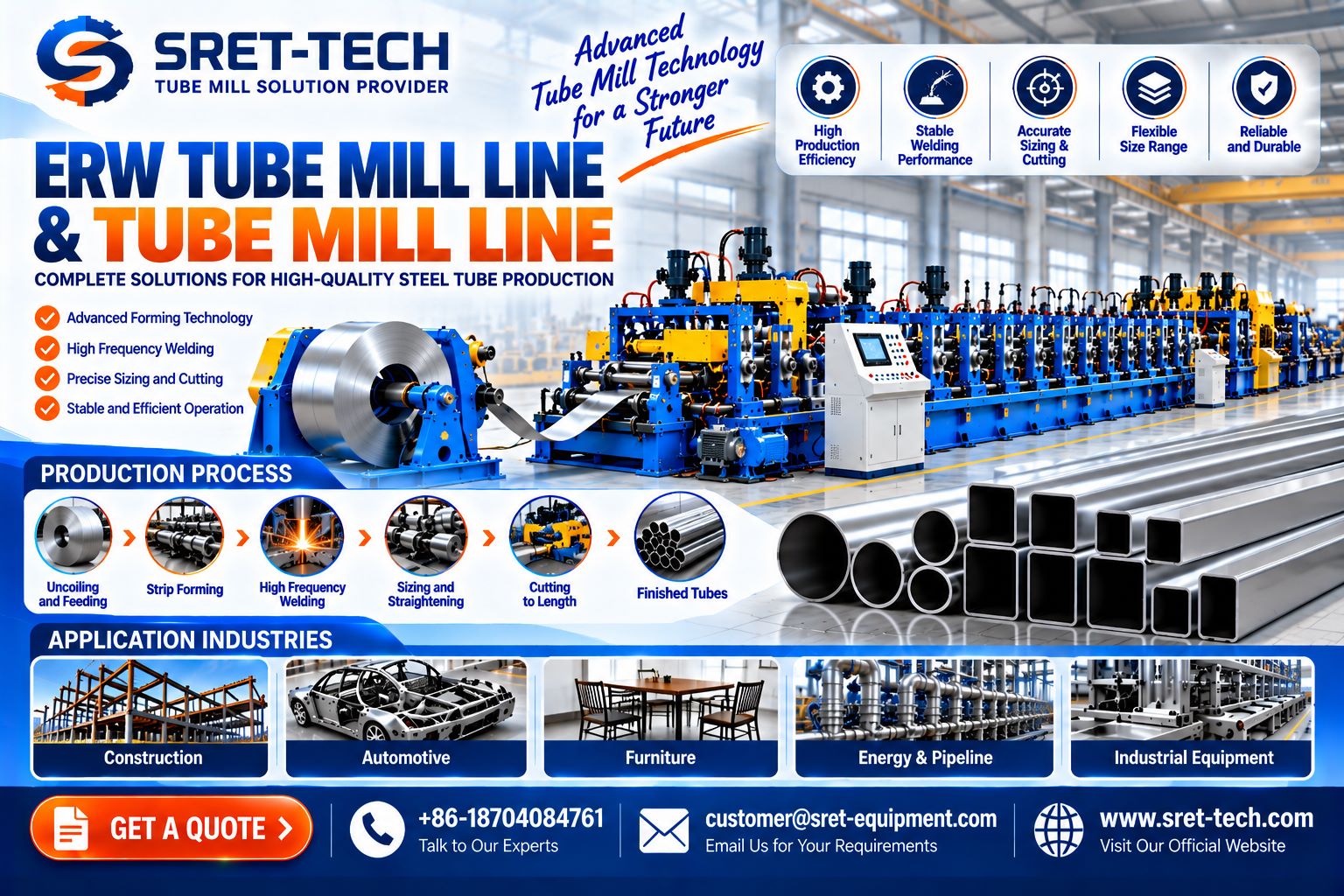
An ERW Tube Mill Line is an integrated manufacturing system used to produce Electric Resistance Welded steel tubes from continuous metal strip.
Steel coil is unwound and fed into forming stands that gradually shape the flat strip into a tubular profile. Once the edges are correctly positioned, electrical energy is used to heat the joining area. Squeeze rolls then bring the heated edges together to form a continuous longitudinal weld.
After welding, the tube normally moves through cooling, sizing, straightening, and cut-off sections before inspection and collection.
The production line may include:
- Coil loading and uncoiling equipment
- Strip leveling
- Shearing and end joining
- Strip accumulator
- Forming stands
- High-frequency welding equipment
- Weld bead treatment
- Cooling
- Sizing and straightening
- Flying cut-off
- Run-out and collection equipment
These stages work continuously to turn coil material into manufactured tube.
Understanding the Tube Mill Line
A Tube Mill Line is the broader manufacturing platform used to form and process metal strip into finished tubular products.
Depending on the installed tooling and design, it can manufacture products such as:
- Round steel tube
- Square hollow sections
- Rectangular tubing
- Structural tubes
- Furniture tubes
- Automotive tubing
- General industrial tubes
Choosing an appropriate mill requires a clear understanding of tube diameter, wall thickness, raw material, profile geometry, required output, and end-use specifications.
Why Controlled Forming Is Essential
Forming quality directly affects everything that follows.
The strip must be progressively shaped so the edges reach the welding station in the correct position. Excessively aggressive or poorly aligned forming can create dimensional and welding problems.
Potential issues can include:
- Edge mismatch
- Tube ovality
- Surface marking
- Excessive material stress
- Unstable weld geometry
- Inconsistent finished dimensions
A properly designed Tube Mill Line uses a sequence of engineered roll passes to create a controlled transition from flat strip to tubular profile.
High-Frequency Welding in ERW Manufacturing
Welding is a critical stage of an ERW Tube Mill Line.
During high-frequency ERW production, electrical energy heats the strip edges before they are pressed together. Several variables must remain properly controlled.
Welding Power
The energy input must suit the material, wall thickness, and manufacturing speed.
Edge Position
The formed edges need accurate alignment at the joining point.
Squeeze Pressure
Suitable pressure helps create a consistent weld.
Mill Speed
Welding settings should remain synchronized with line speed.
Cooling Conditions
Controlled cooling can support stable downstream processing.
Digital controls and monitoring systems can help operators maintain these variables throughout production.
Why an Accumulator Improves Mill Efficiency
Steel tube production can lose significant operating time during coil changes if the mill must stop completely.
An accumulator stores strip temporarily between the coil preparation and forming sections.
While the mill continues consuming the stored strip, operators can prepare and join the next coil.
This can provide:
- Longer continuous production periods
- Fewer unnecessary stops
- Better equipment utilization
- More stable forming conditions
- Improved overall output
For high-throughput operations, accumulator capacity should be selected according to expected mill speed and coil-change requirements.
Sizing Determines Final Tube Geometry
The tube leaving the welding section may still require dimensional correction.
Sizing stands progressively bring the welded tube to its intended dimensions.
Depending on the product, this stage can control:
- Outside diameter
- Roundness
- Width and height
- Corner profile
- Straightness
Accurate sizing is especially valuable when tubes must be fitted, welded, bent, or assembled downstream.
A stable sizing section can therefore have a direct impact on customer acceptance and fabrication efficiency.
Flying Cut-Off Keeps Production Moving
Continuous tube production would become inefficient if the entire mill stopped for every length cut.
Flying cut-off equipment addresses this problem by synchronizing its movement with the continuously traveling tube.
The cutting unit moves alongside the product, completes the cut, and returns for the next cycle.
Potential advantages include:
- Continuous mill operation
- Controlled cut lengths
- Higher throughput
- Reduced interruption
Cutting-system selection should reflect tube diameter, wall thickness, material, and required cut quality.
Automation Is Transforming Tube Mill Operation
Automation has become an important feature of modern production systems.
An advanced ERW Tube Mill Line may incorporate:
- PLC-based control
- HMI operator interfaces
- Variable-frequency drives
- Servo systems
- Sensor monitoring
- Fault alarms
- Production data
- Stored process recipes
Centralized control can improve coordination between different sections of the line.
For repeat orders, previously established production parameters may also help reduce setup time and support greater process repeatability.
Faster Changeovers Improve Production Flexibility
Tube manufacturers increasingly handle mixed order sizes and varied specifications.
Changing from one product to another may involve adjustments to:
- Forming rolls
- Guides
- Sizing rolls
- Welding parameters
- Straightening equipment
- Cut length
A Tube Mill Line designed with efficient changeovers can reduce non-productive time and make smaller batches more commercially practical.
This flexibility is particularly useful for manufacturers serving several industries rather than producing one specification continuously.
Industrial Applications of ERW Tubes
ERW-produced tubing serves diverse markets.
Construction
Steel tubes are used for frames, supports, fabricated structures, and other construction systems.
Automotive
Selected mechanical, structural, seating, and exhaust-related applications may use welded tube.
Furniture
Round, square, and rectangular tubing is commonly used in chairs, tables, shelving, and frames.
Energy and Infrastructure
Appropriately specified welded tubes may support industrial pipeline and infrastructure applications.
Industrial Manufacturing
Tube products are used in machine frames, guards, racks, material-handling systems, and fabricated equipment.
Efficiency Is More Than Maximum Speed
Purchasing decisions should not be based on headline production speed alone.
A mill must maintain acceptable forming, welding, sizing, and cutting conditions at its operating speed.
Increasing speed beyond a stable range can contribute to:
- Increased scrap
- Welding variation
- Tool wear
- More maintenance
- Dimensional inconsistency
For many manufacturers, dependable sustained output produces better commercial results than occasional maximum-speed operation.
Preventive Maintenance Protects Production
Continuous mill operation places substantial demands on mechanical and electrical systems.
Regular inspections should consider:
- Forming and sizing rolls
- Bearings
- Gearboxes
- Motors
- Welding components
- Cooling circuits
- Cutting equipment
- Lubrication systems
Correct roll condition and alignment are particularly important because wear can gradually affect tube geometry.
Preventive maintenance also helps reduce unplanned stoppages.
How to Select the Right Tube Mill Line
Before investing, manufacturers should document their production requirements.
Important considerations include:
- Minimum and maximum tube dimensions
- Wall-thickness range
- Steel grades
- Required profiles
- Expected production speed
- Welding technology
- Typical order quantities
- Changeover frequency
- Automation requirements
- Installation, training, and technical support
An appropriate ERW Tube Mill Line should be matched to actual production goals rather than selected simply because it has the highest specification.
Frequently Asked Questions
What is an ERW Tube Mill Line?
An ERW Tube Mill Line is a continuous manufacturing system that forms steel strip into tube and uses Electric Resistance Welding to create the longitudinal seam.
What does ERW stand for?
ERW stands for Electric Resistance Welding.
What is a Tube Mill Line?
A Tube Mill Line is a coordinated system for forming, welding, sizing, straightening, and cutting metal tube.
Which tube shapes can be manufactured?
Depending on mill design and tooling, round, square, rectangular, and other profiles may be possible.
Why is an accumulator used?
It stores strip so tube production can continue while the next coil is prepared.
Why is sizing necessary?
Sizing helps establish the final tube dimensions, geometry, and straightness.
Can one line manufacture several tube sizes?
Yes. Many mills support multiple sizes through tooling changes and machine adjustments.
What does a flying cut-off do?
It cuts continuously moving tube into specified lengths without requiring the complete line to stop.
Why is automation beneficial?
Automation can support better synchronization, repeatability, diagnostics, parameter storage, and production monitoring.
What information should be provided when requesting tube mill equipment?
Manufacturers should typically provide material type, tube sizes, wall thickness, tube profiles, desired output, and automation expectations.
Media Contact
Tube Mill Equipment Enquiries
Contact: +86-18704084761
Email: customer@sret-equipment.com
Official Website: https://www.sret-tech.com/