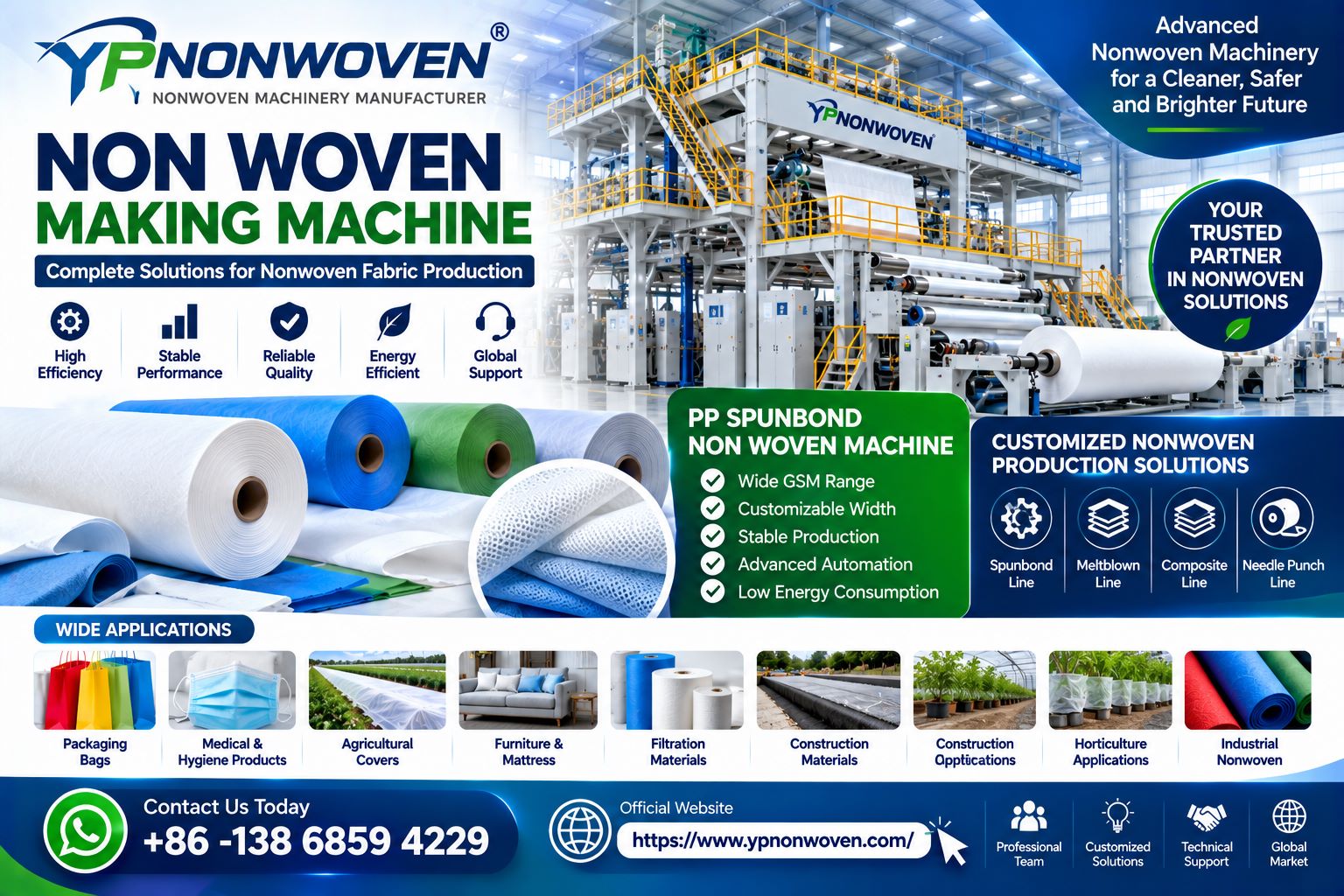
The global nonwoven manufacturing sector is entering a new phase as producers look for equipment that can support consistent fabric quality, efficient operation and changing market requirements. From hygiene and agriculture to packaging, furniture and industrial applications, nonwoven materials continue to serve a broad range of industries.
As production requirements become more specialized, investment decisions surrounding a Non Woven Making Machine are increasingly based on total manufacturing performance rather than production speed alone. Buyers evaluating a Non Woven Machine are considering automation, fabric consistency, raw-material utilization, maintenance requirements, operator control and the ability to manufacture products for different downstream applications.
Nonwoven Equipment Purchasing Is Becoming More Technical
Purchasing nonwoven machinery involves more than comparing equipment prices.
Manufacturers first need to determine what type of fabric they intend to produce, the expected production volume, required width, raw material and intended end-use markets.
These factors influence the configuration of a Non Woven Making Machine.
A company entering agricultural nonwoven production, for example, may have different product priorities from a business manufacturing material for hygiene, packaging or furniture applications.
Defining the commercial objective before equipment selection can prevent investment in unnecessary capacity or unsuitable configurations.
How Does a Non Woven Machine Work?
The exact manufacturing process varies according to the nonwoven technology being used. In a spunbond production process, polymer raw material is prepared, melted and extruded to create continuous filaments.
These filaments are drawn and distributed to form a web. The web is then bonded to create the finished nonwoven structure before being processed into rolls.
A Non Woven Machine therefore operates as an interconnected manufacturing system.
Raw-material preparation, extrusion, filament formation, web laying, bonding, cooling, handling and winding need to work together to maintain production stability.
Automation Is Changing Daily Production Management
Automation is becoming increasingly important in modern nonwoven factories.
Operators need visibility into production conditions so they can identify deviations and make appropriate adjustments.
A well-designed control system can centralize important operating information and simplify the management of different production stages.
For manufacturers, this can support more standardized production procedures and reduce dependence on repeated manual adjustments.
Automation, however, works best when combined with trained personnel.
Operators still need to understand the relationship between machine settings, raw materials and finished fabric characteristics.
Fabric Consistency Is Becoming a Competitive Factor
Customers purchasing nonwoven fabric expect predictable material from one roll to another.
For manufacturers, achieving that consistency requires attention throughout production.
Fiber or filament distribution, web formation, bonding and winding can all influence the finished material.
A Non Woven Making Machine should therefore be evaluated according to how effectively its individual sections work together.
Production teams also need appropriate quality-control procedures to monitor whether manufactured fabric meets the intended specification.
Raw Material Management Deserves More Attention
Raw material is one of the recurring inputs in nonwoven manufacturing.
Material characteristics can influence processing behavior and final fabric performance. Manufacturers should therefore define suitable raw-material requirements and maintain appropriate storage and handling practices.
Where color masterbatch or other compatible processing materials are required, these should be evaluated according to the intended product.
Stable material sourcing also helps operators avoid unnecessary production adjustments caused by unexpected variations.
For any Non Woven Machine, good raw-material management remains an important part of process control.
Production Efficiency Goes Beyond Maximum Speed
Machine speed is easy to compare, which is why it frequently receives attention during equipment purchasing.
But maximum speed does not automatically represent maximum profitability.
A production line that experiences frequent interruptions, excessive startup waste or inconsistent fabric may deliver weaker commercial results despite having a high theoretical output.
Manufacturers should instead consider usable production capacity.
This includes operating stability, changeover requirements, material consumption, waste, downtime and maintenance.
The best Non Woven Making Machine configuration is generally one aligned with the manufacturer’s actual products and operating conditions.
Energy and Resource Management Influence Operating Costs
Equipment purchase price represents only one part of the long-term manufacturing investment.
Energy, polymer, labor, maintenance, spare parts and production losses contribute to ongoing costs.
For this reason, manufacturers increasingly assess equipment through a lifecycle perspective.
Stable processes can help limit unnecessary material waste, while appropriate maintenance can reduce unexpected interruptions.
Businesses comparing a Non Woven Machine should therefore consider operating economics alongside initial capital expenditure.
Preventive Maintenance Supports Reliable Output
Nonwoven manufacturing equipment operates through multiple mechanical, thermal and electrical systems.
Regular inspections and scheduled servicing can help maintain these systems in appropriate working condition.
Maintenance planning may cover areas such as material feeding, extrusion equipment, filtration, web-forming sections, bonding equipment, drive systems and winding components, depending on the machine configuration.
Keeping appropriate records can also help technical teams identify recurring problems.
Rather than waiting for an unexpected breakdown, manufacturers can incorporate preventive maintenance into routine production planning.
Flexibility Can Support Changing Market Demand
Demand for nonwoven products can change according to industry trends, customer requirements and regional markets.
This makes production flexibility valuable.
Before investing in machinery, manufacturers should identify the range of products they realistically expect to manufacture.
A Non Woven Making Machine should then be selected around those requirements rather than hypothetical applications that may never enter production.
Clear product planning can help companies balance flexibility with equipment complexity and investment.
Frequently Asked Questions
What is a Non Woven Making Machine?
A Non Woven Making Machine is manufacturing equipment used to produce nonwoven fabric without conventional weaving or knitting. The exact production process depends on the nonwoven technology and material being used.
What is a Non Woven Machine used for?
A Non Woven Machine produces material that can be used in applications such as hygiene products, agriculture, packaging, furniture, filtration and industrial products, depending on the fabric specification.
How should manufacturers choose nonwoven machinery?
Buyers should consider intended fabric type, raw material, required width, production capacity, factory conditions, automation, maintenance and downstream market requirements.
Is higher machine speed always better?
Not necessarily. Stable usable output, product consistency, waste levels and downtime can be more important than maximum theoretical speed.
Why is automation important in nonwoven production?
Automation can improve process visibility, parameter management and operating consistency while supporting more standardized production procedures.
Does raw material affect nonwoven fabric quality?
Yes. Raw-material characteristics can influence processing behavior and the properties of the finished fabric.
Why is preventive maintenance necessary?
Preventive maintenance can help identify wear or technical issues before they develop into unexpected production interruptions.
Can one machine manufacture different nonwoven products?
Production capability depends on machine technology, configuration, raw material and the specifications required for each product.
What operating costs should buyers consider?
Manufacturers should evaluate energy, raw materials, labor, maintenance, spare parts, waste and downtime in addition to equipment purchase cost.
What information should be prepared before requesting a machine quotation?
Buyers should define the intended fabric, material, width, production expectations, target applications and other relevant manufacturing requirements.
Media Contact
Nonwoven Machinery Sales & Project Enquiries
Email: info@ypnonwoven.com
Contact: +86 -138 6859 4229
Website: https://www.ypnonwoven.com/