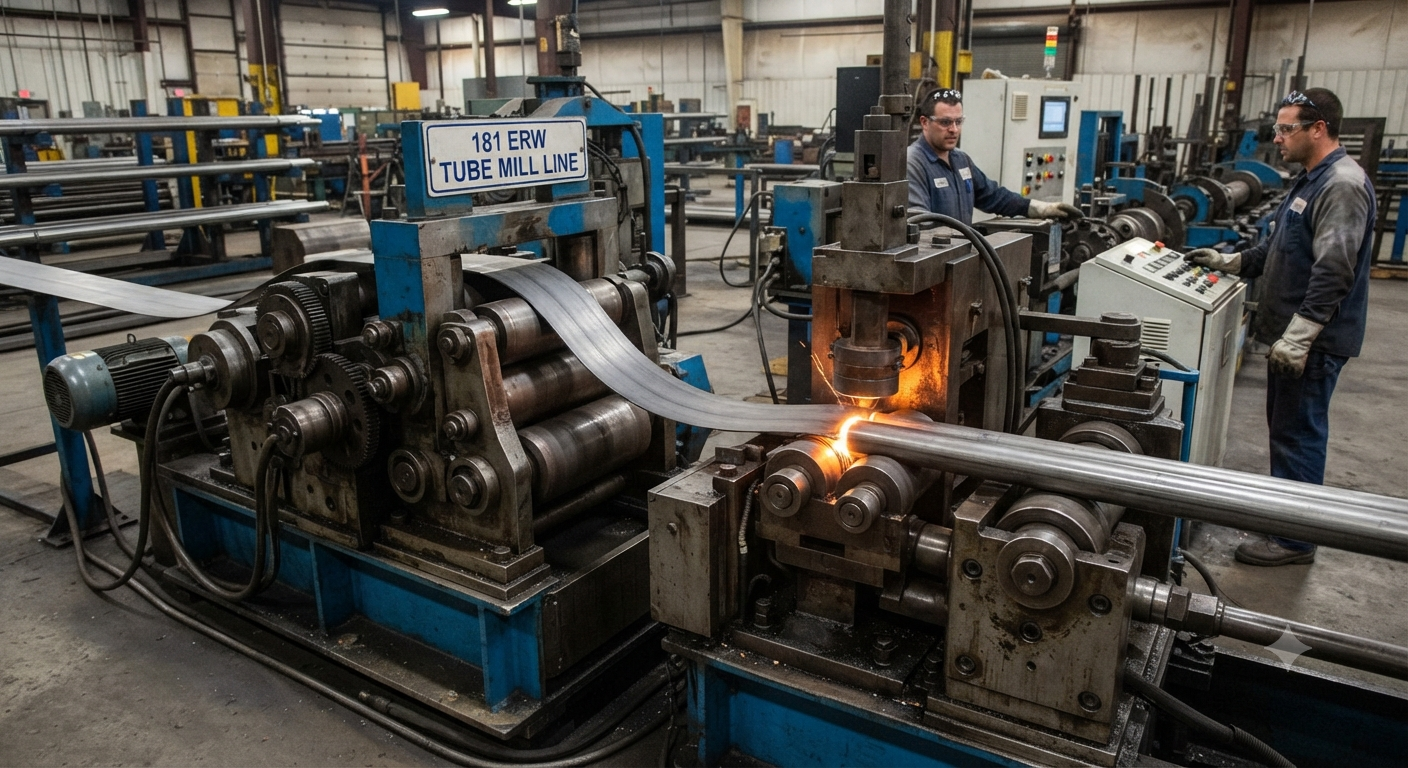
As global demand for steel tubes continues to expand across construction, infrastructure, agriculture, furniture and industrial sectors, manufacturers are looking for faster and more reliable ways to increase production without compromising quality. This is where the modern ERW Tube Mill Line is gaining attention as a complete solution for continuous welded tube manufacturing.
Designed to transform steel coil into finished welded tubes through a coordinated production process, an advanced Tube Mill Line combines forming, high-frequency welding, sizing and cutting into one streamlined system. The result is a production environment where efficiency, consistency and scalability can work together.
A Complete Manufacturing Journey Begins With Steel Coil
Every finished steel tube starts with the right raw material. In an ERW production facility, steel strip is introduced into the mill from a coil and gradually transformed into a finished tube.
The typical production journey includes:
Steel Coil → Uncoiling → Strip Joining → Accumulation → Tube Forming → High-Frequency Welding → Cooling → Sizing → Cutting → Run-Out → Finished Tube
Although the process appears simple, the performance of every section directly influences the final product.
The uncoiler ensures a stable supply of strip material. The shear and butt welding unit connects successive coils to support continuous operation. The accumulator helps maintain a consistent material flow, while the forming mill progressively shapes the flat strip into a tubular profile.
Once the edges meet, the high-frequency welding section creates the longitudinal seam. The tube then passes through cooling and sizing sections before being cut into specific lengths and transferred for collection or packing.
This synchronized operation is the foundation of an efficient Tube Mill Line.
Why ERW Technology Is Becoming a Preferred Choice
Electric Resistance Welding, commonly known as ERW, has become an important manufacturing technology for producing longitudinally welded steel tubes.
Its popularity comes from the ability to support continuous production while maintaining consistent output across a wide range of applications.
Depending on the configuration, an ERW Tube Mill Line can be used for manufacturing:
- Structural steel tubes
- Construction pipes
- Scaffolding tubes
- Greenhouse tubes
- Furniture profiles
- Industrial tubes
- General engineering pipes
- Automotive-related tubular components
This versatility gives manufacturers an opportunity to serve multiple markets from a single production facility, provided the mill is correctly configured for the intended product range.
The Biggest Mistake Buyers Make When Selecting a Tube Mill
Choosing a tube mill based solely on maximum production speed may look attractive—but it is not always the smartest investment decision.
A successful production line must be designed around the actual products that the factory intends to manufacture.
Before selecting an ERW Tube Mill Line, buyers should carefully evaluate:
- Tube diameter range
- Square and rectangular tube dimensions
- Wall thickness
- Raw material grade
- Production capacity
- Required line speed
- Finished tube length
- Product applications
- Automation requirements
- Future product expansion
A line optimized for thin-wall furniture tubes will have different requirements from a mill producing heavy structural sections.
Therefore, the right question is not simply, “How fast can the machine run?”
The better question is, “Can this production line efficiently manufacture the products my business needs today—and the products I plan to sell tomorrow?”
High-Frequency Welding Takes Center Stage
The welding section is arguably one of the most important parts of the entire Tube Mill Line.
High-frequency welding joins the edges of the formed steel strip to create the tube’s longitudinal seam. The welding process must be carefully matched with material characteristics, tube dimensions, wall thickness and production speed.
An improperly selected welding system can affect production stability and seam quality.
For this reason, manufacturers requesting a technical proposal should provide detailed product information rather than simply asking for a standard machine.
Material grade, wall thickness, tube diameter and intended application can help the supplier determine a suitable welding power system and supporting equipment.
One Tube Mill Can Open the Door to Multiple Industries
The demand for welded steel tubes is not limited to one sector.
Construction companies rely on structural tubes. Greenhouse manufacturers need lightweight tubular frames. Furniture producers require accurately sized profiles. Industrial manufacturers use tubes in equipment and machinery.
This broad market demand makes an ERW Tube Mill Line an attractive option for manufacturers looking to diversify their production capabilities.
However, product diversity also introduces another consideration: tooling.
Manufacturers producing multiple sizes or shapes must plan their roll tooling strategy carefully to achieve reliable changeovers and maintain production efficiency.
Planning to Manufacture Square and Rectangular Tubes?
The demand for square and rectangular steel tubes continues to grow in construction, furniture and structural applications.
Manufacturers considering these products should decide early how they want to integrate shaped tube production into their facility.
Depending on the required size range and production strategy, manufacturers may evaluate different forming approaches, including conventional round-to-square production routes or direct forming solutions.
The correct choice depends on product specifications, investment plans, tooling requirements and expected production volume.
A detailed discussion with the equipment manufacturer before ordering can help avoid costly changes later.
The Hidden Partner Behind a Successful Tube Mill: The Slitting Line
Many manufacturers focus heavily on the ERW Tube Mill Line but overlook the importance of raw material preparation.
If a factory purchases wide steel coils, a coil slitting line may be required to convert them into strips of suitable widths for tube production.
Integrating a slitting system into a new tube manufacturing project can provide better control over raw material preparation and production scheduling.
This creates a more connected manufacturing chain:
Wide Steel Coil → Slitting → Strip Preparation → ERW Tube Production → Finished Tube
For companies planning large-scale operations, coordinating the slitting line and Tube Mill Line from the beginning can simplify factory planning and improve overall workflow.
Your Factory Floor Matters More Than You Think
Even the most advanced tube mill cannot deliver its full potential if the factory layout is poorly planned.
Before equipment is manufactured, buyers should evaluate the available workshop space and determine how materials will move through the facility.
Important considerations include:
- Steel coil receiving area
- Crane capacity
- Raw material storage
- Production line length
- Electrical infrastructure
- Machine foundations
- Maintenance access
- Finished tube storage
- Packing area
- Operator movement
- Future expansion space
A detailed workshop drawing can help engineers plan the line layout and identify potential installation challenges before equipment arrives at the factory.
Build Your Quotation Request Around Real Production Goals
A detailed inquiry can make the difference between receiving a generic quotation and receiving a practical technical proposal.
Before contacting an ERW Tube Mill Line manufacturer, buyers should prepare information about:
Product: Round, square or rectangular tube
Size: Diameter or width and height
Thickness: Minimum and maximum wall thickness
Material: Steel grade and strip specifications
Length: Required finished tube lengths
Application: Intended end use
Capacity: Expected production volume
Speed: Desired production speed
Automation: Preferred automation level
Workshop: Available factory dimensions
Project: New installation or existing line modernization
Even when some information is unavailable, buyers can identify it as “to be confirmed.” This gives the supplier an opportunity to help finalize the technical requirements.
Zhongyue Brings Tube Mill Project Planning Into Focus
For international manufacturers planning to enter or expand within the welded steel tube market, Zhongyue can assist with project discussions based on specific production objectives.
The support can include production process consultation, equipment selection, line configuration, layout planning and technical quotation preparation.
Depending on the agreed project scope, overseas customers may also receive assistance covering equipment manufacturing, assembly, pre-shipment inspection, installation guidance, commissioning support, operator training and after-sales communication.
The exact equipment and services should be finalized according to the customer’s product requirements, factory conditions and contractual agreement.
From Steel Coil to Business Growth
A modern Tube Mill Line is more than a collection of machines. It is the core of an integrated manufacturing system designed to convert raw steel into products that serve some of the world’s most important industries.
With the right ERW Tube Mill Line, manufacturers can build production capabilities around their target markets, improve process consistency and prepare their businesses for future expansion.
The key to a successful investment is simple: understand the products first, define the production goals, evaluate the factory conditions and then select the equipment configuration that fits the project.
For manufacturers ready to take the next step in steel tube production, the right ERW technology could be the foundation for a stronger, more flexible and more competitive future.
https://newsgrow.blogspot.com/2026/07/erw-tube-mill-line-powerful-technology.html