
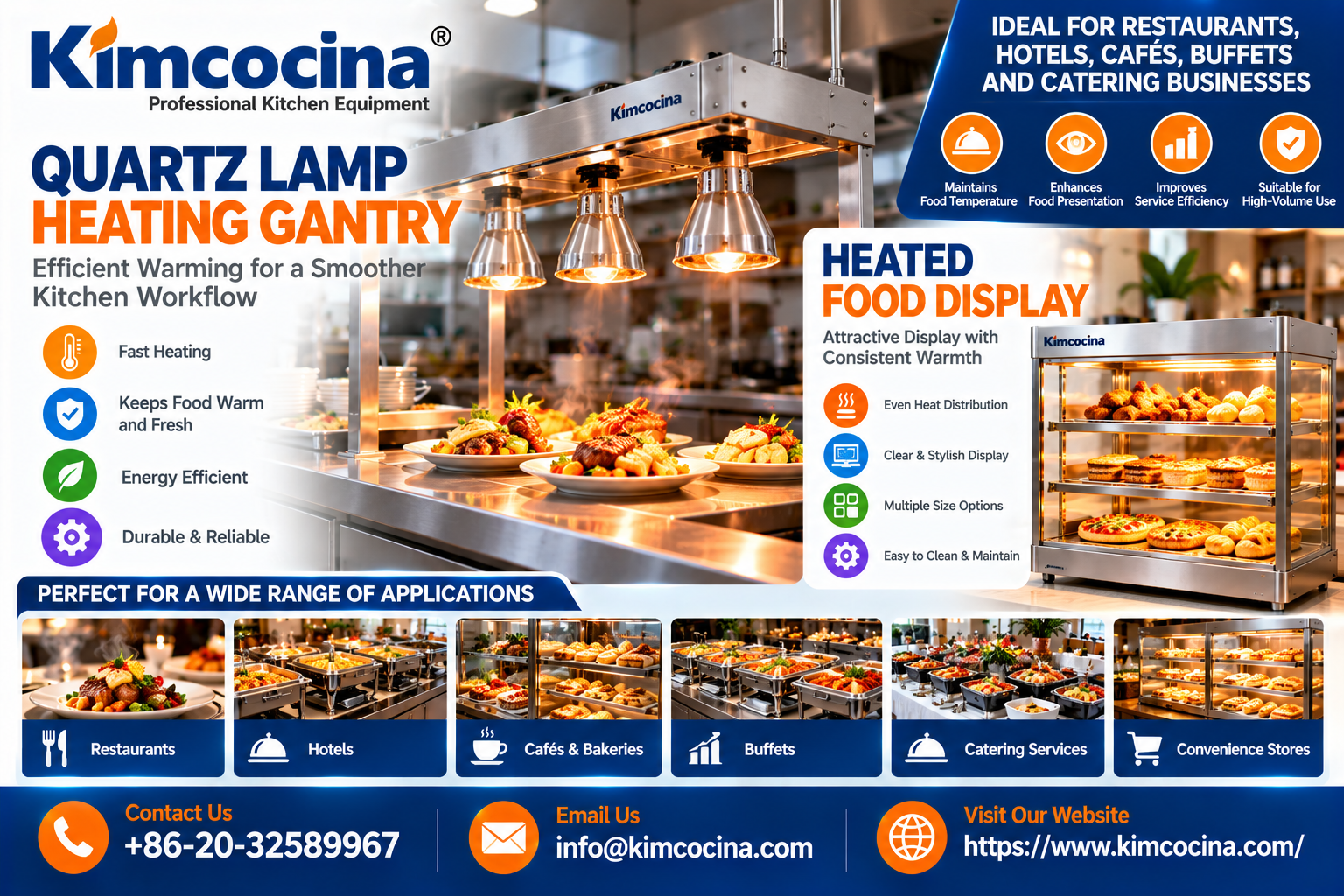
Foodservice businesses are placing greater emphasis on food presentation, serving temperature, and operational efficiency as restaurants, hotels, catering facilities, and buffet operators seek more consistent dining experiences.
A quartz lamp heating gantry provides a radiant heating solution designed to help maintain the warmth of prepared food at suitable serving stations. Meanwhile, a heated food display combines food presentation with controlled warming or hot-holding capabilities, depending on the equipment design.
Both technologies support foodservice operations where food appearance, temperature management, and efficient customer service are important.
For hospitality operators, understanding the differences between radiant heating and heated display systems can improve equipment selection and kitchen planning.
Why Temperature Management Matters in Professional Foodservice
Serving temperature influences food quality, presentation, and customer satisfaction.
Prepared dishes can lose heat while waiting for collection, particularly in busy commercial kitchens.
Uncontrolled holding conditions may also affect texture, moisture, and overall food appeal.
Suitable heating equipment helps operators manage these challenges.
Temperature management should support both food quality and applicable food safety requirements.
What Is a Quartz Lamp Heating Gantry?
A quartz lamp heating gantry is commercial foodservice equipment that uses radiant heat from quartz heating elements positioned above a serving or food preparation area.
The gantry directs heat toward prepared food, helping reduce unwanted cooling during appropriate short-term holding periods.
Unlike equipment that primarily heats surrounding air, radiant heating transfers energy directly toward exposed surfaces.
Key Features
- Radiant Heating: Provides directed warmth to suitable food surfaces.
- Overhead Installation: Helps preserve valuable counter space.
- Rapid Heat Response: Quartz heating elements can respond relatively quickly.
- Service-Line Integration: Supports kitchen pass counters and serving stations.
- Compact Design Options: Available configurations may suit different counter layouts.
- Temperature Management: Suitable models may include adjustable heating controls.
Actual performance depends on heater capacity, installation height, food characteristics, and operating conditions.
Understanding Heated Food Display Equipment
A heated food display is designed to present prepared dishes while providing an appropriate warming or hot-holding environment.
Depending on the model, heating may be supplied through heated shelves, enclosed chambers, radiant elements, or other suitable systems.
These units are commonly used in bakeries, cafeterias, takeaway counters, hotels, and self-service areas.
Common Applications
Restaurant Counters: Presenting ready-to-serve dishes.
Bakery Displays: Keeping suitable savory products warm.
Buffet Areas: Supporting organized hot-food presentation.
Catering Services: Maintaining appropriate serving arrangements.
Quick-Service Restaurants: Displaying prepared menu items for efficient service.
Equipment should be selected according to the food type and the required holding conditions.
Quartz Heating Gantry vs. Heated Food Display
Although both technologies support warm-food service, they perform different functions.
| Feature | Quartz Heating Gantry | Heated Food Display |
| Primary function | Directed radiant warming | Food presentation and warming |
| Installation | Usually overhead | Countertop or floor-standing |
| Food access | Often open service area | Open or enclosed configuration |
| Main benefit | Supports kitchen serving workflow | Supports customer-facing presentation |
| Important consideration | Heat distribution and exposure | Holding temperature and food visibility |
The most suitable option depends on kitchen layout, service volume, and food safety requirements.
How Radiant Heating Influences Food Quality
Radiant heating can help maintain warmth in prepared dishes, particularly when food is awaiting collection.
However, excessive exposure may affect delicate products.
Foods containing sauces, moisture-sensitive ingredients, or thin surfaces may respond differently from dense prepared dishes.
Important Operating Considerations
- Heater positioning and distance.
- Food surface exposure.
- Portion dimensions.
- Holding duration.
- Equipment power settings.
- Food texture and moisture characteristics.
A properly configured quartz lamp heating gantry should complement foodservice procedures rather than replace appropriate cooking or hot-holding equipment.
Designing an Effective Foodservice Counter
Commercial kitchen planning should account for the movement of food between preparation, holding, and customer service.
Poorly positioned equipment can increase staff movement, create congestion, and expose food to unsuitable conditions.
A heating gantry is often positioned near a kitchen pass to help maintain food warmth while staff organize orders.
A heated food display may be positioned where customers can view available items without interfering with safe food handling.
Operators should also consider ventilation, accessible cleaning surfaces, and adequate space for staff activities.
Food Safety and Temperature Control
One critical distinction is that keeping food feeling warm is not the same as maintaining a verified safe hot-holding temperature.
Overhead radiant equipment may warm exposed surfaces without ensuring suitable temperatures throughout the food.
For this reason, a quartz gantry should not automatically be treated as a substitute for validated hot-holding equipment.
Operators should follow applicable food safety regulations, measure food temperatures using suitable instruments, and establish appropriate holding procedures.
Regular monitoring helps identify equipment limitations and unsuitable operating conditions.
Energy Efficiency and Operating Costs
Energy consumption is an important consideration for hospitality businesses.
Quartz heating systems can provide responsive radiant heating, but actual electricity consumption depends on equipment power, operating settings, and utilization.
Heated display units may require energy to maintain their internal temperature or provide controlled surface heating.
Practical Efficiency Measures
- Select equipment appropriate to service demand.
- Avoid unnecessary heating capacity.
- Use approved temperature-control settings.
- Maintain heating elements and equipment surfaces.
- Position equipment according to manufacturer instructions.
- Review operating costs alongside purchase prices.
Efficiency claims should be evaluated using technical specifications and relevant operating conditions.
Cleaning and Maintenance Requirements
Regular cleaning helps maintain foodservice hygiene and equipment performance.
For quartz heating equipment, operators should inspect accessible surfaces, heating elements, supports, and electrical connections according to manufacturer instructions.
Heated display equipment may also require cleaning of glass panels, food-contact surfaces, shelves, and removable accessories.
Equipment must be appropriately isolated and allowed to cool before cleaning where required.
Qualified personnel should address electrical or heating-system faults.
Choosing the Right Commercial Heating Equipment
Businesses selecting commercial food-warming solutions should consider intended applications rather than relying solely on appearance or equipment dimensions.
Important purchasing factors include heating technology, operating capacity, temperature controls, installation requirements, cleaning accessibility, and maintenance support.
For a heated food display, food visibility and appropriate holding performance are particularly important.
For an overhead quartz heating system, heater placement and compatibility with the serving counter deserve greater attention.
Frequently Asked Questions (FAQs)
1. What is a quartz lamp heating gantry?
It is overhead commercial foodservice equipment that uses quartz heating elements to provide radiant warmth to suitable prepared foods.
2. What is a heated food display used for?
It is used to present prepared food while providing warming or hot-holding functions according to the equipment’s design.
3. Can a quartz heating gantry replace a hot-holding cabinet?
Not automatically. The equipment must be capable of maintaining required food temperatures, and its suitability should be verified.
4. Which businesses commonly use food-warming equipment?
Restaurants, bakeries, hotels, cafeterias, catering businesses, and quick-service establishments commonly use suitable warming and display equipment.
5. What should buyers consider before purchasing a heated food display?
They should evaluate food type, capacity, temperature requirements, visibility, installation space, energy consumption, and cleaning procedures.
Media Contact
Department: Commercial Kitchen Heating and Food Display Equipment Enquiries
Email: info@kimcocina.com
Contact: +86-20-32589967
Official Website: https://www.kimcocina.com/