The solar energy industry is experiencing a major transformation. As countries worldwide increase renewable energy capacity and reduce dependence on fossil fuels, utility-scale photovoltaic projects are being developed at an unprecedented pace.
However, the success of a solar farm depends on much more than the efficiency of its photovoltaic modules.
Every solar panel needs a reliable structural system to hold it at the correct angle, maintain its position, and protect it from environmental forces. In large solar installations, this structural framework may include thousands of steel components working together under constantly changing conditions.
Among the materials used for these structures, Electric Resistance Welded steel tubes have become an important solution.
ERW tubes are used in solar tracker torque tubes, mounting posts, piles, crossmembers, braces, and other structural components. Their popularity comes from a combination of manufacturing efficiency, dimensional accuracy, structural performance, and cost competitiveness.
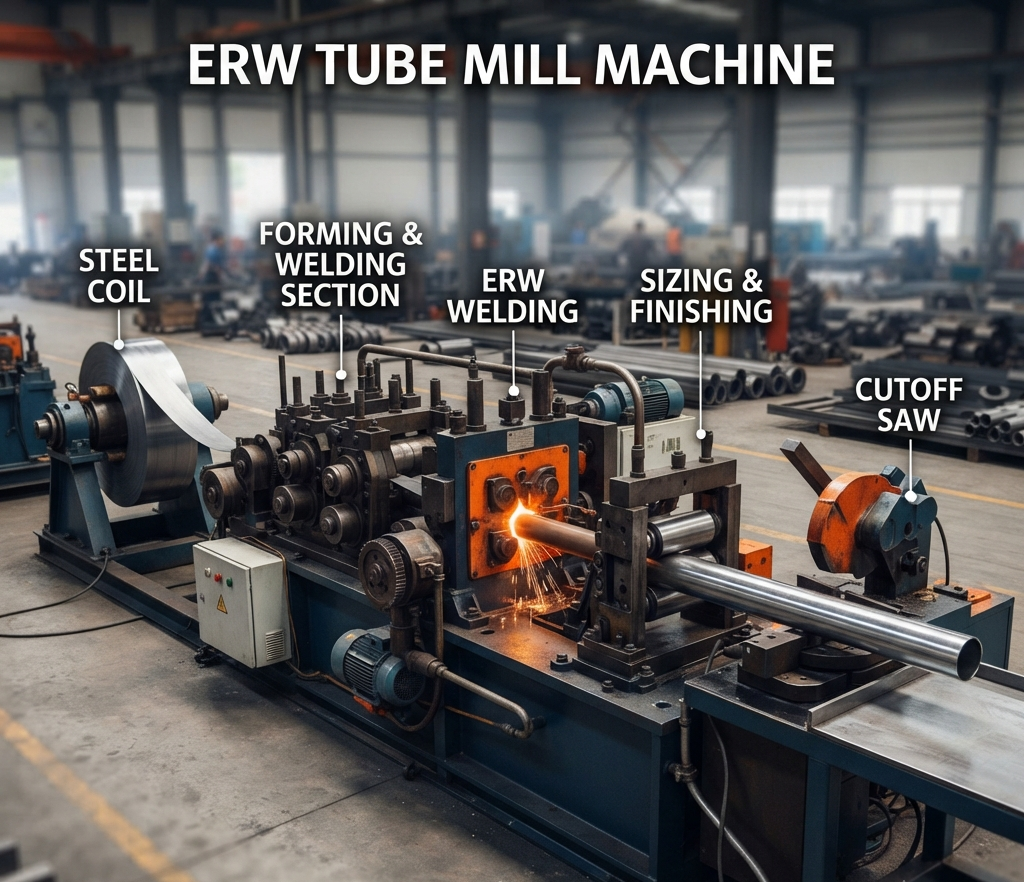
At the manufacturing level, a modern Tube Mill Machine plays a critical role in converting steel coils into accurately formed tubes suitable for demanding photovoltaic applications.
As solar projects become larger and more technologically advanced, understanding the role of ERW tubes—and the technology used to manufacture them—is becoming increasingly important for solar developers, EPC contractors, structural engineers, and steel manufacturers.
The Structural Challenge Behind Large-Scale Solar Power
A solar farm may appear simple from a distance: rows of photovoltaic panels positioned toward the sky.
In reality, the engineering behind a large solar installation is considerably more complex.
The structural system must maintain the position of the PV modules while handling loads generated by:
- Wind pressure and suction
- Snow accumulation
- Rain and moisture
- Temperature variation
- Seismic activity
- Equipment movement
- Thermal expansion
- Long-term corrosion
The challenge becomes even greater when the solar project uses tracking technology.
Unlike fixed-tilt systems, solar trackers continuously adjust the position of PV modules. This introduces moving mechanical components and additional structural forces.
Therefore, the steel tubes used in these systems must be manufactured with appropriate strength, geometry, dimensional control, and corrosion resistance.
This is one of the main reasons ERW technology has become increasingly relevant to the solar industry.
Understanding ERW Steel Tubes
ERW stands for Electric Resistance Welded.
The manufacturing process begins with a flat steel strip, typically supplied in coil form. The strip is gradually shaped through a series of forming rolls until it reaches the required tubular profile.
As the edges approach one another, high-frequency electrical energy heats the steel edges. Pressure is then applied to create a continuous welded seam.
After welding, the tube can pass through additional processes such as:
- Weld bead removal
- Sizing
- Straightening
- Cutting
- End finishing
- Inspection
- Corrosion protection
Depending on the application, the final product may be manufactured as a round, square, rectangular, octagonal, or customized polygonal profile.
This production flexibility is especially useful for solar structural applications because different components require different mechanical characteristics.
Why ERW Tubes Are Becoming a Preferred Solar Structural Material
The solar industry is under constant pressure to increase energy output while reducing the total cost of electricity generation.
Structural materials therefore need to meet two objectives simultaneously:
They must be strong enough to survive demanding environmental conditions while remaining economical enough for large-scale deployment.
ERW tubes can provide a useful balance between these requirements.
1. High Manufacturing Consistency
Solar projects often involve the installation of thousands of identical structural components.
If dimensions vary significantly from one tube to another, assembly can become more difficult and expensive.
Modern ERW production systems can maintain consistent:
- Outer dimensions
- Wall thickness
- Straightness
- Length
- Profile geometry
This consistency can simplify downstream fabrication and installation.
2. Efficient Production
Large solar projects require substantial quantities of steel.
Continuous ERW production allows manufacturers to produce tubes efficiently, helping them meet large-volume requirements.
This is particularly important when project schedules are tight and structural components must arrive at the construction site on time.
3. Competitive Cost
ERW manufacturing can be an economical method for producing large volumes of structural tubes.
The cost advantages can come from:
- Continuous production
- Efficient material utilization
- High production speeds
- Automated processes
- Reduced manual intervention
For solar projects where structural steel represents a significant portion of the overall balance-of-system cost, manufacturing efficiency can have a meaningful impact.
4. Flexible Tube Profiles
Solar applications do not always require traditional round tubes.
Depending on the design, manufacturers may produce:
- Round tubes
- Square tubes
- Rectangular tubes
- Octagonal tubes
- Polygonal profiles
- Customized sections
This allows engineers to select a profile based on structural requirements and connection design.
ERW Tubes in Solar Tracker Systems
Solar tracking technology has become an important development in utility-scale photovoltaic power generation.
A tracker moves solar modules throughout the day to maintain a favorable orientation toward the sun.
The mechanical structure responsible for this movement must be carefully engineered.
One of its key components is the torque tube.
What Does a Torque Tube Do?
The torque tube acts as a structural axis for the tracker.
It can perform several functions simultaneously:
- Support PV modules
- Transfer rotational forces
- Connect multiple module rows
- Resist torsional forces
- Distribute mechanical loads
- Work with bearings and drive systems
Because of these responsibilities, torque tubes require careful control of their geometry and mechanical properties.
A tube that is excessively flexible may experience unwanted deformation. A tube with poor dimensional accuracy may create alignment issues during assembly.
For this reason, solar tracker manufacturers often require tightly controlled tube specifications.
Why Polygonal Profiles Are Used in Solar Trackers
Round tubes have been widely used in structural applications, but tracker systems may benefit from polygonal profiles.
Square and octagonal tubes, for example, can provide flat surfaces that simplify the attachment of:
- Clamps
- Bearings
- Module brackets
- Drive components
Their geometry can also provide useful torsional performance for certain tracker designs.
However, the ideal profile depends on the engineering design.
There is no universal tube shape suitable for every solar tracker.
Engineers must consider:
- Wind loads
- Span length
- Module weight
- Tracker configuration
- Drive system
- Bearing arrangement
- Structural deflection limits
The tube profile should therefore be selected through detailed structural analysis.
ERW Tubes for Fixed-Tilt Solar Mounting Systems
Not every solar farm requires tracking technology.
Fixed-tilt mounting systems remain an important solution because of their relatively simple mechanical design.
In these systems, ERW tubes may be used for:
- Structural posts
- Foundation piles
- Support columns
- Crossbeams
- Bracing
- Rails and secondary structures
The advantage of using ERW products in these applications is their combination of predictable geometry and efficient production.
For foundation components, engineers must also consider soil conditions and installation forces.
The appropriate tube specification may depend on:
- Soil bearing capacity
- Wind loads
- Pull-out resistance
- Bending forces
- Buckling behavior
- Installation method
This demonstrates why tube selection should always be based on project-specific engineering rather than simply choosing the lowest-cost option.
The Role of Corrosion Protection
A solar structure may remain outdoors for decades.
During this period, steel components can be exposed to moisture, humidity, salt, chemicals, and temperature changes.
Corrosion protection is therefore an essential part of solar structural engineering.
Hot-Dip Galvanizing
Hot-dip galvanizing protects steel by applying a zinc coating.
The coating provides a barrier between the steel and the surrounding environment while also offering sacrificial protection.
It is widely used for outdoor steel structures.
Zinc-Aluminum-Magnesium Coatings
Advanced metallic coatings containing zinc, aluminum, and magnesium are also being considered for solar applications.
These coatings can provide strong corrosion protection with relatively thin coating layers and may offer improved performance in certain environments.
They can be particularly attractive for projects where corrosion resistance, material efficiency, and edge protection are important.
The right coating should depend on environmental exposure and project requirements.
What Happens Inside an ERW Tube Production Line?
The quality of the finished solar tube is influenced by every stage of manufacturing.
A typical production sequence can include:
Step 1: Coil Preparation
Steel coils are loaded and prepared for continuous processing.
Step 2: Strip Entry
The steel strip enters the production line under controlled tension and alignment.
Step 3: Forming
A series of rollers gradually shapes the flat strip into the desired tubular profile.
Step 4: High-Frequency Welding
The edges are heated using electrical resistance and joined under pressure.
Step 5: Weld Bead Processing
Excess weld material may be removed depending on the final specification.
Step 6: Sizing
The tube passes through sizing stands to achieve the required dimensions.
Step 7: Straightening
The product is corrected to meet straightness requirements.
Step 8: Cutting
The continuous tube is cut into predetermined lengths.
Step 9: Inspection
The finished products are checked for dimensional accuracy and weld quality.
Step 10: Surface Treatment
Depending on the project, the tubes may receive galvanizing or another protective coating.
This integrated production approach allows manufacturers to maintain consistent output while supplying the high volumes required by large solar projects.
Why Production Equipment Matters
A high-quality tube requires more than good raw material.
The production equipment must also be capable of maintaining stable forming and welding conditions.
An advanced ERW Tube Mill Machine can integrate automated controls and monitoring systems to help manufacturers maintain:
- Stable welding parameters
- Consistent tube dimensions
- Accurate sizing
- Controlled production speed
- Reduced material waste
- Reliable product quality
For manufacturers supplying solar projects, these capabilities can become a significant competitive advantage.
Important Technical Parameters for Solar ERW Tubes
Selecting an ERW tube for solar applications requires careful evaluation of several factors.
Steel Grade
The selected steel grade should meet the required mechanical properties and welding requirements.
Depending on the application, engineers may specify conventional structural grades or higher-strength materials.
Yield Strength
Yield strength indicates the stress level at which permanent deformation begins.
It is an important parameter when designing structural components exposed to wind, snow, and other loads.
Tensile Strength
Tensile strength describes the maximum stress the material can withstand before failure.
Wall Thickness
Wall thickness affects strength, stiffness, weight, and cost.
The optimum thickness should be determined through engineering calculations.
Dimensional Tolerance
Tolerances may apply to:
- Width
- Height
- Diameter
- Wall thickness
- Straightness
- Length
- Corner geometry
Tight control is particularly important for components that connect to mechanical systems.
Weld Integrity
The welded seam must meet the required performance criteria.
Quality control may include non-destructive testing and other inspection methods.
Quality Assurance for Solar ERW Tubes
Solar structures are long-term investments.
A failure in a structural component can result in costly repairs and potentially affect power generation.
For this reason, manufacturers should implement comprehensive quality assurance procedures.
Potential quality checks include:
- Raw material inspection
- Chemical analysis
- Weld monitoring
- Eddy current testing
- Ultrasonic testing
- Dimensional inspection
- Mechanical testing
- Coating inspection
The exact requirements should be established according to applicable standards and customer specifications.
Environmental Factors That Influence Tube Selection
Solar farms can be installed in almost any climate.
This means that structural steel must be selected according to the local environment.
Coastal Areas
Salt exposure can accelerate corrosion.
Enhanced corrosion protection may therefore be required.
Desert Areas
Extreme temperatures, dust, and strong winds can influence structural design.
Snowy Regions
Snow accumulation can create significant vertical loads.
Seismic Zones
Structures may need to withstand additional dynamic forces.
High-Wind Areas
Wind loading is often a major design consideration for solar mounting systems and trackers.
The same tube specification may therefore not be suitable for every project.
ERW Tubes and the Economics of Solar Power
The ultimate goal of a solar project is to produce clean electricity economically over its operating life.
Structural components contribute to the overall cost through:
- Material expenses
- Manufacturing
- Transportation
- Installation
- Maintenance
- Corrosion protection
- Replacement risk
Using appropriately designed ERW tubes can help optimize these costs.
A lighter but sufficiently strong structural design may reduce transportation and installation requirements.
At the same time, accurate manufacturing can simplify assembly and reduce the risk of installation delays.
This means that tube selection is not simply a material decision—it can influence the economics of the entire solar project.
How to Select a Reliable ERW Tube Manufacturer
Solar companies should evaluate potential suppliers carefully.
Key questions include:
Can the manufacturer produce the required tube profiles?
Does the supplier have sufficient production capacity?
What quality control systems are available?
Can the manufacturer support customized specifications?
What testing and inspection procedures are used?
Can the supplier meet project delivery schedules?
Does the manufacturer understand solar structural applications?
The best supplier is not necessarily the one offering the lowest initial price. Long-term quality, production reliability, technical support, and delivery performance are equally important.
The Future of ERW Tube Technology in Renewable Energy
The renewable energy sector is expected to continue evolving.
Solar trackers are becoming more sophisticated. Solar farms are becoming larger. Developers are seeking lighter structures, longer service lives, and lower installation costs.
These trends are encouraging manufacturers to improve:
- Automated forming
- High-frequency welding
- Real-time inspection
- High-strength steel processing
- Advanced coating systems
- Customized tube profiles
The development of more efficient manufacturing technology will likely play an important role in meeting the growing demand for solar structural components.
As the solar industry expands, the demand for reliable ERW tube production capabilities is also expected to increase.
https://shopnets.com/erw-tube-mill-line-redefines-high-efficiency-steel-tube-manufacturing/
https://newsgrow.blogspot.com/2026/07/erw-tube-mill-line-powerful-technology.html
https://newsgrow.blogspot.com/2026/07/how-tube-mill-technology-is-powering.html
https://blogstream.net/the-steel-backbone-behind-modern-solar-farms-why-erw-tubes-matter/