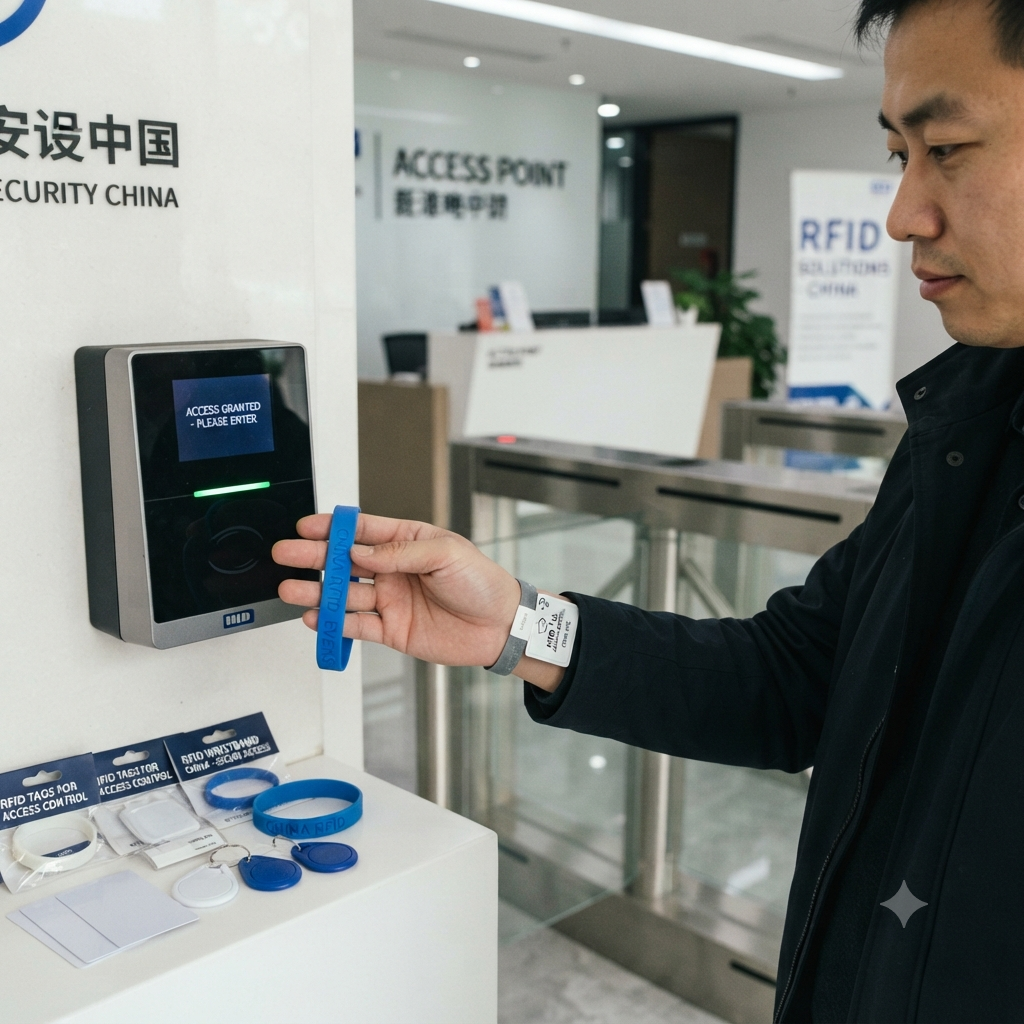
From festivals and amusement parks to conferences, sporting events, hotels, and entertainment venues, RFID technology is changing how people enter, interact with, and experience modern events.
But what exactly happens when you tap your wristband?
Let’s find out.
RFID Wristbands Explained in Simple Terms
RFID stands for Radio Frequency Identification.
The technology uses radio waves to allow an RFID tag and a reader to communicate wirelessly.
An RFID wristband contains a small electronic tag, usually made up of a microchip and an antenna. When the wristband comes close to an RFID reader, the reader detects the tag and communicates with it.
The system then identifies the unique code associated with the wristband.
Depending on how the system is configured, that identification can trigger different actions.
It might:
- Open an entrance gate
- Grant access to a restricted area
- Confirm an event ticket
- Unlock a locker
- Approve a cashless transaction
- Record an attendance entry
- Activate a discount
- Connect a visitor to a loyalty program
For busy venues, RFID tags for access control can provide a convenient way to manage who can enter specific areas without relying entirely on manual ticket checks.
What Happens When You Tap?
The magic behind RFID happens incredibly quickly.
When you approach a reader, it sends out a radio signal.
The RFID tag inside your wristband receives that signal and responds with its identification information.
The connected system then checks the information and decides whether the requested action should be approved.
If your wristband is authorised for entry, the gate opens.
If you’re entering a VIP zone, the system checks whether you have the appropriate permission.
If you’re making a purchase, the system processes the transaction associated with your account.
All of this can happen in seconds.
To the visitor, it feels like a simple tap.
Behind the scenes, it’s a carefully connected digital process.
Why RFID Is Different From Barcodes
Barcodes have been a standard part of event ticketing for many years.
They’re simple and inexpensive, but they have one major limitation: they need to be visually scanned.
The barcode must generally be visible to the scanner and positioned correctly.
RFID works through radio-frequency communication, so it can offer a more flexible and contactless experience.
| Comparison | RFID Wristband | Barcode Wristband |
| Reading Method | Radio-frequency communication | Optical scanning |
| Line of Sight | Usually not necessary | Necessary |
| Reading Position | Flexible | Requires correct positioning |
| Speed | Designed for fast processing | Can be slower at busy entrances |
| Durability | Can be protected within wristband materials | Can become unreadable if damaged |
| Security | Can support unique IDs and secure systems | Can be easier to duplicate |
| Use Cases | Entry, payments, access, lockers, engagement | Mainly ticket validation |
| Visitor Experience | Tap-and-go convenience | Scan-and-go experience |
For a small gathering, the difference may not seem important.
But for a festival with tens of thousands of visitors arriving within a few hours, faster access can make a huge difference.
The Technology Hidden Inside the Wristband
An RFID wristband doesn’t need to look high-tech to contain sophisticated technology.
Inside the wearable is an RFID inlay that typically includes:
- A microchip
- An antenna
- A unique identifier
The technology can be embedded into several types of materials.
Popular options include:
- Silicone
- Fabric
- Plastic
- Waterproof materials
- Custom event wristbands
The wristband can also be designed around the event’s visual identity.
This means organisers don’t have to choose between technology and branding.
They can have both.
Businesses working with RFID wristband China manufacturers can explore customised designs suitable for large festivals, conferences, amusement parks, exhibitions, and other high-volume events.
Three Types of RFID Technology You Should Know
RFID tags generally fall into three main categories.
Passive RFID
Passive tags don’t have an internal battery.
They receive the energy required for communication from the reader itself.
Because they are relatively small and cost-effective, passive RFID tags are widely used for access control and event ticketing.
Active RFID
Active tags include their own battery.
This allows them to communicate over longer distances and support applications that require more frequent transmissions.
Battery-Assisted Passive RFID
These tags include a battery but typically communicate with a reader when they enter the appropriate range.
Each type has its own advantages, and the best choice depends on the required reading distance, environment, application, and budget.
Your Wristband Can Become Your Event Wallet
One of the most interesting applications of RFID is cashless payment.
Imagine attending a festival without carrying your wallet around all day.
Instead, your wristband is linked to your payment account or prepaid balance.
You can use it to pay for:
- Food
- Beverages
- Merchandise
- Event activities
- Special experiences
This can make transactions faster and more convenient.
For event organisers, cashless RFID payments can also provide useful insights into purchasing behaviour.
They may discover which products sell best, when visitors spend the most, and which areas generate the highest revenue.
In other words, the wristband can benefit both the visitor and the business.
RFID and Access Management
Access control is another major reason organisations are adopting RFID.
Not everyone at an event has the same level of access.
There may be:
- General attendees
- VIP guests
- Staff members
- Performers
- Vendors
- Security personnel
- Media representatives
Each group may require different permissions.
An RFID system can associate a specific wristband with a defined access level.
When the wristband is presented at a reader, the system can verify the user’s permission.
This creates a more organised approach to managing restricted areas.
With RFID tags for access control, organisers can help reduce unauthorised access while making the verification process faster for legitimate visitors.
Does RFID Track Your Every Move?
Not exactly.
This is one of the most common misunderstandings about RFID wristbands.
Most passive RFID wristbands are not GPS devices.
They don’t continuously broadcast your exact location.
Instead, the system can record an interaction when the wristband comes within range of a reader.
For example, if a visitor enters a VIP area, the system may record that access event.
If readers are positioned throughout a venue, organisers may be able to analyse movement patterns and identify trends.
They could learn:
- When people enter the venue
- Which attractions are most popular
- Where queues become longest
- Which areas experience heavy traffic
- When visitor activity increases or decreases
These insights can help organisers improve future events.
How Much Information Can an RFID Wristband Hold?
Many people assume that an RFID wristband stores all of their personal information.
In reality, many systems use the wristband primarily as a unique identifier.
The wristband’s ID connects to information stored in a backend database or cloud-based platform.
Depending on the system, that information could relate to:
- Ticket credentials
- Access permissions
- Payment accounts
- Discounts
- Loyalty programs
- Event registration
- Locker access
This allows organisers to manage data through a central system while keeping the physical wristband relatively simple.
Why Are Events Switching to RFID?
The popularity of RFID is growing because it can solve several event challenges at the same time.
Faster Entry
Contactless identification can help reduce queues at busy entrances.
Improved Security
Digital permissions can help organisers control access to restricted zones.
Cashless Convenience
Visitors don’t need to repeatedly carry cash or payment cards.
Better Data
Organisers can gain insights into how visitors interact with the venue.
Greater Convenience
One wristband can potentially replace multiple physical credentials.
Stronger Engagement
RFID can connect visitors with promotions, loyalty programs, and interactive experiences.
This combination makes RFID more than just an access technology.
It becomes part of the complete event ecosystem.
The Rise of Custom RFID Wristbands
The technology inside the wristband matters, but so does the wristband itself.
A festival held outdoors may require waterproof and durable materials.
A luxury conference may want a premium appearance.
A large amusement park may prioritise comfort and long-term wearability.
An international event may need thousands of customised wristbands with unique identifiers.
This is where RFID wristband China suppliers can offer custom manufacturing options that combine event branding, wearable comfort, durability, and RFID functionality.
What Does the Future Hold?
The future of event technology is moving toward greater connectivity.
RFID wristbands are already helping connect:
Tickets + Access + Payments + Security + Data + Visitor Engagement
As digital platforms become more advanced, RFID could become even more integrated with mobile applications, loyalty programs, personalised experiences, and smart venue systems.
The goal isn’t simply to make event entry faster.
It’s to create an experience where every interaction feels effortless.
https://freeseobacklinks.online/how-rfid-technology-is-changing-the-way-we-enter-pay-and-interact/
https://blogstream.net/the-tap-that-is-changing-events-how-rfid-technology-is-making-life-easier/
https://newsgrow.blogspot.com/2026/07/rfid-labels-and-rfid-silicone.html
https://newsgrow.blogspot.com/2026/07/rfid-wristbands-are-changing-events.html
https://blogstream.net/one-tiny-wristband-a-smarter-event-the-rise-of-rfid-technology/
https://freeseobacklinks.info/rfid-wristbands-how-one-small-tap-is-changing-modern-events/