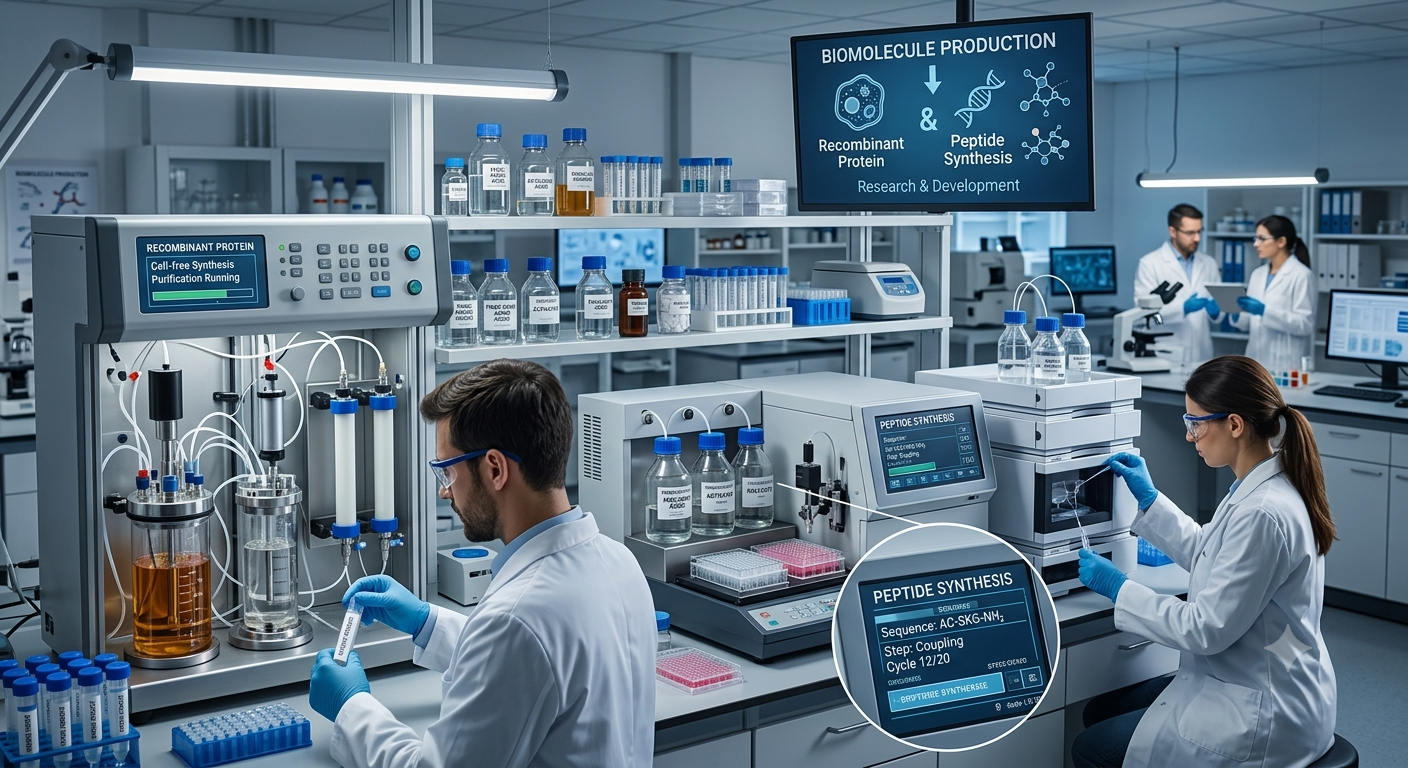
The development of modern biotechnology depends heavily on the ability to produce precise biological molecules at scale. Among the most important technologies supporting pharmaceutical research, diagnostics, drug discovery, and life sciences are recombinant protein production and peptide synthesis. Although both approaches are used to create valuable biomolecules, they rely on different manufacturing principles and are suited to different scientific applications.
Understanding how these technologies work, where they differ, and how researchers select the right production strategy can help organizations make better decisions when developing new therapeutics, research tools, vaccines, or diagnostic products.
What Is Recombinant Protein Production?
Recombinant protein production is a biotechnology process used to manufacture proteins by introducing a specific gene into a suitable biological expression system. The engineered host then uses its cellular machinery to produce the desired protein.
The process begins by identifying and designing the DNA sequence that encodes the target protein. This gene is inserted into an expression vector and transferred into a host system. Depending on the protein’s complexity and intended use, researchers may select bacterial, yeast, insect, or mammalian cells.
Common expression systems include:
- Escherichia coli (E. coli): Fast, economical, and widely used for many research proteins.
- Yeast: Useful for scalable production and certain eukaryotic proteins.
- Insect cells: Suitable for complex recombinant proteins requiring more advanced expression capabilities.
- Mammalian cells: Often selected for antibodies and proteins requiring sophisticated post-translational modifications.
After expression, the recombinant protein is harvested and purified. Additional characterization is performed to confirm identity, purity, activity, and structural integrity.
Why Recombinant Proteins Matter
Recombinant proteins have transformed biological research and medicine. They can be used as therapeutic agents, research reagents, diagnostic components, and tools for studying cellular mechanisms.
Applications include:
- Enzyme replacement therapies
- Therapeutic hormones and growth factors
- Recombinant antibodies
- Vaccine development
- Cell culture supplements
- Diagnostic assays
- Structural biology research
- Drug screening and discovery
The major advantage is the ability to produce a consistent protein with defined characteristics under controlled conditions.
Understanding Peptide Synthesis
Peptides are short chains of amino acids connected by peptide bonds. While proteins are generally larger and structurally more complex, peptides can perform highly specific biological functions and are increasingly important in pharmaceutical research.
Peptide synthesis is commonly performed through chemical methods, especially solid-phase peptide synthesis (SPPS). In this approach, amino acids are added sequentially to a growing peptide chain attached to a solid support.
The general process includes:
- Attaching the first amino acid to a solid resin.
- Removing the protecting group from the amino acid.
- Adding the next protected amino acid.
- Repeating the coupling and deprotection cycle.
- Cleaving the completed peptide from the resin.
- Removing protecting groups.
- Purifying and characterizing the final product.
This controlled process allows researchers to create peptides with specific amino acid sequences and modifications.
Advantages of Custom Peptide Synthesis
Custom peptide synthesis provides flexibility for research and development projects requiring molecules with precise sequences or specialized properties.
Researchers can request:
- Specific amino acid sequences
- N-terminal or C-terminal modifications
- Fluorescent labels
- Biotinylation
- Phosphorylation
- Lipidation
- Cyclization
- Stable isotope labeling
- Peptide conjugates
These options make synthetic peptides valuable in antibody development, assay design, vaccine research, biomarker studies, and therapeutic discovery.
Recombinant Protein vs. Peptide Synthesis
Although both technologies produce biologically relevant molecules, their applications and manufacturing methods differ significantly.
| Feature | Recombinant Protein | Peptide Synthesis |
| Production method | Biological expression | Chemical synthesis |
| Typical molecule | Larger proteins | Short amino acid chains |
| Common systems | Bacteria, yeast, insect, mammalian cells | Solid-phase or liquid-phase chemistry |
| Modification flexibility | Depends on expression host | Highly customizable |
| Structural complexity | Often high | Generally lower |
| Typical applications | Therapeutics, enzymes, antibodies | Drug discovery, diagnostics, research |
| Scalability | Strong for established expression systems | Strong for many short-to-medium peptides |
The right approach depends on the target molecule, required purity, biological activity, production scale, and desired modifications.
How to Choose the Right Production Strategy
Selecting between recombinant protein production and peptide synthesis requires careful consideration of project objectives.
1. Define the Target Molecule
Determine whether the desired product is a full-length protein, protein fragment, peptide, fusion construct, or modified sequence.
2. Evaluate Structural Requirements
Proteins requiring complex folding or post-translational modifications may benefit from a mammalian or other eukaryotic expression system. Short sequences may be more efficiently produced through chemical synthesis.
3. Consider Purity Requirements
High-purity products are essential for pharmaceutical, diagnostic, and sensitive research applications. Analytical methods such as HPLC, mass spectrometry, SDS-PAGE, and spectroscopy may be used for characterization.
4. Assess Biological Activity
A successful production process must deliver a molecule that retains the required biological function. Purity alone does not guarantee performance.
5. Review Scale and Timeline
Production requirements can vary dramatically between laboratory-scale research and commercial manufacturing. Early planning can help minimize delays and optimize costs.
Quality Control in Recombinant Protein and Peptide Production
Quality assurance is a critical part of biomolecule development. Reliable suppliers typically implement multiple analytical checkpoints throughout production.
Common Quality Control Methods
- Mass spectrometry: Confirms molecular mass and helps verify identity.
- HPLC: Evaluates purity and separates impurities.
- SDS-PAGE: Assesses protein size and sample quality.
- Western blotting: Confirms specific protein identity.
- Amino acid analysis: Supports composition verification.
- Endotoxin testing: Important for applications involving sensitive biological systems.
- Activity assays: Determine whether the molecule performs its intended function.
For research-grade products, the appropriate level of characterization depends on the application. Therapeutic development generally requires significantly more extensive testing and documentation.
Key Applications Across Modern Biotechnology
The combined capabilities of recombinant protein production and peptide synthesis support a wide range of scientific fields.
Pharmaceutical Research
Researchers use recombinant proteins and synthetic peptides to investigate disease pathways, identify therapeutic targets, and develop biologic drugs.
Drug Discovery
Peptides can serve as lead compounds or targeting molecules, while recombinant proteins are frequently used in screening assays and mechanism-of-action studies.
Diagnostics
Both technologies contribute to the development of diagnostic reagents, assay components, and biomarker detection platforms.
Vaccine Development
Recombinant antigens and synthetic peptides can be evaluated as vaccine candidates or research tools for studying immune responses.
Academic Research
Scientists rely on custom biomolecules to investigate protein interactions, cellular signaling, enzyme activity, and molecular mechanisms.
Frequently Asked Questions
1. What is recombinant protein production?
It is the process of producing a target protein using genetically engineered host cells containing the desired gene.
2. What is peptide synthesis?
Peptide synthesis is the controlled chemical assembly of amino acids into a defined peptide sequence.
3. Are recombinant proteins and peptides the same?
No. Recombinant proteins are generally produced biologically and can be structurally complex, while peptides are shorter amino acid chains commonly produced through chemical synthesis.
4. Which expression system is best for recombinant proteins?
The best system depends on protein complexity, folding requirements, post-translational modifications, yield, and intended application.
5. What is solid-phase peptide synthesis?
SPPS is a chemical method in which amino acids are sequentially added to a peptide chain attached to a solid resin.
6. Can synthetic peptides be modified?
Yes. Researchers can request modifications such as fluorescent labels, phosphorylation, cyclization, and terminal modifications.
7. How is recombinant protein purity tested?
Common methods include HPLC, SDS-PAGE, mass spectrometry, and specialized protein assays.
8. Why is protein folding important?
Correct folding is essential because a protein’s three-dimensional structure often determines its biological activity.
9. Which method is better for drug discovery?
Neither is universally better. The choice depends on the molecule, research objective, required modifications, and biological properties.
10. Can these technologies support commercial research?
Yes. Both are widely used in pharmaceutical development, biotechnology, diagnostics, academic research, and industrial applications.
https://newsgrow.blogspot.com/2026/06/recombinant-protein-and-peptide.html