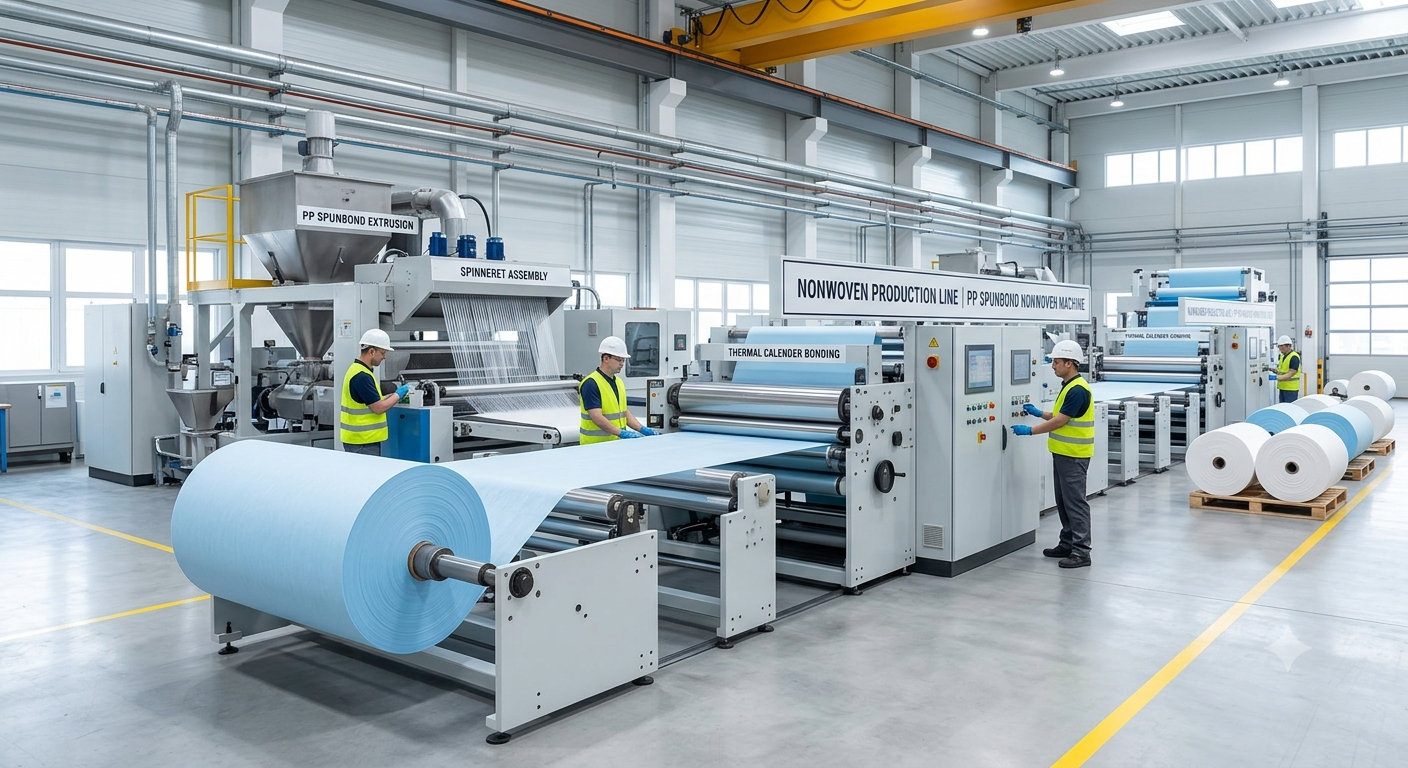
Among the various nonwoven manufacturing technologies available today, the PP Spunbond Nonwoven Machine has attracted considerable attention because of its ability to produce continuous polypropylene filament webs efficiently.
Polypropylene, commonly known as PP, is widely used because it is lightweight, chemically resistant, durable, and suitable for many applications. In a typical spunbond process, polypropylene resin is melted, extruded through spinnerets, stretched into continuous filaments, laid into a web, and bonded using thermal techniques.
The result is a uniform nonwoven fabric that can be engineered for different thicknesses, strengths, and performance characteristics.
How the Production Process Works
A modern spunbond manufacturing process generally includes several key stages:
- Raw Material Feeding: Polypropylene resin is introduced into the production system.
- Melting and Extrusion: The polymer is heated and converted into a molten form.
- Filament Formation: The molten polymer passes through specialized spinnerets to create continuous filaments.
- Filament Drawing: Airflow and drawing systems stretch and orient the filaments.
- Web Formation: Filaments are distributed across a moving forming surface.
- Thermal Bonding: Heat and pressure bond the fibers together.
- Calendering and Finishing: The fabric receives the required surface structure and characteristics.
- Winding: Finished material is collected into rolls for storage and further processing.
The efficiency of each stage directly influences fabric uniformity, production speed, and final product quality.
Why Manufacturers Are Upgrading Production Lines
Investment in a modern Nonwoven Production Line is increasingly viewed as a strategic decision rather than simply an equipment purchase. Manufacturers must balance production capacity with quality, energy consumption, labor requirements, maintenance, and long-term scalability.
Advanced production systems can help manufacturers address several important objectives.
Higher Production Efficiency
Automated controls and optimized processing systems can reduce unnecessary downtime and improve production consistency. Higher line speeds may also allow manufacturers to increase output without proportionally increasing operational resources.
Better Product Consistency
Uniform fabric weight, thickness, strength, and appearance are critical for demanding applications. Modern monitoring systems help manufacturers maintain stable process parameters throughout production.
Flexible Product Development
Different industries require different fabric specifications. A well-designed production line can support variations in basis weight, width, color, and bonding patterns, enabling producers to serve multiple customer segments.
Improved Resource Management
Efficient polymer handling, temperature management, and automated controls can help reduce material waste and optimize energy consumption. These improvements are increasingly important as manufacturers face pressure to improve operational sustainability.
Comparing Production Technologies
| Feature | Traditional Nonwoven Systems | Modern PP Spunbond Nonwoven Machine |
| Production control | More manual intervention | Higher automation |
| Output consistency | Can vary by process | More consistent |
| Product flexibility | Application dependent | Supports multiple specifications |
| Process monitoring | Limited in older systems | Advanced monitoring capabilities |
| Material efficiency | May require optimization | Designed for efficient processing |
| Scalability | Depends on equipment | Suitable for expanding production |
The right technology ultimately depends on the intended application, production volume, available infrastructure, and required fabric specifications.
Applications Expand Across Multiple Industries
The growing adoption of polypropylene spunbond materials reflects their versatility.
Healthcare and Hygiene
Nonwoven fabrics are widely used in medical and hygiene products, including protective garments, surgical materials, masks, disposable covers, and other applications where lightweight construction and controlled performance are important.
Agriculture
Agricultural nonwovens can be used for crop covers, plant protection, weed control, and soil-related applications. Their breathable structure and lightweight design make them useful for managing agricultural environments.
Construction
Nonwoven materials are increasingly incorporated into construction products for insulation, separation, filtration, and protective applications. Their durability and customizable characteristics support a variety of building requirements.
Packaging and Consumer Products
Reusable bags, protective packaging, furniture materials, and household products represent additional areas where spunbond nonwovens can provide practical performance.
Filtration
The controlled fiber structure of nonwoven fabrics makes them suitable for selected air, liquid, and industrial filtration applications, depending on the required filtration characteristics.
Key Factors to Consider Before Purchasing
Companies planning to install a Nonwoven Production Line should evaluate more than headline production capacity. A successful investment requires careful consideration of technical and commercial requirements.
Important Evaluation Criteria
- Required fabric width and basis weight
- Desired production capacity
- Polymer compatibility
- Energy consumption
- Automation and control systems
- Maintenance requirements
- Availability of technical support
- Spare-parts accessibility
- Installation and commissioning assistance
- Future expansion opportunities
A manufacturer should also assess whether the proposed PP Spunbond Nonwoven Machine can meet current product specifications while allowing room for future product development.
The Role of Automation in the Future
Automation is becoming a major factor in modern nonwoven manufacturing. Digital controls, automated monitoring, and real-time process management can help operators identify variations and respond quickly to production issues.
Future-focused systems are expected to place greater emphasis on:
- Intelligent production monitoring
- Predictive maintenance
- Automated quality inspection
- Energy optimization
- Data-based process management
- Reduced production waste
These developments could help manufacturers create more reliable production environments while improving competitiveness in global markets.
FAQ: Nonwoven Production Line and PP Spunbond Nonwoven Machine
1. What is a Nonwoven Production Line?
It is an integrated manufacturing system used to produce nonwoven fabrics through processes such as fiber formation, web formation, bonding, finishing, and winding.
2. What is a PP Spunbond Nonwoven Machine?
It is specialized equipment designed to manufacture nonwoven fabric from polypropylene by extruding, stretching, laying, and thermally bonding continuous filaments.
3. Why is polypropylene widely used?
Polypropylene is lightweight, durable, chemically resistant, and suitable for producing nonwoven materials for many industrial applications.
4. What products can spunbond nonwoven fabric make?
It can be used in medical products, hygiene materials, agricultural fabrics, construction products, packaging, furniture, and various industrial applications.
5. Is spunbond fabric recyclable?
The recyclability of spunbond fabric depends on its composition, additives, contamination, and local recycling infrastructure. Monomaterial PP products may offer easier recycling pathways.
6. How does automation improve production?
Automation can improve process consistency, reduce manual intervention, monitor operating parameters, and support more efficient production management.
7. What determines fabric quality?
Key factors include polymer quality, filament formation, web uniformity, bonding conditions, basis weight, machine stability, and process control.
8. Can one machine produce different fabric specifications?
Many modern systems can accommodate different specifications, but the available range depends on machine configuration and production requirements.
9. What should buyers consider before purchasing?
Buyers should evaluate capacity, fabric width, product requirements, automation, energy efficiency, maintenance, technical support, and long-term scalability.
10. Why is equipment selection important?
The right equipment can influence production efficiency, fabric consistency, operating costs, maintenance requirements, and a manufacturer’s ability to respond to changing market demand.
https://newsgrow.blogspot.com/2026/06/nonwoven-production-line-powers.html