
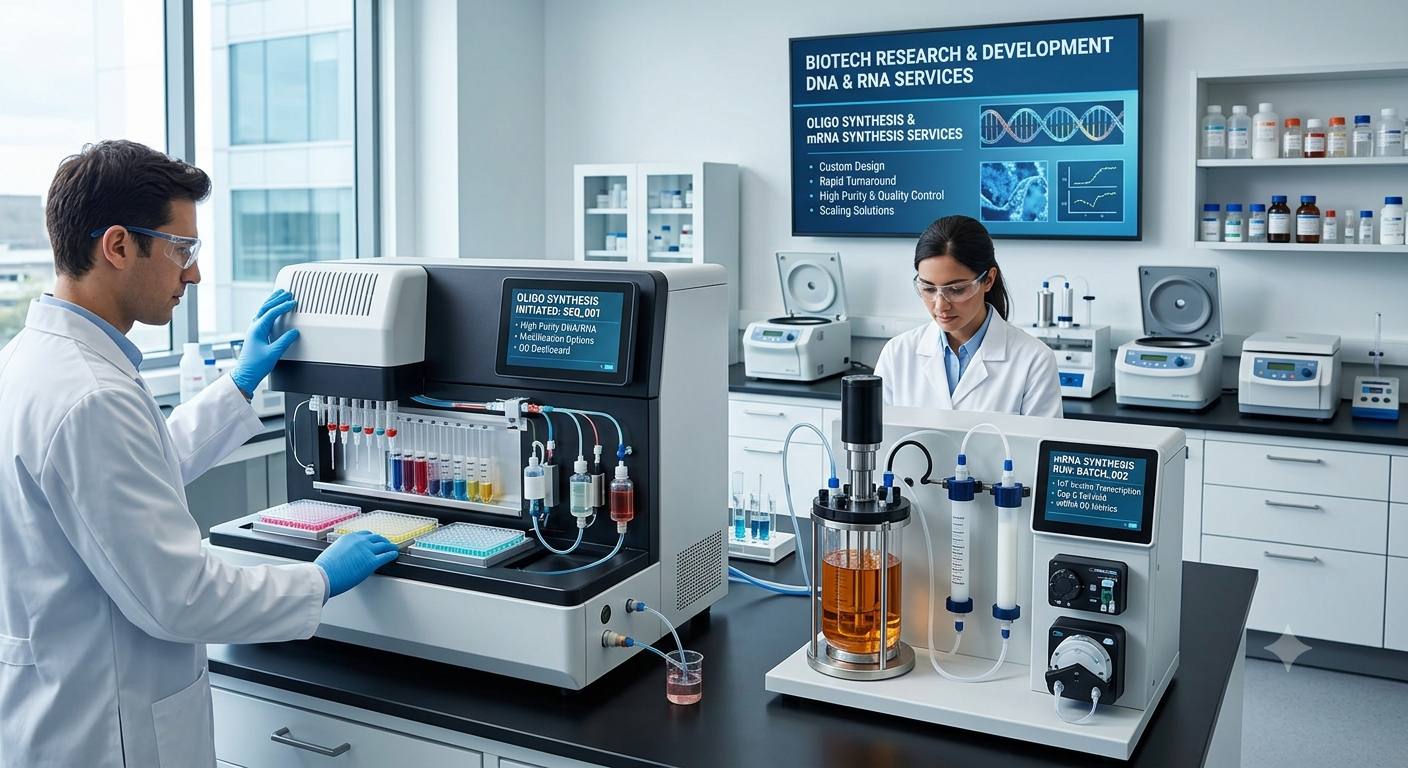
Modern life science research depends on accurate, reliable, and scalable genetic materials. From early-stage discovery to advanced therapeutic development, scientists need high-quality nucleic acids that can support experiments with precision and consistency. This is where oligo synthesis and mRNA synthesis services have become essential tools for laboratories, biotechnology companies, pharmaceutical developers, and academic research institutions.
Although both technologies involve nucleic acid production, they serve different scientific purposes. Oligonucleotides are commonly used for molecular biology, genetic analysis, diagnostics, and research applications, while messenger RNA is increasingly important in protein expression, vaccine development, gene-based research, and emerging therapeutic platforms.
As demand for customized genetic materials continues to grow, choosing a dependable synthesis partner can help researchers improve workflow efficiency, shorten development timelines, and achieve more reproducible results.
What Is Oligo Synthesis?
Oligo synthesis is the controlled chemical production of short, single-stranded DNA or RNA sequences called oligonucleotides. Researchers can specify the desired nucleotide sequence, length, purification method, and other characteristics based on their intended application.
Synthetic oligonucleotides are widely used in laboratories because they can be designed for highly specific biological functions. Depending on the project, researchers may require primers, probes, antisense oligonucleotides, small interfering RNA, or other specialized sequences.
Common applications include:
- PCR and quantitative PCR
- DNA sequencing
- Molecular cloning
- Gene expression analysis
- Genotyping
- CRISPR-related research
- Diagnostics development
- RNA interference studies
- Synthetic biology
- Genetic engineering
Why Custom Oligonucleotides Matter
Off-the-shelf sequences may not meet the exact requirements of a research project. Custom oligo production allows scientists to order sequences designed for a specific experiment.
The process can also include different purification and quality-control options. Depending on the application, researchers may choose standard purification or higher-purity methods to meet demanding experimental requirements.
Understanding mRNA Synthesis Services
mRNA synthesis services focus on producing messenger RNA molecules designed to deliver genetic instructions for protein production. In biological systems, mRNA carries information from DNA to cellular machinery, where it can be translated into proteins.
In research and biotechnology, synthetic mRNA can be engineered for specific experimental objectives. It may be used in transient protein expression, vaccine research, cellular studies, and the development of emerging RNA-based technologies.
A typical mRNA production workflow may involve:
- Designing the target sequence.
- Preparing a suitable DNA template.
- Performing in vitro transcription.
- Adding appropriate structural elements.
- Purifying the resulting mRNA.
- Conducting quality-control testing.
- Delivering the final product according to project specifications.
The exact manufacturing process depends on the intended use, sequence requirements, scale, and quality standards.
Key Components of Synthetic mRNA
High-quality mRNA may require several carefully optimized features, including:
- A suitable coding sequence
- A 5′ cap structure
- An appropriate poly(A) tail
- Optimized untranslated regions
- Controlled RNA integrity
- Low levels of unwanted impurities
These characteristics can influence stability, translation performance, and suitability for downstream research.
Oligo Synthesis vs. mRNA Synthesis Services
While both technologies support molecular biology, their applications and production requirements differ.
| Feature | Oligo Synthesis | mRNA Synthesis Services |
| Primary material | Short DNA or RNA sequences | Messenger RNA |
| Typical use | Primers, probes, gene research | Protein expression and RNA research |
| Production approach | Chemical synthesis | Enzymatic in vitro transcription |
| Common applications | PCR, sequencing, diagnostics | Vaccines, protein expression, therapeutic research |
| Customization | Sequence and modification options | Sequence, structural and production customization |
| Typical scale | Small to moderate | Research to larger development scales |
Understanding these differences helps researchers select the right service according to project goals.
Benefits of Professional Nucleic Acid Synthesis Services
Working with an experienced synthesis provider offers advantages beyond simply ordering genetic material.
1. Customized Sequence Design
Researchers can request sequences tailored to their specific experimental requirements. This can be particularly valuable for complex projects involving specialized modifications or demanding performance criteria.
2. Quality and Consistency
Reliable quality control is critical in molecular research. Professional providers typically use established production procedures and analytical testing to verify product quality.
3. Flexible Scale
Projects may begin with small research quantities and later require larger production volumes. A scalable service provider can support changing requirements throughout the development process.
4. Specialized Modifications
Certain applications require chemically modified oligonucleotides or specialized RNA characteristics. Depending on provider capabilities, researchers may access a broad range of customization options.
5. Improved Research Efficiency
Outsourcing synthesis can reduce the need for researchers to maintain specialized in-house production capabilities. This allows laboratory teams to focus more time on experimental design, data analysis, and scientific discovery.
How to Choose the Right Synthesis Provider
Selecting a suitable partner requires more than comparing prices. Researchers should evaluate the provider’s technical capabilities, quality systems, communication, and ability to support the entire project lifecycle.
Important Factors to Consider
1. Technical Expertise: Look for experience in both oligonucleotide and RNA production where relevant.
2. Quality Control: Ask about analytical testing, purity assessment, sequence verification, and batch consistency.
3. Customization: Confirm whether the provider can accommodate specific sequences, modifications, scales, and purification requirements.
4. Scalability: Consider whether the supplier can support future research or development needs.
5. Documentation: Clear product specifications and quality documentation can simplify laboratory workflows and project management.
6. Turnaround Time: Reliable delivery schedules are important when synthesis materials are linked to time-sensitive experiments.
Applications Across Modern Biotechnology
The growing demand for synthetic nucleic acids reflects their expanding role across multiple scientific fields.
Drug Discovery
Oligonucleotides can support target validation, gene expression studies, and molecular screening. Synthetic mRNA also contributes to research involving protein expression and emerging therapeutic approaches.
Molecular Diagnostics
Custom primers and probes are fundamental components of many molecular diagnostic workflows. Their specificity enables researchers to detect and analyze genetic targets.
Vaccine Research
mRNA technology has attracted significant scientific interest because it offers a flexible approach to investigating antigen expression and vaccine development.
Cell and Gene Research
Synthetic nucleic acids are frequently used in studies involving gene regulation, cellular pathways, and genetic engineering.
Synthetic Biology
Researchers use designed DNA and RNA sequences to construct and investigate biological systems, enabling innovation in areas ranging from industrial biotechnology to advanced medicine.
The Future of Oligo and mRNA Technologies
The field of nucleic acid synthesis continues to evolve. Improvements in sequence design, manufacturing processes, analytical methods, and purification technologies are helping researchers work with increasingly sophisticated genetic materials.
Artificial intelligence and computational biology are also influencing experimental planning. Researchers can use computational tools to analyze sequences, predict biological behavior, and optimize designs before production.
As RNA-based medicines, molecular diagnostics, personalized medicine, and synthetic biology continue to advance, demand for dependable oligo synthesis and mRNA synthesis services is likely to remain strong.
Frequently Asked Questions
1. What is oligo synthesis?
Oligo synthesis is the controlled production of short DNA or RNA sequences for research, diagnostic, and biotechnology applications.
2. What are oligonucleotides used for?
They are commonly used as PCR primers, sequencing components, molecular probes, gene-regulation tools, and research reagents.
3. What are mRNA synthesis services?
These services produce customized messenger RNA for applications such as protein expression, vaccine research, and RNA biotechnology studies.
4. How is mRNA produced?
Synthetic mRNA is generally produced through an in vitro transcription process using a DNA template and appropriate biochemical components.
5. Can oligonucleotides be customized?
Yes. Depending on the provider, researchers can customize sequence design, length, purification, scale, and certain chemical modifications.
6. Why is mRNA quality important?
RNA integrity and purity can influence downstream performance, stability, and experimental reproducibility.
7. Are oligo synthesis and mRNA synthesis the same?
No. Oligonucleotides are generally shorter sequences produced through chemical synthesis, while mRNA is typically generated through enzymatic transcription.
8. What industries use synthetic nucleic acids?
Pharmaceutical, biotechnology, diagnostics, academic research, healthcare, and synthetic biology organizations commonly use them.
9. How do I select a synthesis provider?
Evaluate technical expertise, quality control, customization options, scalability, documentation, customer support, and delivery reliability.
10. Can synthesis services support large projects?
Many providers offer scalable production capabilities, although available quantities and specifications depend on the provider and project requirements.
https://newsgrow.blogspot.com/2026/06/oligo-synthesis-and-mrna-synthesis.html