The global demand for lightweight, durable, hygienic, and cost-effective nonwoven materials continues to influence manufacturing across healthcare, agriculture, construction, packaging, automotive, and consumer products. As industries search for efficient alternatives to traditional textiles, manufacturers are investing in advanced Nonwoven Production Line technology and high-performance PP Spunbond Nonwoven Machine systems to achieve consistent quality, higher output, and greater production flexibility.
Unlike conventional woven fabrics, nonwoven materials are manufactured by bonding fibers together through mechanical, thermal, or chemical processes. Among the available technologies, polypropylene spunbond production has become particularly important because it combines strength, versatility, scalability, and efficient processing.
Rising Demand for Advanced Nonwoven Manufacturing
Nonwoven fabrics have become an essential material in many everyday and industrial applications. From medical gowns and surgical masks to crop covers and packaging materials, their use continues to expand.
The growing adoption of nonwoven products is driven by several factors:
- Increasing demand for disposable hygiene products
- Expansion of healthcare and medical manufacturing
- Growth in agricultural applications
- Rising infrastructure and construction activities
- Demand for lightweight automotive components
- Greater interest in recyclable and resource-efficient materials
- Development of innovative technical textiles
This changing market environment is encouraging manufacturers to upgrade their production capabilities. A modern Nonwoven Production Line can help businesses produce fabrics with controlled weight, uniformity, strength, and appearance while supporting continuous manufacturing.
What Is a Nonwoven Production Line?
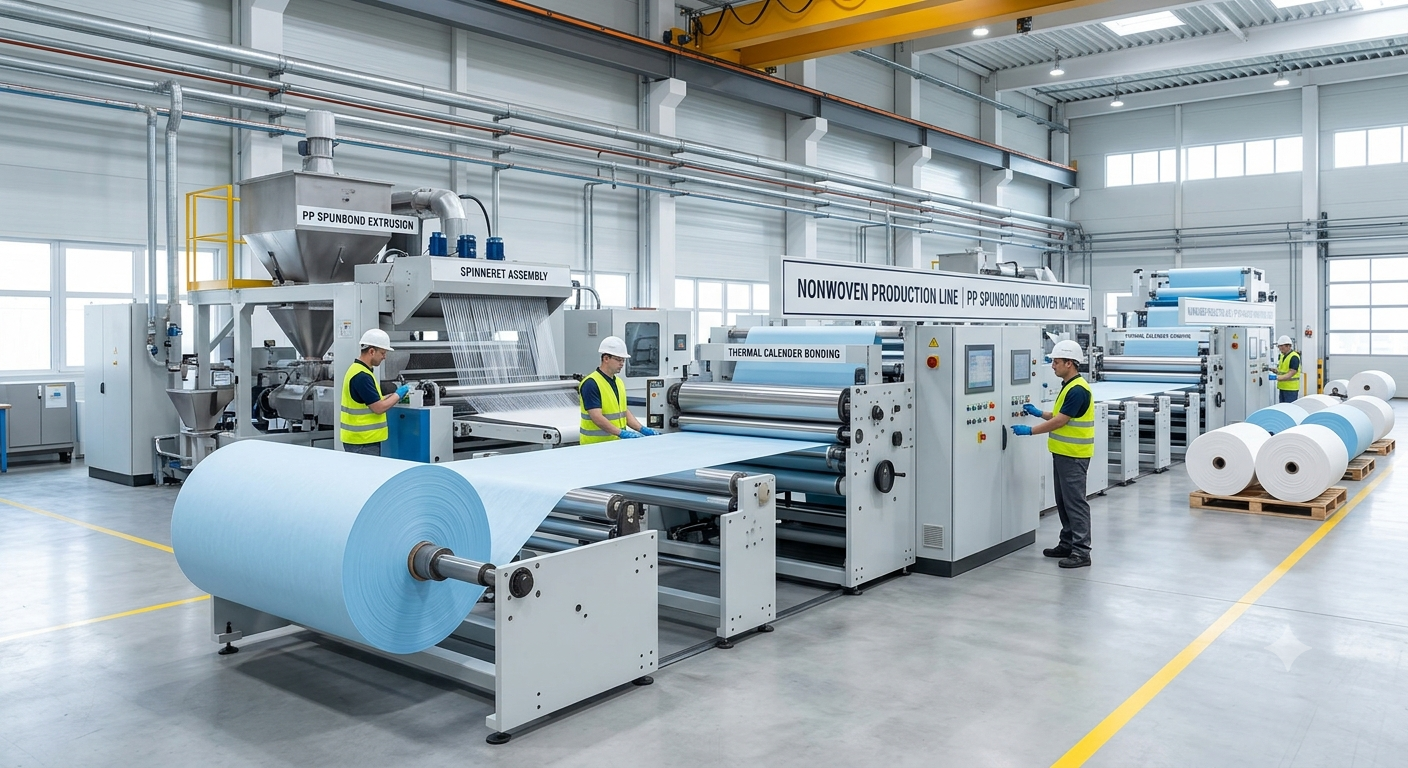
A Nonwoven Production Line is an integrated manufacturing system designed to convert polymer materials or fibers into nonwoven fabric. Depending on the technology, the line can include raw material feeding, polymer extrusion, spinning, web formation, bonding, winding, and automated control systems.
For PP spunbond manufacturing, polypropylene polymer is typically melted and extruded through specialized spinning components. The resulting continuous filaments are stretched and distributed across a moving forming surface. The web is then bonded, commonly through thermal calendering, to create a stable fabric structure.
Key Components of a Modern Production Line
A typical production setup may include:
- Raw Material Feeding System – Delivers polypropylene material consistently into the extrusion process.
- Extrusion Unit – Melts and processes polymer under controlled temperature conditions.
- Spinning System – Converts molten polymer into continuous filaments.
- Web Formation Section – Arranges filaments into a uniform web.
- Bonding Unit – Uses heat and pressure to provide structural integrity.
- Winding System – Rolls finished fabric for storage, transportation, or further processing.
- Automatic Control System – Monitors critical production parameters and improves operational consistency.
The integration of these components allows manufacturers to maintain stable production while reducing manual intervention and improving process control.
Why Choose a PP Spunbond Nonwoven Machine?
A PP Spunbond Nonwoven Machine is specifically designed to manufacture spunbond fabric using polypropylene as the primary raw material. Polypropylene is widely used because it offers a useful combination of low density, chemical resistance, moisture resistance, and mechanical performance.
A well-designed machine can support manufacturers seeking:
- Continuous high-speed production
- Consistent fabric quality
- Adjustable fabric weight
- Efficient polypropylene processing
- Reduced material waste
- Automated production control
- Flexible product development
For businesses operating in competitive markets, equipment performance can directly influence production costs and product consistency. Selecting the right PP Spunbond Nonwoven Machine therefore requires careful evaluation of production requirements, fabric specifications, energy efficiency, automation, and after-sales technical support.
Comparing Nonwoven Production Technologies
Different nonwoven manufacturing technologies are suitable for different applications. The following comparison provides a simplified overview:
| Technology | Main Feature | Common Applications |
| Spunbond | Continuous filament structure | Hygiene, agriculture, packaging |
| Meltblown | Fine fiber structure | Filtration and medical products |
| Spunmelt | Combination of spunbond and meltblown | Advanced medical and hygiene products |
| Needle-punched | Mechanical fiber entanglement | Geotextiles and automotive materials |
| Thermal bonded | Heat-based fiber bonding | Insulation and industrial products |
Among these options, spunbond technology remains attractive for applications requiring strong, lightweight, and versatile fabrics.
Applications Driving Market Expansion
The versatility of PP spunbond fabric has helped create opportunities across multiple industries.
Medical and Hygiene Products
Nonwoven materials are widely used in disposable medical gowns, surgical drapes, protective covers, diapers, sanitary products, and other hygiene applications. Their lightweight construction and ability to support customized product designs make them suitable for large-scale manufacturing.
Agriculture
Farmers and agricultural suppliers use spunbond fabrics for crop protection, plant covers, weed control, and other applications. The material can help manage environmental conditions while providing a lightweight protective layer.
Construction
In construction, nonwoven fabrics can be used in roofing systems, insulation, filtration, and protective layers. Their durability and processing flexibility support a wide range of technical applications.
Packaging and Consumer Products
Manufacturers are increasingly exploring nonwoven materials for reusable bags, protective packaging, and specialized consumer products. This creates opportunities for producers capable of delivering customized fabric specifications.
Important Factors When Selecting Machinery
Choosing manufacturing equipment should be based on more than the initial purchase price. A production line represents a long-term investment, making technical evaluation essential.
1. Production Capacity
Determine the required output before selecting equipment. The ideal system should match current demand while providing reasonable room for future expansion.
2. Fabric Specifications
Consider the required fabric width, basis weight, strength, color, and end-use requirements. These factors influence machine configuration and production capabilities.
3. Automation
Advanced automation can improve process monitoring, reduce operator dependency, and help maintain consistent quality.
4. Energy Efficiency
Energy consumption directly affects operating costs. Manufacturers should evaluate equipment design, heating systems, motors, and overall power requirements.
5. Maintenance and Support
Reliable technical support and access to replacement components can help reduce unexpected downtime and protect long-term productivity.
How to Build a More Efficient Production Strategy
Manufacturers can improve results by following a structured approach:
- Identify target markets and product applications.
- Define required fabric specifications.
- Estimate current and future production capacity.
- Compare suitable machine configurations.
- Evaluate automation and energy consumption.
- Review installation and maintenance requirements.
- Conduct quality testing before full-scale production.
- Monitor operational performance and optimize processes continuously.
This approach helps companies make informed equipment decisions rather than selecting machinery solely on upfront cost.
Frequently Asked Questions
1. What is a Nonwoven Production Line?
It is an integrated system used to manufacture nonwoven fabrics through processes such as extrusion, spinning, web formation, and bonding.
2. What is a PP Spunbond Nonwoven Machine?
It is specialized equipment that converts polypropylene polymer into continuous filaments and bonds them into nonwoven fabric.
3. Why is polypropylene widely used?
Polypropylene offers low density, moisture resistance, chemical resistance, and good mechanical properties, making it suitable for numerous applications.
4. What products can spunbond fabric be used for?
Applications include hygiene products, medical supplies, agricultural covers, packaging, construction materials, and industrial textiles.
5. Is spunbond fabric lightweight?
Yes. Spunbond technology can produce lightweight materials while maintaining useful strength and durability.
6. Can production lines manufacture different fabric weights?
Many modern systems can be configured to produce different basis weights, depending on machine design and process parameters.
7. Is automation important in nonwoven manufacturing?
Automation can improve process consistency, production monitoring, operational efficiency, and quality control.
8. How should manufacturers select a production line?
They should consider capacity, fabric specifications, automation, energy efficiency, maintenance, technical support, and future expansion plans.
9. What industries use PP spunbond nonwoven fabric?
Healthcare, hygiene, agriculture, construction, packaging, automotive, and industrial manufacturing are major application areas.
10. How can manufacturers improve production efficiency?
Efficient equipment, preventive maintenance, process monitoring, operator training, quality control, and optimized raw material management can improve overall performance.
https://newsgrow.blogspot.com/2026/06/nonwoven-production-line-drives.html