
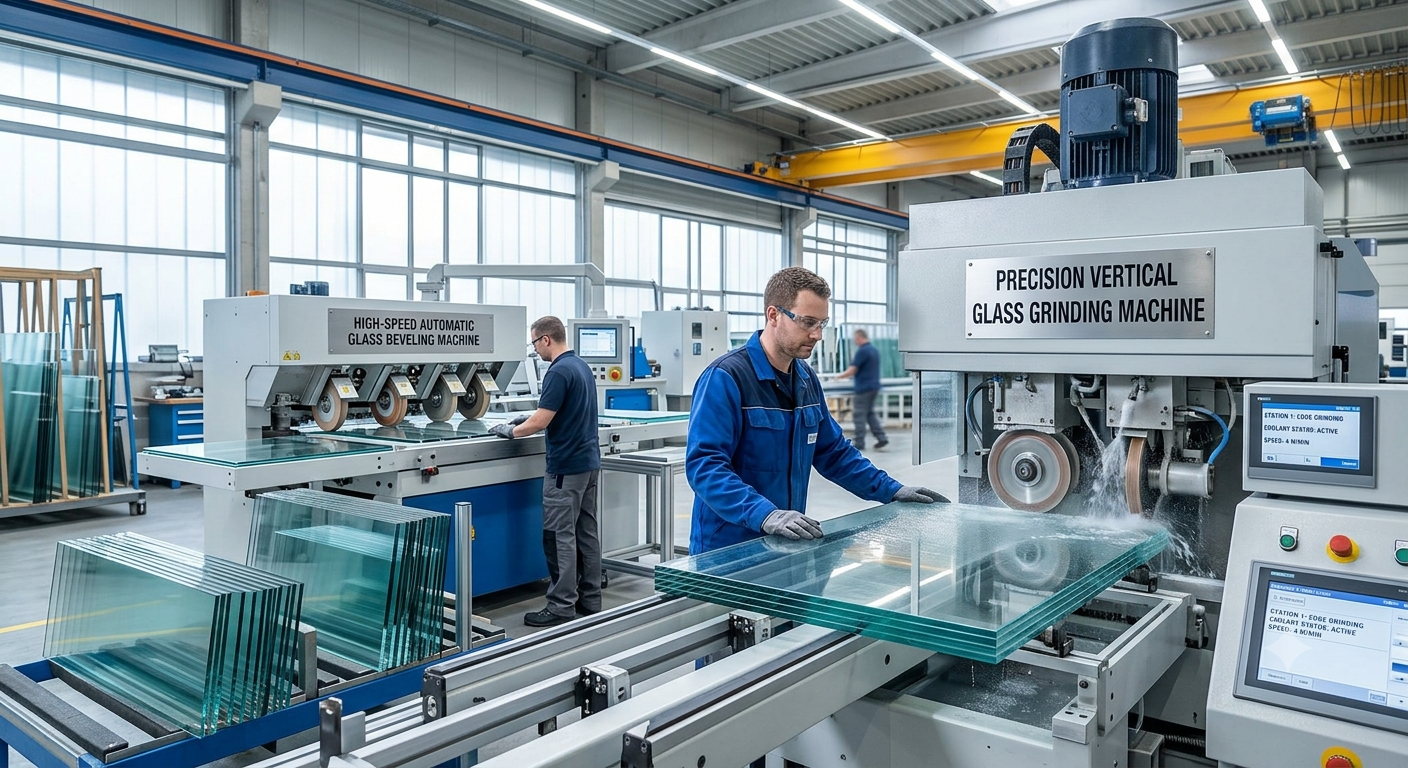
The glass processing industry is entering a new phase of precision, automation, and efficiency, and modern equipment is playing a central role in that transformation. Among the most important technologies supporting this shift are the glass grinding machine and glass beveling machine. These machines help manufacturers transform raw or cut glass into accurately finished products with smooth edges, refined surfaces, and consistent dimensions.
As demand grows for architectural glass, decorative panels, furniture glass, automotive components, shower enclosures, mirrors, and high-end interior applications, manufacturers are increasingly investing in advanced glass processing machinery. The combination of precision engineering, automated controls, and improved grinding technology is helping businesses reduce manual work while achieving higher production quality.
Understanding Glass Grinding and Beveling Technology
Glass edges require careful processing after cutting. A freshly cut glass sheet may have sharp edges, small chips, or irregularities that can affect safety, appearance, and functionality. This is where grinding and beveling equipment becomes essential.
A glass grinding machine is designed to process glass edges and surfaces by removing sharp portions, correcting imperfections, and achieving the required finish. Depending on the machine configuration, it can perform rough grinding, fine grinding, polishing, or edge finishing.
A glass beveling machine, meanwhile, is specifically engineered to create angled or decorative edges along the glass perimeter. Beveled glass is widely used in mirrors, furniture, interior décor, architectural projects, and premium decorative products.
Together, these technologies provide manufacturers with greater flexibility to meet different product specifications.
Why Precision Matters in Glass Processing
Precision is one of the most important factors in modern glass manufacturing. Even minor inconsistencies can affect the final appearance or create problems during installation.
Advanced machinery helps manufacturers achieve:
- Consistent edge dimensions
- Smooth and polished surfaces
- Reduced chipping and edge damage
- Accurate bevel angles
- Improved operator safety
- Higher production efficiency
- Better repeatability across large production runs
The result is a finished glass product that combines visual appeal with functional performance.
How a Glass Grinding Machine Supports Modern Manufacturing
A modern glass grinding machine can perform multiple edge-processing operations depending on its design and tooling configuration. Manufacturers can select equipment according to glass thickness, production volume, edge profile, and required surface quality.
Key Applications of Grinding Equipment
Glass grinding systems are commonly used for:
- Edge smoothing: Removing sharp edges after cutting.
- Edge shaping: Creating specific profiles for different applications.
- Fine grinding: Producing smoother surfaces before polishing.
- Surface correction: Addressing minor imperfections created during processing.
- Pre-polishing preparation: Preparing edges for a high-quality polished finish.
Automation has also become an important feature. CNC-controlled systems can improve dimensional accuracy while reducing dependence on manual operations.
Improving Production Consistency
For manufacturers handling large quantities of glass, consistency is essential. Manual edge finishing can produce variations between individual pieces, particularly when production requirements are demanding. Automated grinding equipment helps standardize processing parameters, allowing manufacturers to maintain similar results across multiple batches.
This consistency can be especially valuable for architectural projects where dozens or hundreds of glass components must meet the same specifications.
The Growing Role of Glass Beveling Machines
The demand for decorative and premium glass products has increased interest in specialized beveling technology. A glass beveling machine creates a sloped edge, commonly known as a bevel, that adds both aesthetic value and design flexibility.
Beveled glass can create attractive light-reflecting surfaces that enhance the appearance of mirrors, tabletops, doors, cabinets, and interior installations.
Where Beveled Glass Is Used
Common applications include:
- Decorative mirrors
- Furniture and tabletops
- Glass doors
- Interior partitions
- Cabinet panels
- Luxury residential interiors
- Hospitality projects
- Retail displays
- Architectural installations
The ability to produce accurate bevels makes advanced beveling equipment particularly valuable for manufacturers serving customized and high-end markets.
Glass Grinding Machine vs. Glass Beveling Machine
Although both machines process glass edges, their primary purposes are different.
| Feature | Glass Grinding Machine | Glass Beveling Machine |
| Main function | Smooths, shapes, or finishes edges | Creates angled decorative edges |
| Primary focus | Safety, accuracy, and edge quality | Design, aesthetics, and edge geometry |
| Typical applications | Industrial, architectural, furniture glass | Mirrors, decorative glass, premium interiors |
| Edge result | Smooth, polished, or shaped edge | Sloped or angled bevel |
| Production needs | General and specialized edge processing | Precision bevel production |
| Design flexibility | Depends on tooling and configuration | Strong focus on bevel dimensions and angles |
Manufacturers may choose one machine or integrate both capabilities into a broader production line, depending on their product portfolio.
Choosing the Right Glass Processing Equipment
Selecting the right equipment requires more than comparing machine prices. Manufacturers should evaluate their production requirements, future growth plans, and desired product quality.
Important factors include:
- Glass thickness range
- Maximum glass dimensions
- Required edge profiles
- Bevel width and angle
- Production capacity
- Automation level
- Grinding wheel configuration
- Control system
- Maintenance requirements
- Energy efficiency
- Availability of technical support
Automation and Smart Manufacturing
The modern glass industry is increasingly adopting automation to improve productivity. Digitally controlled equipment can simplify machine operation, improve repeatability, and help reduce processing errors.
CNC technology, programmable controls, automatic positioning, and monitoring systems are helping manufacturers create more efficient workflows. These developments are particularly useful for businesses producing customized glass products, where flexibility and precision are equally important.
Benefits for Glass Manufacturers
Investing in advanced grinding and beveling technology can deliver several operational advantages.
1. Higher Product Quality
Accurate processing creates cleaner edges and more consistent finishes, improving the overall appearance of finished products.
2. Greater Productivity
Automated machinery can process multiple pieces efficiently, helping manufacturers increase output without relying entirely on manual labor.
3. Reduced Material Waste
Precise processing can minimize unnecessary removal of material and reduce the risk of damage caused by inconsistent manual operations.
4. Improved Workplace Safety
By reducing direct handling of sharp glass edges, automated equipment can contribute to safer production environments when combined with appropriate safety procedures.
5. Expanded Product Opportunities
Manufacturers equipped with grinding and beveling capabilities can offer a broader range of products, from standard architectural components to customized decorative glass.
Industry Outlook: Precision Meets Customization
The future of glass processing is expected to focus increasingly on customization, automation, and production efficiency. Customers are seeking distinctive designs, while manufacturers need reliable systems capable of delivering consistent results at competitive costs.
This trend is creating opportunities for advanced glass grinding machine and glass beveling machine technologies. As architectural designs become more sophisticated and interior applications increasingly emphasize premium finishes, accurate edge processing will remain an essential part of the manufacturing process.
Businesses that invest in flexible equipment and modern production capabilities can position themselves to respond more effectively to changing customer expectations.
Frequently Asked Questions
1. What is a glass grinding machine?
A glass grinding machine is equipment used to smooth, shape, or finish glass edges and surfaces after cutting or other processing operations.
2. What does a glass beveling machine do?
A glass beveling machine creates an angled edge along glass, producing a decorative and visually distinctive finish.
3. Can grinding machines polish glass edges?
Many grinding systems can perform fine grinding and, depending on their configuration, edge polishing operations using appropriate tooling.
4. What industries use glass grinding machines?
They are used in architectural glass, furniture, automotive, interior design, construction, mirror manufacturing, and other glass-processing industries.
5. Where is beveled glass commonly used?
Beveled glass is frequently used for mirrors, furniture, doors, decorative panels, cabinets, and premium interior applications.
6. Is a beveling machine suitable for mass production?
Yes. Automated beveling equipment can be suitable for high-volume production when configured according to the required glass dimensions and specifications.
7. How does automation improve glass processing?
Automation can improve consistency, reduce repetitive manual work, increase productivity, and support more accurate processing.
8. What should manufacturers consider before buying equipment?
They should evaluate glass thickness, dimensions, production volume, edge requirements, automation, maintenance, tooling, and technical support.
9. Are grinding and beveling the same process?
No. Grinding primarily focuses on smoothing, shaping, or finishing edges, while beveling creates a specific angled edge for functional or decorative purposes.
10. Why is edge finishing important?
Proper edge finishing improves safety, appearance, dimensional accuracy, and the suitability of glass for installation or further processing.
https://newsgrow.blogspot.com/2026/06/glass-grinding-machine-and-glass.html