Titanium dioxide is one of the most important white pigments used across modern industries. Its exceptional opacity, brightness, whiteness, and light-scattering ability make it valuable in paints, coatings, plastics, printing inks, paper, cosmetics, and several specialty applications. However, the performance of titanium dioxide depends heavily on its crystal structure, particle characteristics, surface treatment, and manufacturing quality.
For businesses sourcing high-performance pigments, selecting the right Titanium Dioxide Manufacturer is an important decision. Among the two primary crystal forms, rutile titanium dioxide is widely preferred for applications requiring superior durability, weather resistance, and high hiding power.
This article explores the role of titanium dioxide manufacturers, the characteristics of rutile titanium dioxide, its applications, and the key factors buyers should consider when selecting a reliable supplier.
Understanding Titanium Dioxide
Titanium dioxide, commonly represented by the chemical formula TiO₂, is a naturally occurring compound that can also be produced commercially. It is valued primarily as a white pigment because of its high refractive index, which enables it to scatter visible light effectively.
Commercial titanium dioxide is mainly available in two crystalline forms:
| Property | Rutile Titanium Dioxide | Anatase Titanium Dioxide |
| Crystal structure | Rutile | Anatase |
| Refractive index | Higher | Lower |
| Opacity | Excellent | Good |
| Weather resistance | Very high | Moderate |
| Durability | Excellent | Moderate |
| Common uses | Exterior coatings, plastics, industrial paints | Paper, coatings, selected specialty uses |
Among these forms, Rutile Titanium Dioxide is generally selected for demanding applications where long-term stability and strong optical performance are essential.
Why Crystal Structure Matters
The crystal structure directly influences the pigment’s optical and physical properties. Rutile has a higher refractive index than anatase, allowing it to provide stronger light scattering. This characteristic contributes to excellent whiteness and opacity, helping manufacturers achieve the desired visual appearance with efficient pigment loading.
The Role of a Titanium Dioxide Manufacturer
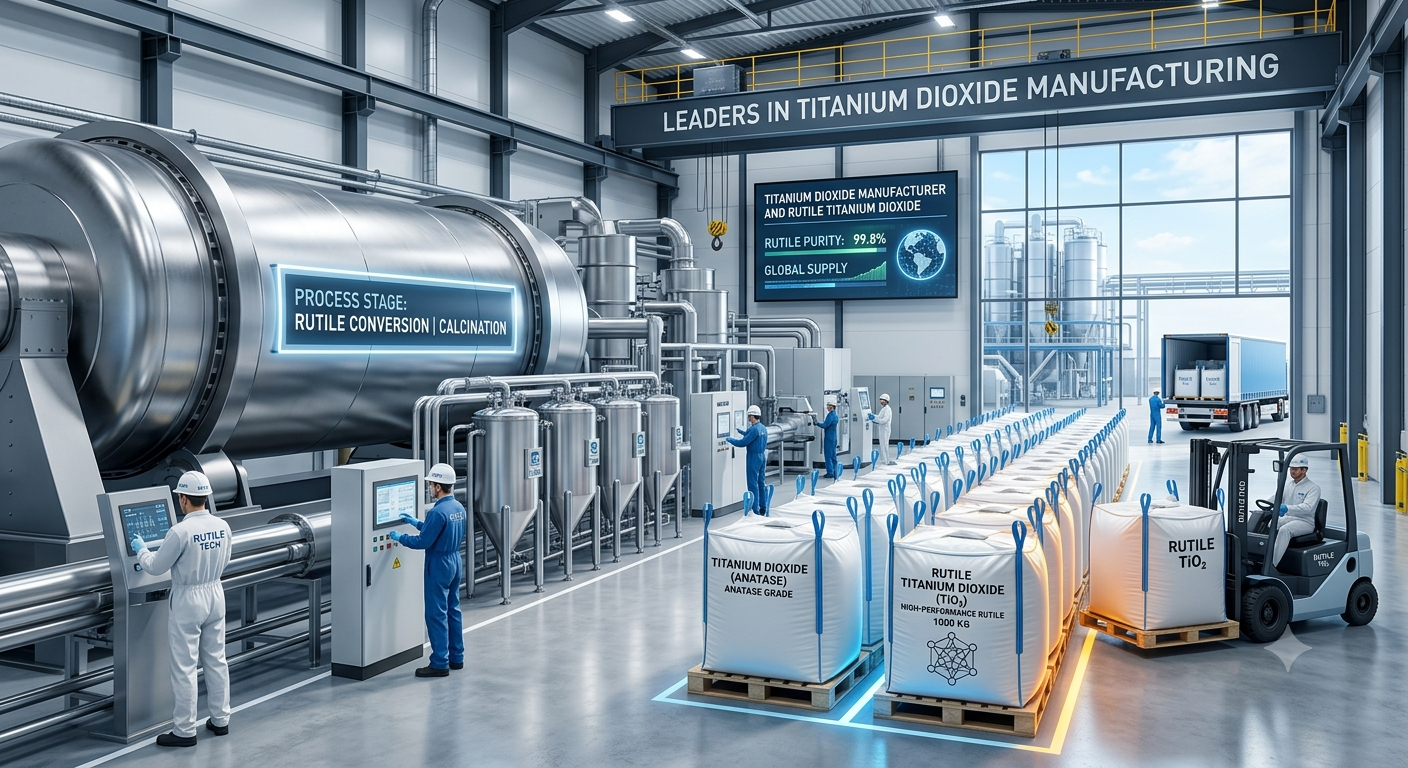
A professional Titanium Dioxide Manufacturer does more than produce pigment. Consistent manufacturing processes, quality control, surface treatment, and technical support all influence the final performance of the product.
Leading manufacturers typically focus on:
- Consistent particle size distribution
- High pigment purity
- Excellent whiteness and brightness
- Strong dispersibility
- Controlled surface treatment
- Batch-to-batch consistency
- Application-specific product grades
- Reliable technical documentation
Manufacturers may use either the sulfate process or chloride process to produce titanium dioxide. Each production route has different characteristics, and the final product is further processed to achieve specific performance requirements.
Key Manufacturing Considerations
When evaluating a supplier, buyers should examine several factors rather than focusing solely on price.
1. Product Consistency
Consistent pigment quality is essential for large-scale production. Variations in particle size, surface treatment, or purity can affect color, opacity, viscosity, and processing performance.
2. Technical Expertise
A knowledgeable manufacturer can recommend suitable grades according to the customer’s application, whether it involves architectural coatings, industrial paints, plastics, masterbatch, inks, or other products.
3. Quality Assurance
Reliable manufacturers generally maintain structured quality control systems and test important parameters before products are released.
4. Supply Reliability
A stable supply chain is critical for manufacturers that depend on titanium dioxide for continuous production. Delivery capabilities, packaging options, and production capacity should therefore be considered.
What Makes Rutile Titanium Dioxide Different?
Rutile Titanium Dioxide is known for its outstanding optical efficiency and durability. Its high refractive index enables strong light scattering, making it effective for producing bright, opaque formulations.
Its major advantages include:
- High hiding power
- Excellent whiteness
- Strong tinting strength
- Superior weather resistance
- Good chemical stability
- Excellent durability
- Broad industrial applicability
These properties make rutile grades particularly attractive for outdoor and high-performance applications.
Major Applications of Rutile Titanium Dioxide
The versatility of rutile titanium dioxide has made it an essential material for numerous industries.
Paints and Coatings
The coatings industry is one of the largest consumers of titanium dioxide. Rutile grades are widely used in architectural, automotive, industrial, marine, and protective coatings.
They help provide:
- High opacity
- Bright white appearance
- Better coverage
- Improved durability
- Resistance to outdoor exposure
For exterior coatings, the weather resistance of rutile titanium dioxide can be particularly valuable.
Plastics and Masterbatch
Titanium dioxide is widely incorporated into plastic products to improve whiteness, opacity, and visual quality. Rutile grades are commonly used in applications exposed to sunlight because of their strong durability.
Typical applications include:
- Packaging materials
- PVC products
- Polyolefins
- Household plastic goods
- Profiles and sheets
- Plastic masterbatch
Printing Inks
Titanium dioxide can improve the opacity and brightness of printing inks. The correct grade allows formulators to achieve consistent color and coverage while maintaining suitable dispersion characteristics.
Paper Industry
Titanium dioxide is used in selected paper applications where brightness, opacity, and light-scattering performance are important. It can help improve the visual quality of certain coated and specialty papers.
Specialty Products
Depending on grade and surface treatment, titanium dioxide can also be used in various specialty formulations and industrial products requiring controlled optical performance.
How to Choose the Right Titanium Dioxide Manufacturer
Choosing a suitable Titanium Dioxide Manufacturer requires a combination of technical and commercial evaluation.
- Define your application: Identify whether the pigment will be used in coatings, plastics, inks, paper, or another industry.
- Compare technical specifications: Review purity, particle characteristics, opacity, whiteness, and dispersion.
- Check consistency: Ask about quality-control procedures and batch uniformity.
- Evaluate technical support: A manufacturer should understand your formulation requirements.
- Review documentation: Check product specifications, safety information, and relevant compliance documents.
- Assess supply capability: Consider production capacity, lead times, packaging, and logistics.
- Request samples: Testing the material in your own formulation provides valuable practical insight.
Rutile Titanium Dioxide vs. Anatase: Which Is Better?
There is no universal answer because the best pigment depends on the intended application. Rutile is generally favored where high opacity, durability, and weather resistance are priorities. Anatase may be suitable for applications where specific optical or processing characteristics are preferred.
The selection should therefore be based on:
- Final product requirements
- Exposure conditions
- Desired whiteness
- Opacity expectations
- Processing method
- Cost considerations
- Regulatory requirements
Frequently Asked Questions
1. What is titanium dioxide?
Titanium dioxide is a white inorganic compound widely used as a pigment because of its excellent whiteness, opacity, and light-scattering properties.
2. What is rutile titanium dioxide?
Rutile titanium dioxide is a crystalline form of TiO₂ recognized for its high refractive index, strong opacity, and excellent durability.
3. Why is rutile titanium dioxide widely used?
Its combination of high hiding power, brightness, and weather resistance makes it suitable for demanding applications.
4. What industries use titanium dioxide?
Major industries include paints, coatings, plastics, masterbatch, printing inks, paper, and specialty manufacturing.
5. Is rutile better than anatase?
Rutile is generally preferred for applications requiring superior durability and opacity, while anatase can be appropriate for selected applications.
6. How does a titanium dioxide manufacturer ensure quality?
Manufacturers use controlled production processes, laboratory testing, particle analysis, and quality-control procedures to maintain consistency.
7. What affects titanium dioxide performance?
Crystal structure, particle size, surface treatment, purity, dispersion, and formulation compatibility can all influence performance.
8. Can rutile titanium dioxide be used in plastics?
Yes. It is widely used in various plastic products and masterbatch formulations where whiteness, opacity, and durability are required.
9. How should buyers evaluate suppliers?
Buyers should consider technical quality, consistency, documentation, production capacity, delivery reliability, and technical support.
10. Why is surface treatment important?
Surface treatment can improve dispersion, compatibility, durability, and performance within specific formulations.
https://newsgrow.blogspot.com/2026/06/titanium-dioxide-manufacturer-drives.html