
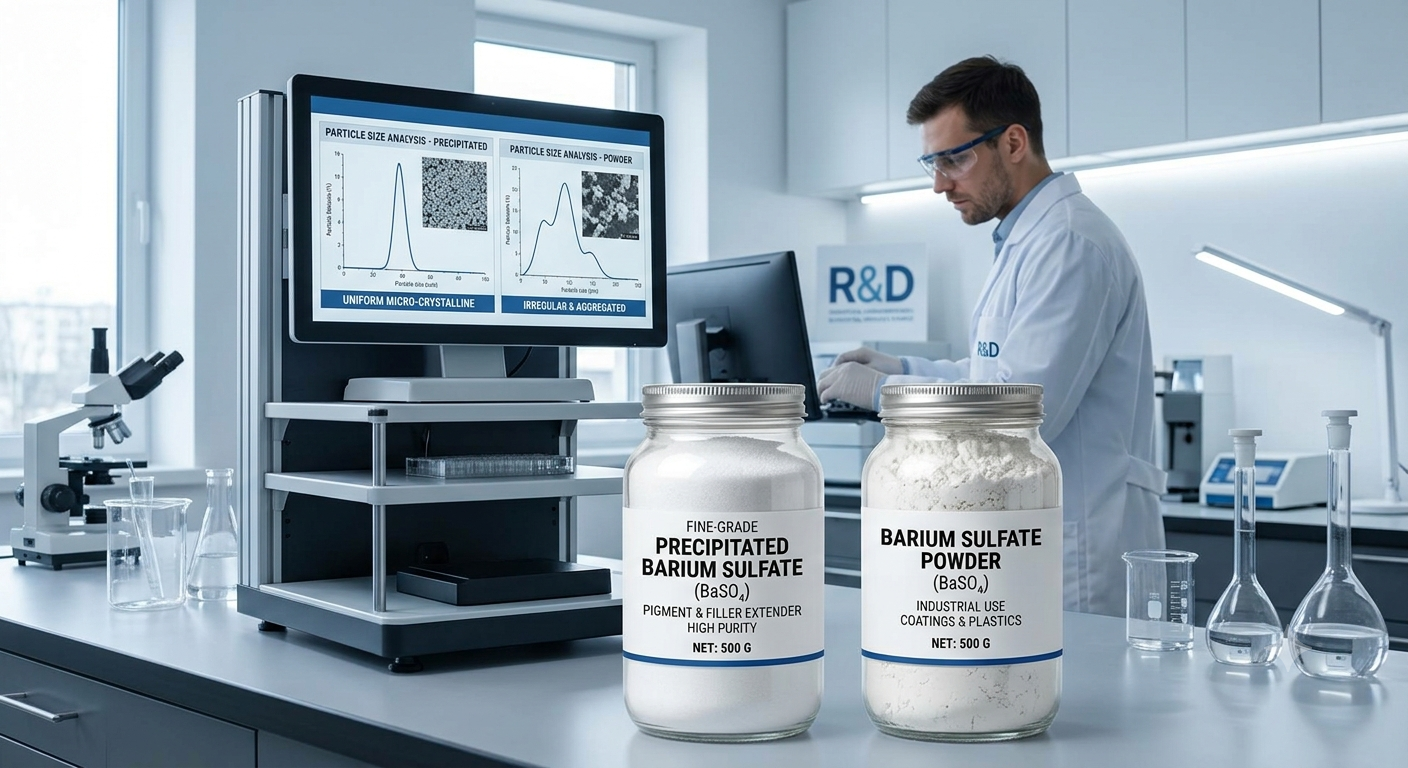
As manufacturers continue to seek materials that improve product performance, consistency, and durability, Precipitated Barium Sulfate and Barium Sulfate Powder are gaining importance across a wide range of industrial applications. From coatings and plastics to rubber, paints, inks, and specialized manufacturing processes, these materials are valued for their chemical stability, high density, brightness, and functional versatility.
The growing demand for advanced fillers and functional additives has encouraged manufacturers to focus on particle size, purity, dispersion, and application-specific performance. As a result, businesses are increasingly evaluating barium sulfate products not simply as basic mineral fillers but as engineered materials that can contribute to improved product quality.
Understanding Precipitated Barium Sulfate
Precipitated Barium Sulfate is a chemically produced form of barium sulfate manufactured through controlled precipitation processes. Unlike naturally mined barytes, precipitated grades can offer greater control over particle characteristics, purity, whiteness, and consistency.
This level of control makes the material suitable for applications where predictable performance is essential. Manufacturers can select grades based on specific requirements such as particle size distribution, surface properties, brightness, and compatibility with different formulations.
Key characteristics may include:
- High chemical stability
- Excellent whiteness and brightness
- Controlled particle size
- High density
- Low oil absorption in selected grades
- Good resistance to acids and alkalis
- Strong compatibility with numerous industrial formulations
These properties make precipitated grades particularly attractive for high-quality coatings, plastics, specialty compounds, and other performance-focused applications.
Why Particle Control Matters
Particle size can significantly influence the behavior of a filler within a finished product. Fine and consistently distributed particles can improve dispersion and help manufacturers achieve a smoother surface, enhanced appearance, and more uniform formulation.
For this reason, manufacturers often consider particle morphology and distribution when selecting Precipitated Barium Sulfate for demanding applications.
The Role of Barium Sulfate Powder in Manufacturing
Barium Sulfate Powder is widely recognized for its versatility as a functional filler and performance-enhancing material. Its high density and chemical resistance make it useful in formulations where stability and durability are important.
Depending on the grade and processing method, barium sulfate powder can be incorporated into:
- Paints and industrial coatings
- Powder coatings
- Plastics and polymer compounds
- Rubber products
- Printing inks
- Adhesives and sealants
- Specialized industrial materials
- Certain construction-related formulations
In coatings, it can contribute to surface quality, hardness, and overall formulation characteristics. In plastics and polymers, it may help modify density, dimensional properties, and processing behavior.
Precipitated Barium Sulfate vs. Barium Sulfate Powder
Although the terms are sometimes used interchangeably, they can describe materials with different production characteristics and intended performance profiles.
| Feature | Precipitated Barium Sulfate | Barium Sulfate Powder |
| Production | Chemically precipitated | May be produced from processed mineral or chemical routes |
| Particle control | Typically highly controlled | Depends on grade and processing |
| Purity | Often available in high-purity grades | Varies according to product specification |
| Brightness | Generally excellent | Depends on grade |
| Applications | Specialty and high-performance formulations | Broad industrial applications |
| Consistency | Designed for controlled performance | Varies by manufacturer and grade |
The right selection depends on the final product, manufacturing process, regulatory requirements, and desired performance.
Applications Across Key Industries
Paints and Coatings
The coatings industry is one of the important application areas for barium sulfate. Its brightness, density, and chemical stability can make it useful in decorative and industrial coating formulations.
In premium coatings, carefully selected grades may support improved surface appearance and help optimize formulation performance.
Plastics and Polymers
Plastic manufacturers use functional fillers to modify specific properties while maintaining processing efficiency. Barium Sulfate Powder can be incorporated into selected polymer systems to increase density and influence mechanical or dimensional characteristics.
Its suitability depends on polymer compatibility, particle size, dispersion, and processing conditions.
Rubber Manufacturing
In rubber formulations, barium sulfate may be used as a functional filler where density, stability, and material consistency are required. Product selection is important because different rubber systems can respond differently to filler characteristics.
Printing Inks
The controlled characteristics of high-quality barium sulfate can be beneficial in certain ink formulations. Brightness and particle uniformity may support appearance and consistency when the material is correctly dispersed.
Construction and Specialty Materials
Barium sulfate products can also be considered for specialized construction and industrial formulations where high density and chemical resistance are advantageous. Application requirements should always determine the appropriate grade and loading level.
How Manufacturers Can Choose the Right Grade
Selecting between different barium sulfate products requires more than comparing price. Manufacturers should evaluate the complete technical profile.
Important factors include:
- Chemical purity
- Particle size distribution
- Whiteness and brightness
- Oil absorption
- Moisture content
- Bulk density
- Dispersion behavior
- Surface treatment
- Compatibility with the final formulation
- Packaging and storage requirements
A Practical Selection Process
Step 1: Define the target application and performance requirements.
Step 2: Review the technical data sheet and product specifications.
Step 3: Compare particle size and dispersion characteristics.
Step 4: Conduct laboratory trials using the intended formulation.
Step 5: Evaluate final product performance before moving to commercial production.
This approach can help reduce formulation problems and improve production consistency.
Market Outlook and Industry Expectations
The continuing development of advanced coatings, engineered plastics, specialty polymers, and high-performance industrial materials is expected to maintain interest in functional fillers. Manufacturers are increasingly focused on improving efficiency while achieving consistent product quality.
Within this changing environment, Precipitated Barium Sulfate offers an advantage where controlled particle characteristics and high purity are critical. Meanwhile, versatile Barium Sulfate Powder remains relevant for manufacturers seeking dependable performance across broader industrial applications.
Future demand is likely to be influenced by product innovation, quality standards, sustainability considerations, and the growing need for customized material solutions.
Frequently Asked Questions
1. What is Precipitated Barium Sulfate?
Precipitated Barium Sulfate is a chemically manufactured form of barium sulfate produced through controlled precipitation to achieve specific purity and particle characteristics.
2. What is Barium Sulfate Powder used for?
It is used in applications including paints, coatings, plastics, rubber, inks, adhesives, and specialized industrial formulations.
3. Is precipitated barium sulfate different from natural barytes?
Yes. Precipitated grades are chemically produced and can provide greater control over purity and particle characteristics than naturally mined barytes.
4. Why is barium sulfate used in coatings?
Its brightness, density, chemical stability, and functional filler properties can make it suitable for various coating formulations.
5. Can barium sulfate be used in plastics?
Yes. Selected grades can be incorporated into polymer formulations to modify properties such as density and dimensional performance.
6. How does particle size affect performance?
Particle size can influence dispersion, surface finish, formulation behavior, and the overall performance of the finished product.
7. What industries use barium sulfate powder?
Major application areas include coatings, plastics, rubber, inks, adhesives, construction materials, and specialty manufacturing.
8. How should manufacturers select a barium sulfate grade?
They should consider purity, particle size, brightness, dispersion, oil absorption, compatibility, and the technical requirements of the final product.
9. Is Precipitated Barium Sulfate suitable for specialty applications?
Yes. Its controlled characteristics can make it appropriate for applications requiring consistent particle properties and high material quality.
10. Why is supplier quality important?
Reliable suppliers can provide consistent specifications, technical documentation, quality control, and application support, helping manufacturers maintain stable production.
https://newsgrow.blogspot.com/2026/06/precipitated-barium-sulfate-drives-high.html