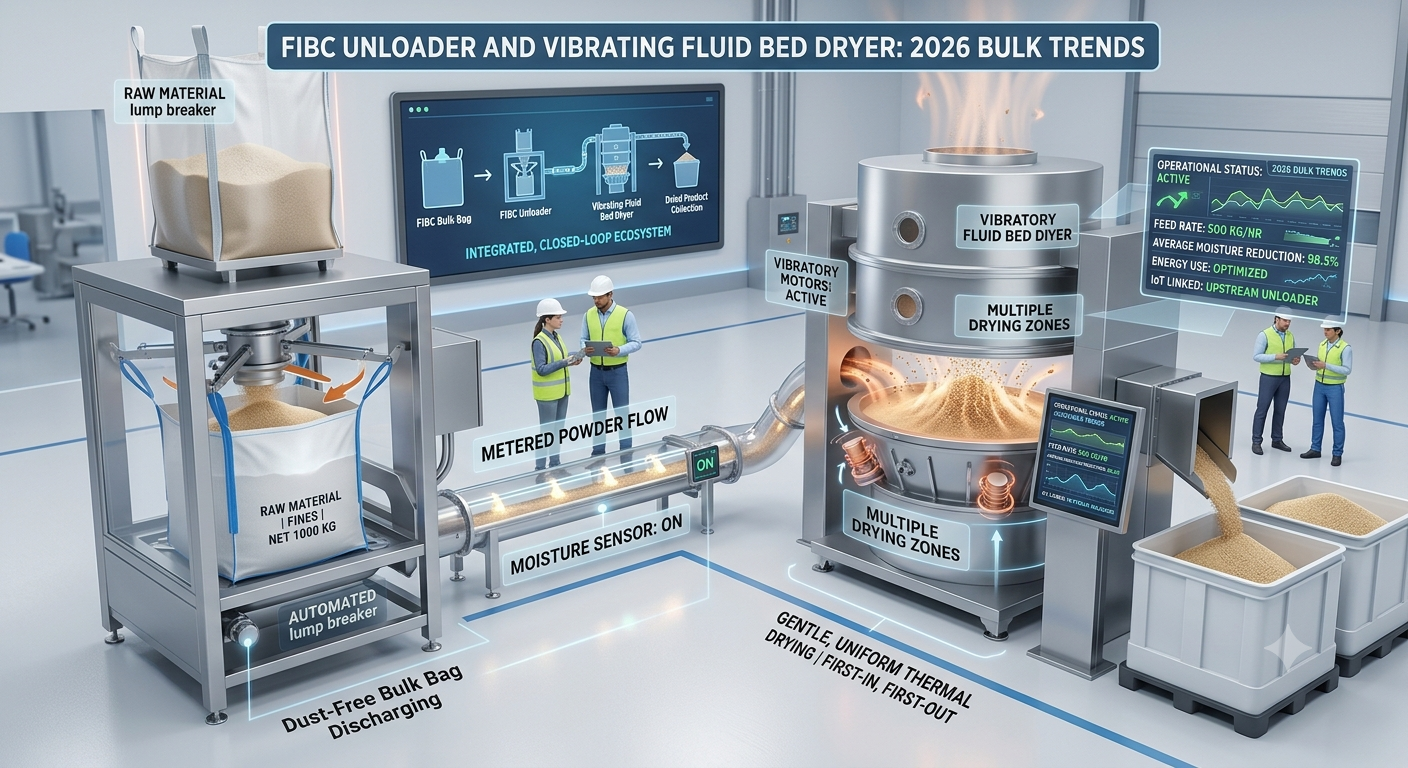
Industrial processing has changed dramatically over the past several decades. Equipment that once relied heavily on manual handling, basic mechanical controls, and labor-intensive drying methods is now evolving toward automated, energy-efficient, and digitally connected systems. Two technologies that demonstrate this transformation are the FIBC unloader and vibrating fluid bed dryer.
Although they serve different purposes, both machines play important roles in bulk material processing. An FIBC unloader helps industries safely and efficiently discharge powders and granules from flexible intermediate bulk containers, while a vibrating fluid bed dryer supports controlled drying, cooling, and processing of particulate materials. Their development reflects the broader movement toward automation, improved hygiene, higher productivity, and smarter manufacturing.
The Past: How Bulk Material Handling and Drying Evolved
In the early stages of industrial manufacturing, bulk powders and granules were often transferred manually using bags, drums, and simple conveying equipment. Workers had to lift, open, and empty containers, creating challenges related to dust exposure, material loss, workplace safety, and inconsistent feeding.
Large bags eventually became a practical alternative for transporting and storing bulk solids. The introduction of flexible intermediate bulk containers, commonly called FIBCs or bulk bags, allowed manufacturers to handle significantly larger quantities of material. However, unloading these bags efficiently created a new challenge.
Early bulk bag unloading systems were relatively simple. Operators positioned the bag above a receiving vessel and manually opened the bottom outlet. While this approach reduced some handling requirements, it still depended on workers and could cause problems when materials were cohesive, dusty, or difficult to discharge.
The development of the modern FIBC unloader addressed many of these issues. Improved support frames, bag lifting systems, dust containment arrangements, and controlled discharge mechanisms made bulk bag unloading safer and more reliable.
Drying technology followed a similar path. Traditional industrial dryers often required considerable energy and extended processing times. Uneven heat distribution could also affect product quality, particularly when dealing with sensitive powders, food ingredients, pharmaceuticals, and chemicals.
The emergence of fluid bed drying represented an important advancement. By passing heated air through particulate material, fluidized systems created better contact between the air and individual particles. Later, vibration was introduced to improve material movement and enhance drying performance.
The Present: Modern FIBC Unloader Technology
Today, an FIBC unloader is a critical component in many bulk material handling operations. It is designed to receive flexible bulk bags and discharge their contents into downstream equipment such as conveyors, mixers, hoppers, feeders, and processing lines.
Modern systems can be configured according to the characteristics of the material and the requirements of the production environment.
Key Features of Contemporary FIBC Unloaders
- Robust frames for supporting heavy bulk bags
- Controlled bag discharge systems
- Dust-tight connections
- Vibratory assistance for difficult-flowing materials
- Bag massagers for improving product flow
- Hoists or lifting mechanisms for bag positioning
- Integrated screening and feeding options
- Flexible connections to downstream equipment
- Safety features for operator protection
One of the biggest advantages is improved containment. When handling fine powders, dust can become a significant workplace and environmental concern. Modern equipment can minimize exposure by incorporating enclosed discharge points and dust extraction systems.
Another important development is automation. Load cells, sensors, pneumatic controls, and programmable systems can help monitor material flow and improve process consistency.
The Present: Vibrating Fluid Bed Dryer Applications
A vibrating fluid bed dryer combines fluidization with controlled mechanical vibration. Instead of relying only on airflow to move particles, vibration helps transport and distribute the material across the drying surface.
This combination can provide several benefits for industries processing powders, crystals, granules, and other particulate products.
Where Vibrating Fluid Bed Dryers Are Used
Vibrating fluid bed dryers are commonly considered for applications involving:
- Food and food ingredients
- Pharmaceutical materials
- Chemicals and specialty chemicals
- Minerals and industrial powders
- Fertilizers
- Agricultural products
- Detergent and cleaning products
- Other granular materials
The technology can be adapted for drying, cooling, or sometimes combined drying-and-cooling operations. Precise temperature and airflow control can help manufacturers achieve more consistent moisture levels while protecting product characteristics.
FIBC Unloader vs. Vibrating Fluid Bed Dryer
| Feature | FIBC Unloader | Vibrating Fluid Bed Dryer |
| Primary function | Bulk bag discharge | Drying and cooling |
| Main material handled | Powders and granules | Moist powders and granules |
| Key process | Controlled unloading | Heat and mass transfer |
| Main benefit | Efficient material handling | Consistent moisture reduction |
| Typical integration | Hoppers, feeders, conveyors | Upstream and downstream processing |
| Automation potential | High | High |
| Dust control importance | Very high | Very high |
Although these machines perform different jobs, they can operate within the same production line. An FIBC unloader can feed raw material into a process, while a vibrating fluid bed dryer can later condition or dry the product before packaging.
The Future: Smarter and More Automated Processing
The future of bulk material handling and drying is expected to focus heavily on automation, connectivity, energy efficiency, and predictive maintenance.
1. Intelligent FIBC Unloading
Future FIBC unloading systems are likely to become more connected. Sensors could monitor bag weight, discharge rates, vibration, and material flow in real time. Automated controls may adjust operating conditions according to production requirements.
Artificial intelligence and advanced analytics could also help identify unusual flow behavior before it causes production interruptions.
2. Energy-Efficient Drying
Energy consumption is a major concern for industrial manufacturers. Future vibrating fluid bed dryers are likely to incorporate improved air distribution, heat recovery, insulation, and process controls.
The goal will not simply be faster drying but achieving the required moisture level with lower energy consumption and reduced operating costs.
3. Greater Process Integration
Future factories will increasingly connect individual machines into complete automated processing systems. An FIBC unloader, conveyor, feeder, mixer, dryer, cooling system, and packaging line may operate as one coordinated process.
This approach can reduce manual intervention and improve traceability.
4. Digital Monitoring and Predictive Maintenance
Connected equipment can provide valuable information about machine performance. Vibration sensors, temperature monitoring, motor diagnostics, and airflow measurements can help operators detect potential problems.
Instead of waiting for equipment failure, manufacturers may increasingly use predictive maintenance strategies to schedule servicing when it is actually needed.
What Manufacturers Should Consider
When selecting future-ready equipment, businesses should evaluate:
- Material characteristics
- Required throughput
- Moisture content
- Dust control requirements
- Cleaning procedures
- Automation needs
- Energy consumption
- Maintenance requirements
- Available installation space
- Integration with existing equipment
Frequently Asked Questions
1. What is an FIBC unloader?
An FIBC unloader is industrial equipment designed to safely and efficiently discharge powders and bulk solids from flexible intermediate bulk containers.
2. Why are FIBC unloaders important?
They reduce manual handling, improve material flow, support dust control, and increase efficiency in bulk material processing.
3. What is a vibrating fluid bed dryer?
It is a drying machine that uses heated air and mechanical vibration to move and dry particulate materials under controlled conditions.
4. What materials can a vibrating fluid bed dryer process?
Depending on the design, it can handle various powders, crystals, granules, food ingredients, chemicals, and pharmaceutical materials.
5. Can an FIBC unloader handle difficult powders?
Yes. Specialized systems may use vibration, bag massagers, agitators, or other flow-assistance technologies for cohesive or poorly flowing materials.
6. Is a vibrating fluid bed dryer energy efficient?
It can be highly efficient when correctly designed and operated, particularly when airflow, temperature, residence time, and heat recovery are optimized.
7. Can these machines be automated?
Yes. Modern equipment can incorporate sensors, programmable controls, weighing systems, and automated process monitoring.
8. How does vibration help during drying?
Vibration promotes material movement and distribution, helping particles maintain better contact with the drying air.
9. Are these systems suitable for hygienic industries?
With appropriate sanitary design, cleaning provisions, and suitable materials of construction, they can be used in food and pharmaceutical processing.
10. What is the future of bulk material processing?
The future will likely emphasize automation, digital monitoring, energy efficiency, predictive maintenance, and seamless integration between processing equipment.
https://newsgrow.blogspot.com/2026/06/fibc-unloader-and-vibrating-fluid-bed.html