
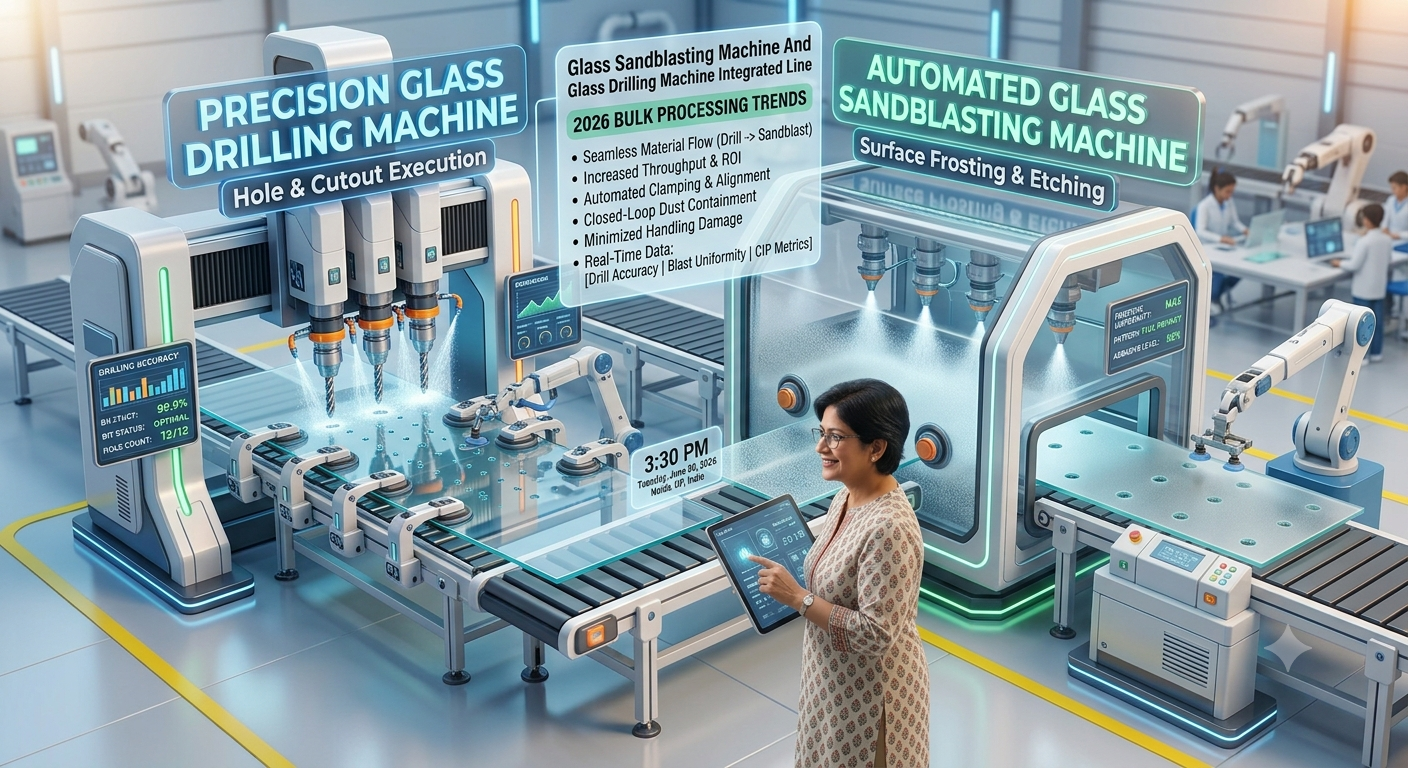
The glass processing industry has changed significantly as manufacturers demand greater precision, faster production, and better surface quality. Two machines that play an important role in this transformation are the Glass Sandblasting Machine and Glass Drilling Machine. While both are designed for glass fabrication, they perform very different operations. One creates decorative or functional surface textures, while the other produces accurate holes for fittings, hardware, and specialized applications.
Understanding how these machines work, their applications, advantages, and selection criteria can help glass processors, architects, furniture manufacturers, and construction companies choose the right equipment for their production requirements.
What Is a Glass Sandblasting Machine?
A Glass Sandblasting Machine is specialized equipment used to create frosted, matte, textured, or decorative patterns on glass surfaces. The process works by directing abrasive particles at high velocity toward the glass. The controlled impact removes or roughens the surface layer, producing a translucent or etched appearance.
Modern machines can perform consistent surface treatment across individual panels as well as larger production batches. Depending on the machine design, operators can create uniform frosting, patterns, logos, lettering, and customized designs.
How Does Glass Sandblasting Work?
The basic process generally involves several stages:
- The glass sheet is cleaned and positioned securely.
- Areas that should remain transparent are protected using masking materials.
- Abrasive media is propelled toward the exposed glass surface.
- The controlled abrasion creates the required texture or opacity.
- The masking material is removed and the finished glass is cleaned.
Key Factors Affecting Sandblasting Quality
The final result depends on several technical factors, including:
- Abrasive particle size
- Air pressure
- Blasting distance
- Processing speed
- Masking quality
- Glass thickness
- Surface preparation
Accurate control of these parameters is essential for achieving consistent results and avoiding uneven frosting or unwanted surface damage.
Applications of Glass Sandblasting Machines
A Glass Sandblasting Machine is widely used in architectural and decorative glass production. It can transform ordinary glass into a functional design element for both commercial and residential projects.
Common applications include:
- Shower doors and bathroom partitions
- Office privacy glass
- Decorative windows
- Glass doors
- Interior partitions
- Retail displays
- Restaurant décor
- Signage and logos
- Furniture glass
- Architectural façades
The technology is especially valuable when privacy and visual appeal need to be combined. Frosted glass allows light to pass through while reducing visibility, making it suitable for offices, hospitals, hotels, and modern homes.
What Is a Glass Drilling Machine?
A Glass Drilling Machine is designed to create precise circular or specialized holes in glass without causing excessive cracking, chipping, or breakage. These holes are required for applications where glass must accommodate bolts, handles, hinges, pipes, electrical fittings, or other hardware.
Because glass is brittle, drilling requires specialized equipment and carefully controlled machining conditions. Unlike conventional metal drilling, glass processing must account for heat generation, vibration, pressure, and edge quality.
How Does Glass Drilling Work?
The drilling process typically uses diamond-coated or diamond-tipped tools. These tools gradually remove glass material while cooling systems, commonly using water, help control heat and flush away debris.
A typical workflow includes:
- Measuring and marking the drilling location.
- Positioning the glass accurately.
- Securing the workpiece to minimize movement.
- Aligning the drilling tool with the required coordinates.
- Applying controlled drilling pressure.
- Using coolant to reduce heat buildup.
- Completing the hole and inspecting its edges.
Modern CNC-controlled systems can automate positioning and drilling, improving repeatability and reducing operator error.
Key Applications of Glass Drilling Machines
The versatility of a Glass Drilling Machine makes it essential for many glass fabrication industries.
Typical applications include:
- Glass furniture manufacturing
- Shower enclosure production
- Architectural glazing
- Curtain wall systems
- Balustrades and railings
- Glass doors
- Display cabinets
- Commercial interiors
- Solar and specialty glass
- Industrial glass components
Precise hole placement is particularly important in structural and architectural applications because even small dimensional errors can create installation problems.
Glass Sandblasting Machine vs. Glass Drilling Machine
Although both machines process glass, their functions and technologies are fundamentally different.
| Feature | Glass Sandblasting Machine | Glass Drilling Machine |
| Primary function | Surface texturing and frosting | Hole creation |
| Main process | Abrasive blasting | Diamond drilling |
| Typical output | Matte or patterned surface | Precise circular or shaped holes |
| Main applications | Decoration and privacy | Hardware and assembly |
| Key requirement | Uniform surface treatment | Accurate positioning |
| Cooling requirement | Depends on system | Often uses water cooling |
| Automation | Manual to CNC | Manual to CNC |
Choosing between the two depends entirely on the intended glass application. In many modern fabrication facilities, both machines are used together to provide comprehensive processing capabilities.
Benefits of Modern Glass Processing Equipment
Investing in advanced glass machinery can improve productivity and product quality. Automated systems offer several advantages over traditional manual techniques.
Higher Precision
Computer-controlled positioning and programmable settings help maintain consistent dimensions and patterns across multiple workpieces.
Improved Productivity
Automation reduces repetitive manual work and allows manufacturers to process more glass in less time.
Better Quality Control
Stable processing parameters can reduce defects such as uneven frosting, incorrect hole positioning, and excessive edge damage.
Reduced Material Waste
Accurate processing lowers the risk of broken or incorrectly machined glass, helping manufacturers control production costs.
Greater Design Flexibility
Modern equipment can support customized patterns, complex layouts, and different glass sizes, making it easier to respond to changing customer requirements.
How to Choose the Right Machine
Before purchasing a Glass Sandblasting Machine or Glass Drilling Machine, manufacturers should evaluate several factors.
Consider Production Volume
A small workshop may require a compact machine, while a high-volume factory may benefit from a fully automated production line.
Evaluate Glass Specifications
Check the machine’s compatibility with the required glass thickness, dimensions, and types.
Examine Automation Features
CNC control, automatic positioning, programmable settings, and digital interfaces can improve efficiency and repeatability.
Check Safety and Maintenance
Look for reliable safety systems, accessible maintenance points, dust management, cooling systems, and replacement-part availability.
Assess Long-Term Value
The lowest purchase price is not always the best investment. Consider energy consumption, maintenance costs, productivity, machine durability, and technical support.
Frequently Asked Questions
1. What is a Glass Sandblasting Machine used for?
It is mainly used to frost, texture, decorate, or create patterns and designs on glass surfaces.
2. What is a Glass Drilling Machine?
It is specialized equipment used to create accurate holes in glass for fittings, hardware, fixtures, and installation purposes.
3. Can sandblasting create custom designs?
Yes. With suitable masking or automated systems, manufacturers can produce logos, patterns, text, and decorative designs.
4. Why is diamond tooling used for glass drilling?
Diamond tools are highly effective for machining brittle materials and can produce cleaner, more accurate holes when properly controlled.
5. Does glass drilling require cooling?
Many drilling operations use water cooling to manage heat, reduce friction, and improve tool and surface performance.
6. Can these machines process different glass thicknesses?
Yes, but the supported thickness range depends on the specific machine model and tooling configuration.
7. Are automated glass machines better than manual equipment?
For high-volume production, automated machines generally offer greater consistency, speed, and repeatability.
8. What industries use glass sandblasting?
Architecture, interior design, furniture, hospitality, retail, signage, and decorative glass industries commonly use sandblasting equipment.
9. What causes glass to crack during drilling?
Excessive pressure, improper tooling, vibration, poor cooling, incorrect speed, and unsuitable drilling techniques can contribute to cracking.
10. How can manufacturers reduce glass processing waste?
Accurate programming, proper tooling, optimized drilling parameters, careful handling, and regular machine maintenance can significantly reduce breakage and material waste.
https://newsgrow.blogspot.com/2026/06/glass-sandblasting-machine-drives.html