
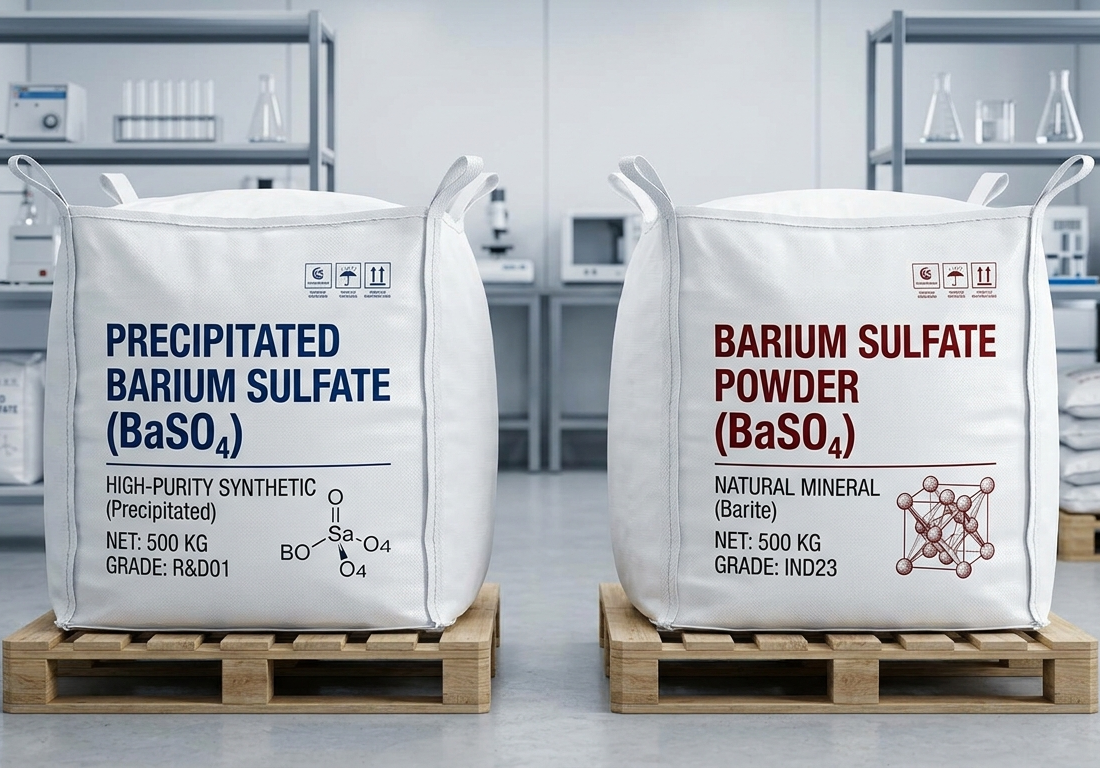
Barium sulfate is represented by the chemical formula BaSO₄ and occurs naturally as the mineral barite. Industrially manufactured grades are designed to meet specific requirements for applications such as coatings, plastics, paints, rubber, inks, construction materials, and specialized industrial formulations.
The choice between Precipitated Barium Sulfate and conventional Barium Sulfate Powder depends on factors such as particle size, purity, surface properties, dispersion, brightness, and the final application’s technical demands.
What Is Precipitated Barium Sulfate?
Precipitated Barium Sulfate is a chemically manufactured form of barium sulfate produced through a controlled precipitation process. Unlike naturally mined barite, precipitation allows manufacturers to control important physical properties, including particle size distribution, morphology, purity, and surface characteristics.
This level of control makes precipitated grades particularly useful when consistent performance is essential. Fine particles can provide improved dispersion and help manufacturers achieve specific optical or mechanical properties in finished products.
Key Characteristics of Precipitated Barium Sulfate
Some important characteristics include:
- High chemical purity
- Excellent whiteness and brightness
- Fine and controlled particle size
- Good dispersion characteristics
- High density
- Low oil absorption in selected grades
- Strong resistance to heat and chemicals
- Excellent compatibility with various industrial formulations
These properties have made precipitated grades valuable in applications where consistency and surface finish are important.
How Is It Produced?
The production process generally involves a controlled chemical reaction that forms barium sulfate as a precipitate. The resulting material is then processed through stages such as filtration, washing, drying, milling, and classification.
Manufacturers can adjust process conditions to achieve desired specifications. This flexibility is one of the main advantages of precipitated material compared with certain naturally sourced grades.
What Is Barium Sulfate Powder?
Barium Sulfate Powder is a finely processed form of BaSO₄ used as a functional filler, extender, or performance-enhancing ingredient across multiple industries. It may be produced from naturally occurring barite or through synthetic processes, depending on the required grade.
Its high specific gravity and chemical inertness make it useful in formulations where manufacturers need increased density, durability, or resistance without significantly affecting chemical stability.
Important Properties of Barium Sulfate Powder
The performance of Barium Sulfate Powder is influenced by its purity and particle characteristics. Common properties include:
- High density and specific gravity
- Excellent chemical resistance
- Low solubility in water
- Good thermal stability
- High brightness in refined grades
- Strong resistance to weathering
- Useful radiation-shielding capabilities
Because different industries require different specifications, buyers should evaluate particle size, purity, moisture content, whiteness, and surface treatment before selecting a product.
Precipitated Barium Sulfate vs. Barium Sulfate Powder
Although the terms are sometimes used interchangeably, the materials may differ in production method and performance.
| Feature | Precipitated Barium Sulfate | Barium Sulfate Powder |
| Production | Chemically precipitated | Often processed from barite or manufactured synthetically |
| Purity | Typically very high and controlled | Depends on grade and processing |
| Particle control | Highly controlled | Varies by product |
| Whiteness | Generally excellent | Depends on refinement |
| Dispersion | Often highly consistent | Depends on particle characteristics |
| Applications | High-performance coatings, plastics, inks | Fillers, coatings, rubber, construction |
| Cost | May be higher for specialized grades | Varies according to source and grade |
The right selection ultimately depends on the performance requirements of the final formulation.
Major Industrial Applications
Paints and Coatings
In the coatings industry, barium sulfate can function as a filler and extender. It may improve hardness, durability, gloss, surface smoothness, and resistance to environmental conditions.
Precipitated Barium Sulfate is especially useful in premium coatings where consistent particle size and high brightness are important. It can also contribute to improved surface appearance and formulation stability.
Plastics and Polymers
Barium sulfate is used in selected plastic and polymer formulations to modify density, dimensional properties, and surface performance. Fine grades can provide good dispersion when properly incorporated into polymer systems.
Applications may include:
- Engineering plastics
- Automotive components
- Polymer compounds
- Plastic masterbatches
- Specialty molded products
Rubber Products
In rubber manufacturing, barium sulfate can serve as a functional filler. Depending on the formulation, it may influence density, hardness, and processing characteristics while maintaining chemical stability.
Printing Inks
Fine barium sulfate grades can be used in printing ink formulations where brightness, smoothness, and controlled particle size are valuable. The material can support consistent appearance when appropriately selected and dispersed.
Construction Materials
Barium sulfate is also used in specialized construction products. Its high density makes it suitable for certain radiation-shielding concrete and other high-density materials.
Choosing the Right Barium Sulfate Product
Selecting the appropriate product requires more than simply comparing prices. Manufacturers should consider the complete technical requirements of the application.
Factors to Evaluate
1. Particle Size
Particle size affects dispersion, surface finish, rheology, and formulation behavior. Fine particles are often preferred for applications requiring smooth surfaces.
2. Purity
Higher-purity products may be necessary for demanding applications where unwanted impurities can affect color, stability, or performance.
3. Whiteness
For paints, coatings, plastics, and inks, brightness can influence the appearance of the final product.
4. Surface Treatment
Some specialized products may feature surface modifications that improve compatibility with specific resins or polymers.
5. Application Requirements
Always match the grade to the end-use environment, processing method, and performance expectations.
Benefits of Using High-Quality Barium Sulfate
A properly selected Barium Sulfate Powder can offer several advantages:
- Enhances product consistency
- Supports improved surface characteristics
- Provides high density
- Offers excellent chemical stability
- Performs well under demanding conditions
- Can improve formulation economics as a functional extender
- Supports specialized industrial applications
However, performance depends strongly on grade selection and processing conditions.
Frequently Asked Questions
1. What is Precipitated Barium Sulfate?
It is a synthetically produced barium sulfate manufactured through a controlled precipitation process to achieve specific purity and particle characteristics.
2. What is Barium Sulfate Powder used for?
It is used in paints, coatings, plastics, rubber, printing inks, construction materials, and other industrial formulations.
3. Are Precipitated Barium Sulfate and barite the same?
They have the same basic chemical composition, BaSO₄, but their physical properties and production methods can differ.
4. Why is barium sulfate used in coatings?
It can contribute to brightness, surface smoothness, durability, hardness, and formulation performance.
5. Is barium sulfate chemically stable?
Yes. Barium sulfate is known for its very low water solubility and strong chemical stability.
6. What industries use precipitated grades?
Common industries include coatings, plastics, inks, specialty polymers, and other applications requiring controlled particle characteristics.
7. How does particle size affect performance?
Particle size can influence dispersion, surface finish, optical properties, processing behavior, and overall formulation performance.
8. How should manufacturers choose a grade?
They should evaluate purity, particle size, whiteness, moisture, surface treatment, compatibility, and the requirements of the final application.
9. Can barium sulfate be used as a filler?
Yes. It is widely used as a functional filler or extender in several industrial products.
10. What makes high-quality barium sulfate important?
Consistent quality helps manufacturers achieve predictable processing and reliable performance across production batches.
https://newsgrow.blogspot.com/2026/06/precipitated-barium-sulfate-enhances.html